{"title":"How Can Robotic Devices Help Clinicians Determine the Treatment Dose for Post-Stroke Arm Paresis?","authors":"Ophélie Pila, Christophe Duret","doi":"10.3390/s25051612","DOIUrl":null,"url":null,"abstract":"<p><p>Upper limb training dose after stroke is usually quantified by time and repetitions. This study analyzed upper limb motor training dose in stroke participants (N = 36) using a more comprehensive approach. Participants, classified by initial motor severity (severe/moderate/mild) and recovery trajectory (good/poor), received daily robotic and occupational therapy. Treatment dose was reported using a multidimensional framework. Fugl-Meyer Assessment (FMA) score and robot-derived kinematic parameters (reach distance (cm), velocity (cm/s), accuracy (cm) and smoothness (number of velocity peaks)) were analyzed pre- and post-intervention. FMA scores (mean (SD)) improved significantly post-intervention in severe (+11 (12) pts; <i>p</i> < 0.001) and moderate (+13 (6) pts; <i>p</i> ≤ 0.01) impairment groups. In the severe group, good recoverers showed greater improvement (+18 (12) pts) than poor recoverers (+4 (4) pts). Despite similar robotic therapy duration (34 min/session) and number of movements (600-900/session) between good and poor recoverers, both groups experienced very different therapeutic plans in the use of physical modalities: good recoverers gradually moved from assisted to the unassisted then resisted modality. Kinematic analysis showed distinct patterns of motor improvement across severity levels, ranging from quantitative (reach distance/velocity) to qualitative (accuracy/smoothness) changes. This approach provides a more accurate description of the therapeutic dose by characterizing the movements actually performed and can help personalize rehabilitation strategies.</p>","PeriodicalId":21698,"journal":{"name":"Sensors","volume":"25 5","pages":""},"PeriodicalIF":3.5000,"publicationDate":"2025-03-06","publicationTypes":"Journal Article","fieldsOfStudy":null,"isOpenAccess":false,"openAccessPdf":"https://www.ncbi.nlm.nih.gov/pmc/articles/PMC11902740/pdf/","citationCount":"0","resultStr":null,"platform":"Semanticscholar","paperid":null,"PeriodicalName":"Sensors","FirstCategoryId":"103","ListUrlMain":"https://doi.org/10.3390/s25051612","RegionNum":3,"RegionCategory":"综合性期刊","ArticlePicture":[],"TitleCN":null,"AbstractTextCN":null,"PMCID":null,"EPubDate":"","PubModel":"","JCR":"Q2","JCRName":"CHEMISTRY, ANALYTICAL","Score":null,"Total":0}
引用次数: 0
Abstract
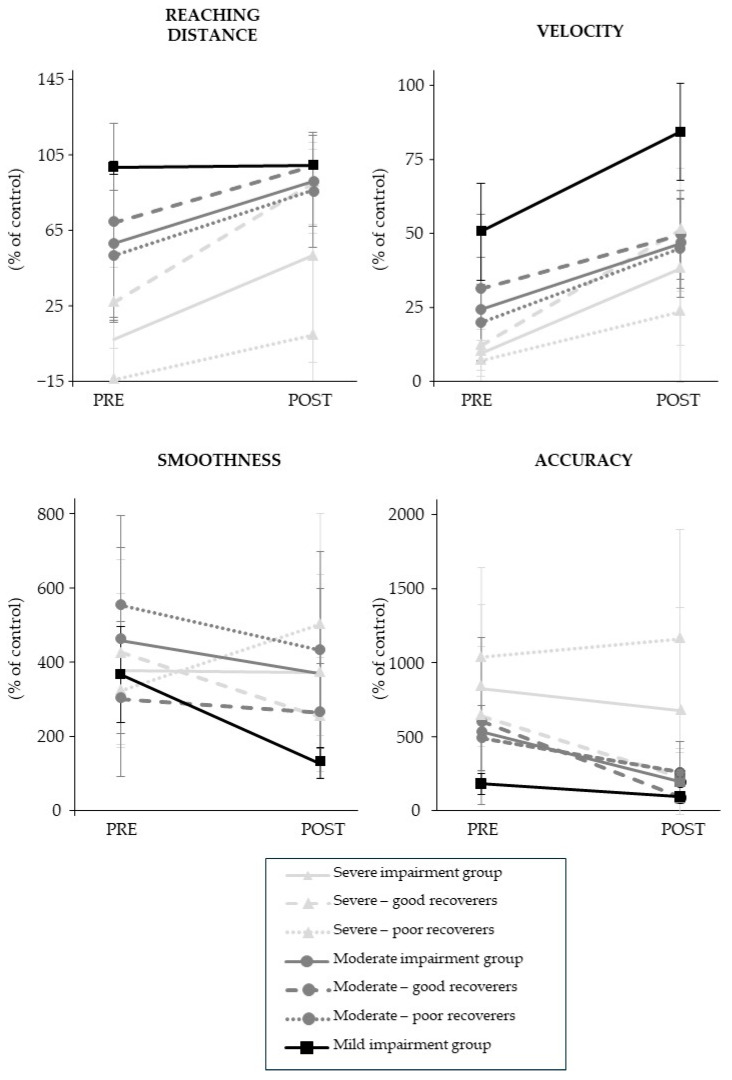
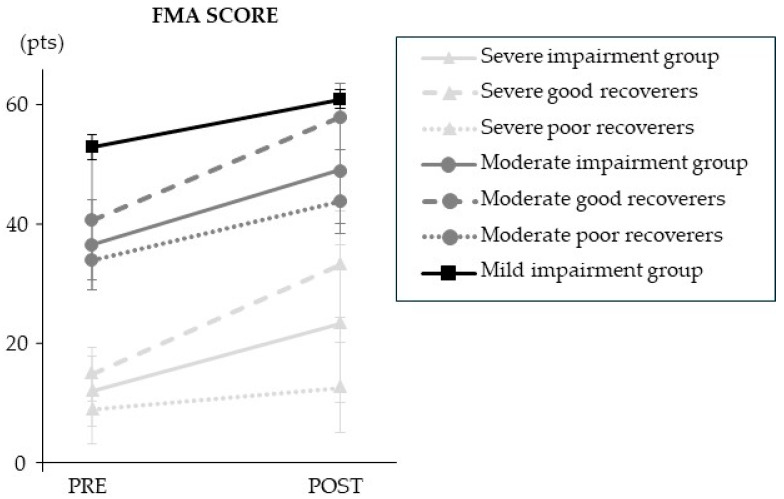
Upper limb training dose after stroke is usually quantified by time and repetitions. This study analyzed upper limb motor training dose in stroke participants (N = 36) using a more comprehensive approach. Participants, classified by initial motor severity (severe/moderate/mild) and recovery trajectory (good/poor), received daily robotic and occupational therapy. Treatment dose was reported using a multidimensional framework. Fugl-Meyer Assessment (FMA) score and robot-derived kinematic parameters (reach distance (cm), velocity (cm/s), accuracy (cm) and smoothness (number of velocity peaks)) were analyzed pre- and post-intervention. FMA scores (mean (SD)) improved significantly post-intervention in severe (+11 (12) pts; p < 0.001) and moderate (+13 (6) pts; p ≤ 0.01) impairment groups. In the severe group, good recoverers showed greater improvement (+18 (12) pts) than poor recoverers (+4 (4) pts). Despite similar robotic therapy duration (34 min/session) and number of movements (600-900/session) between good and poor recoverers, both groups experienced very different therapeutic plans in the use of physical modalities: good recoverers gradually moved from assisted to the unassisted then resisted modality. Kinematic analysis showed distinct patterns of motor improvement across severity levels, ranging from quantitative (reach distance/velocity) to qualitative (accuracy/smoothness) changes. This approach provides a more accurate description of the therapeutic dose by characterizing the movements actually performed and can help personalize rehabilitation strategies.
期刊介绍:
Sensors (ISSN 1424-8220) provides an advanced forum for the science and technology of sensors and biosensors. It publishes reviews (including comprehensive reviews on the complete sensors products), regular research papers and short notes. Our aim is to encourage scientists to publish their experimental and theoretical results in as much detail as possible. There is no restriction on the length of the papers. The full experimental details must be provided so that the results can be reproduced.




 京公网安备 11010802042870号
京ICP备2023020795号-1
京公网安备 11010802042870号
京ICP备2023020795号-1

 分享
分享
 求助内容:
求助内容: 应助结果提醒方式:
 扫码关注我们
