{"title":"Factors associated with flexed knee gait in unilateral cerebral palsy.","authors":"K Patrick Do, Jing Feng, Jeremy P Bauer","doi":"10.1177/18632521251325037","DOIUrl":null,"url":null,"abstract":"<p><strong>Purpose: </strong>A flexed knee gait is a common gait in children with unilateral cerebral palsy. In children without knee contracture, hamstring spasticity is commonly considered a major contributor to a flexed knee gait. We hypothesized that the popliteal angle would not correlate to a flexed knee gait.</p><p><strong>Methods: </strong>This retrospective study included 109 children with unilateral cerebral palsy who had undergone complete 3D gait analysis. Children who had previous surgery or knee flexion contracture were excluded. Children were divided into three groups based on knee position during stance as determined by 3D gait analysis: flexion (FK, 47), hyperextension (HK, 42), and normal (NK, 20).</p><p><strong>Results: </strong>There were no significant correlations between popliteal angle and dynamic peak knee extension in stance or at initial contact. Similarly, peak dorsiflexion during the stance phase did not correlate with dynamic peak knee extension in stance (all <i>p</i> > 0.05). Significant differences were observed in foot position during stance between FK and HK groups, as well as in quick stretch dorsiflexion with the knee extended between HK and NK groups.</p><p><strong>Conclusion: </strong>A flexed knee gait in children with unilateral cerebral palsy does not always correlate with the popliteal angle or dynamic ankle position in gait. These factors may contribute but are insufficient to explain all observed differences. A flexed knee gait likely involves a complex interplay of motor control, strength, spasticity, and lever arm dynamics, indicating that interventions at a single level may not fully improve dynamic knee extension.</p>","PeriodicalId":56060,"journal":{"name":"Journal of Childrens Orthopaedics","volume":" ","pages":"151-157"},"PeriodicalIF":1.6000,"publicationDate":"2025-03-12","publicationTypes":"Journal Article","fieldsOfStudy":null,"isOpenAccess":false,"openAccessPdf":"https://www.ncbi.nlm.nih.gov/pmc/articles/PMC11907585/pdf/","citationCount":"0","resultStr":null,"platform":"Semanticscholar","paperid":null,"PeriodicalName":"Journal of Childrens Orthopaedics","FirstCategoryId":"3","ListUrlMain":"https://doi.org/10.1177/18632521251325037","RegionNum":4,"RegionCategory":"医学","ArticlePicture":[],"TitleCN":null,"AbstractTextCN":null,"PMCID":null,"EPubDate":"2025/4/1 0:00:00","PubModel":"eCollection","JCR":"Q3","JCRName":"ORTHOPEDICS","Score":null,"Total":0}
引用次数: 0
Abstract
Purpose: A flexed knee gait is a common gait in children with unilateral cerebral palsy. In children without knee contracture, hamstring spasticity is commonly considered a major contributor to a flexed knee gait. We hypothesized that the popliteal angle would not correlate to a flexed knee gait.
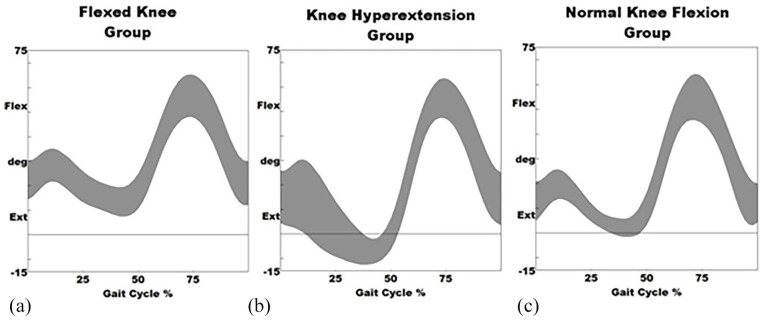
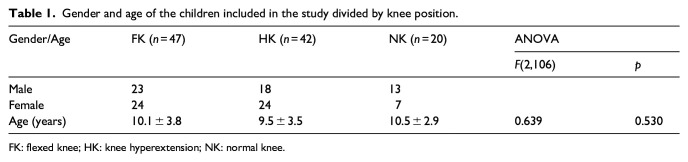
Methods: This retrospective study included 109 children with unilateral cerebral palsy who had undergone complete 3D gait analysis. Children who had previous surgery or knee flexion contracture were excluded. Children were divided into three groups based on knee position during stance as determined by 3D gait analysis: flexion (FK, 47), hyperextension (HK, 42), and normal (NK, 20).
Results: There were no significant correlations between popliteal angle and dynamic peak knee extension in stance or at initial contact. Similarly, peak dorsiflexion during the stance phase did not correlate with dynamic peak knee extension in stance (all p > 0.05). Significant differences were observed in foot position during stance between FK and HK groups, as well as in quick stretch dorsiflexion with the knee extended between HK and NK groups.
Conclusion: A flexed knee gait in children with unilateral cerebral palsy does not always correlate with the popliteal angle or dynamic ankle position in gait. These factors may contribute but are insufficient to explain all observed differences. A flexed knee gait likely involves a complex interplay of motor control, strength, spasticity, and lever arm dynamics, indicating that interventions at a single level may not fully improve dynamic knee extension.
期刊介绍:
Aims & Scope
The Journal of Children’s Orthopaedics is the official journal of the European Paediatric Orthopaedic Society (EPOS) and is published by The British Editorial Society of Bone & Joint Surgery.
It provides a forum for the advancement of the knowledge and education in paediatric orthopaedics and traumatology across geographical borders. It advocates an increased worldwide involvement in preventing and treating musculoskeletal diseases in children and adolescents.
The journal publishes high quality, peer-reviewed articles that focus on clinical practice, diagnosis and treatment of disorders unique to paediatric orthopaedics, as well as on basic and applied research. It aims to help physicians stay abreast of the latest and ever-changing developments in the field of paediatric orthopaedics and traumatology.
The journal welcomes original contributions submitted exclusively for review to the journal. This continuously published online journal is fully open access and will publish one print issue each year to coincide with the EPOS Annual Congress, featuring the meeting’s abstracts.




 京公网安备 11010802042870号
京ICP备2023020795号-1
京公网安备 11010802042870号
京ICP备2023020795号-1

 分享
分享
 求助内容:
求助内容: 应助结果提醒方式:
 扫码关注我们
