Andriana H Velmahos, Briah Cooley Demidkina, Caroline M Mitchell
{"title":"Comparison of bacterial vaginosis symptoms reported in social media vs. those reported by patients.","authors":"Andriana H Velmahos, Briah Cooley Demidkina, Caroline M Mitchell","doi":"10.3389/frph.2025.1549331","DOIUrl":null,"url":null,"abstract":"<p><strong>Introduction: </strong>There is an increasing tendency to seek health information online rather than through medical professionals. However, the easy accessibility of information online allows for an increased risk of encountering medical misinformation.</p><p><strong>Methods: </strong>We compared descriptions of symptomatology of bacterial vaginosis (BV) on four social media platforms: Instagram, Facebook, YouTube and X (Twitter). We then compared the frequency of discussion of symptoms with patients' report of symptoms in clinically diagnosed BV, vulvovaginal candidiasis and vulvodynia.</p><p><strong>Results: </strong>Social media was more likely to report burning (45% of posts), itching (45%) or pain (23%) as symptoms of BV than patients (moderate-severe itching 30%, burning 21% or pain 21%). Although pain was reported more often by people with vulvodynia, other symptoms were not different across diagnoses.</p><p><strong>Discussion: </strong>Social media overemphasizes the ability of symptoms to allow self-diagnosis of vaginitis, which can lead to delayed treatment, highlighting the need to promote accurate health information online.</p>","PeriodicalId":73103,"journal":{"name":"Frontiers in reproductive health","volume":"7 ","pages":"1549331"},"PeriodicalIF":3.1000,"publicationDate":"2025-02-28","publicationTypes":"Journal Article","fieldsOfStudy":null,"isOpenAccess":false,"openAccessPdf":"https://www.ncbi.nlm.nih.gov/pmc/articles/PMC11906998/pdf/","citationCount":"0","resultStr":null,"platform":"Semanticscholar","paperid":null,"PeriodicalName":"Frontiers in reproductive health","FirstCategoryId":"1085","ListUrlMain":"https://doi.org/10.3389/frph.2025.1549331","RegionNum":0,"RegionCategory":null,"ArticlePicture":[],"TitleCN":null,"AbstractTextCN":null,"PMCID":null,"EPubDate":"2025/1/1 0:00:00","PubModel":"eCollection","JCR":"Q2","JCRName":"PUBLIC, ENVIRONMENTAL & OCCUPATIONAL HEALTH","Score":null,"Total":0}
引用次数: 0
Abstract
Introduction: There is an increasing tendency to seek health information online rather than through medical professionals. However, the easy accessibility of information online allows for an increased risk of encountering medical misinformation.
Methods: We compared descriptions of symptomatology of bacterial vaginosis (BV) on four social media platforms: Instagram, Facebook, YouTube and X (Twitter). We then compared the frequency of discussion of symptoms with patients' report of symptoms in clinically diagnosed BV, vulvovaginal candidiasis and vulvodynia.
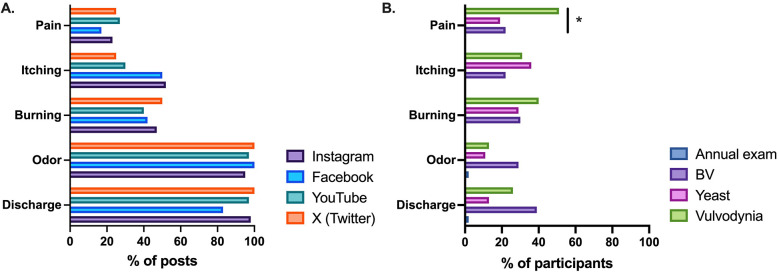
Results: Social media was more likely to report burning (45% of posts), itching (45%) or pain (23%) as symptoms of BV than patients (moderate-severe itching 30%, burning 21% or pain 21%). Although pain was reported more often by people with vulvodynia, other symptoms were not different across diagnoses.
Discussion: Social media overemphasizes the ability of symptoms to allow self-diagnosis of vaginitis, which can lead to delayed treatment, highlighting the need to promote accurate health information online.




 京公网安备 11010802042870号
京ICP备2023020795号-1
京公网安备 11010802042870号
京ICP备2023020795号-1

 分享
分享

 求助内容:
求助内容: 应助结果提醒方式:
 扫码关注我们
