Alessandra Lo Cicero, Simona Campora, Gabriele Lo Buglio, Paolo Cinà, Margot Lo Pinto, Simone Dario Scilabra, Giulio Ghersi
{"title":"Enhancing therapeutic efficacy through degradation of endogenous extracellular matrix in primary breast tumor spheroids","authors":"Alessandra Lo Cicero, Simona Campora, Gabriele Lo Buglio, Paolo Cinà, Margot Lo Pinto, Simone Dario Scilabra, Giulio Ghersi","doi":"10.1111/febs.70069","DOIUrl":null,"url":null,"abstract":"<p>Solid tumors have a complex extracellular matrix (ECM) that significantly affects tumor behavior and response to therapy. Understanding the ECM's role is crucial for advancing cancer research and treatment. This study established an <i>in vitro</i> model using primary cells isolated from a rat breast tumor to generate three-dimensional spheroids. Monolayer cells and spheroid cultures exhibited different protein expression patterns, with primary tumor spheroids presenting an increased level of ECM-related proteins and a more complex extracellular environment. Furthermore, spheroids produce endogenous collagen type I matrix, which is the main component of the tumoral ECM. This matrix is arranged predominantly around the 3D structure, mimicking the conditions of solid tumors. Treatments with recombinant collagenases class II (acting on the linear collagen region) and class I (acting on the 3D-helix region) completely degrade collagen within the spheroid structure. Collagenase pretreatment enhances the accessibility of the anticancer drug doxorubicin to penetrate the core of spheroids and sensitize them to doxorubicin-induced cytotoxicity. Our findings highlight the importance of overcoming drug resistance in breast cancer by targeting the ECM and proposing a novel strategy for improving therapeutic outcomes in solid tumors. By employing a three-dimensional spheroid model, with an endogenous ECM, we can offer more relevant insights into tumor biology and treatment responses.</p>","PeriodicalId":94226,"journal":{"name":"The FEBS journal","volume":"292 13","pages":"3494-3507"},"PeriodicalIF":4.2000,"publicationDate":"2025-03-17","publicationTypes":"Journal Article","fieldsOfStudy":null,"isOpenAccess":false,"openAccessPdf":"https://onlinelibrary.wiley.com/doi/epdf/10.1111/febs.70069","citationCount":"0","resultStr":null,"platform":"Semanticscholar","paperid":null,"PeriodicalName":"The FEBS journal","FirstCategoryId":"1085","ListUrlMain":"https://febs.onlinelibrary.wiley.com/doi/10.1111/febs.70069","RegionNum":0,"RegionCategory":null,"ArticlePicture":[],"TitleCN":null,"AbstractTextCN":null,"PMCID":null,"EPubDate":"","PubModel":"","JCR":"","JCRName":"","Score":null,"Total":0}
引用次数: 0
Abstract
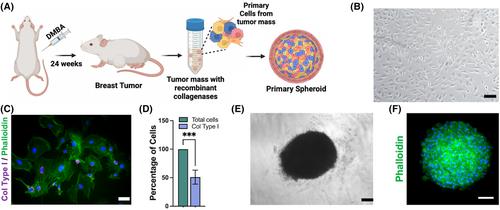
Solid tumors have a complex extracellular matrix (ECM) that significantly affects tumor behavior and response to therapy. Understanding the ECM's role is crucial for advancing cancer research and treatment. This study established an in vitro model using primary cells isolated from a rat breast tumor to generate three-dimensional spheroids. Monolayer cells and spheroid cultures exhibited different protein expression patterns, with primary tumor spheroids presenting an increased level of ECM-related proteins and a more complex extracellular environment. Furthermore, spheroids produce endogenous collagen type I matrix, which is the main component of the tumoral ECM. This matrix is arranged predominantly around the 3D structure, mimicking the conditions of solid tumors. Treatments with recombinant collagenases class II (acting on the linear collagen region) and class I (acting on the 3D-helix region) completely degrade collagen within the spheroid structure. Collagenase pretreatment enhances the accessibility of the anticancer drug doxorubicin to penetrate the core of spheroids and sensitize them to doxorubicin-induced cytotoxicity. Our findings highlight the importance of overcoming drug resistance in breast cancer by targeting the ECM and proposing a novel strategy for improving therapeutic outcomes in solid tumors. By employing a three-dimensional spheroid model, with an endogenous ECM, we can offer more relevant insights into tumor biology and treatment responses.






 京公网安备 11010802042870号
京ICP备2023020795号-1
京公网安备 11010802042870号
京ICP备2023020795号-1

 分享
分享

 求助内容:
求助内容: 应助结果提醒方式:
 扫码关注我们
