Rainer Dziewas, Tobias Warnecke, Bendix Labeit, Volker Schulte, Inga Claus, Paul Muhle, Anna Brake, Lena Hollah, Anne Jung, Jonas von Itter, Sonja Suntrup-Krüger
{"title":"Decannulation ahead: a comprehensive diagnostic and therapeutic framework for tracheotomized neurological patients.","authors":"Rainer Dziewas, Tobias Warnecke, Bendix Labeit, Volker Schulte, Inga Claus, Paul Muhle, Anna Brake, Lena Hollah, Anne Jung, Jonas von Itter, Sonja Suntrup-Krüger","doi":"10.1186/s42466-025-00376-1","DOIUrl":null,"url":null,"abstract":"<p><strong>Background: </strong>Decannulation in tracheotomized neurological patients is often complicated by severe dysphagia, which compromises airway safety and delays weaning. Additional challenges, including reduced cough strength, excessive bronchial secretions, and altered airway anatomy exacerbate weaning issues, thereby increasing morbidity and mortality. This review summarizes diagnostic procedures and therapeutic options crucial for the rehabilitation of tracheotomized patients.</p><p><strong>Main body: </strong>Key diagnostic strategies for assessing decannulation readiness focus on airway protection, airway patency, bronchial secretion management, and cough function. These are collectively introduced as the A<sup>2</sup>BC criteria in this review. Advanced tools such as flexible endoscopic evaluation of swallowing, endoscopic assessment of airway anatomy, measurement of cough strength, and intrathoracic pressure are essential components of a systematic evaluation. Therapeutic interventions encompass restoring physiological airflow, behavioral swallowing treatment, secretion management, and pharyngeal electrical stimulation. The proposed decannulation algorithm integrates two pathways: the \"fast-track\" pathway, which facilitates rapid decannulation based on relevant predictors of decannulation-success, and the \"standard-track\" pathway, which progressively increases cuff deflation intervals to build tolerance over time.</p><p><strong>Conclusion: </strong>Successful decannulation in neurological patients demands a multidisciplinary, patient-centered approach that combines advanced diagnostics, targeted therapies, and structured management pathways. The proposed algorithm integrates fast-track and standard-track pathways, balancing rapid diagnostics with gradual weaning strategies. This framework promotes flexibility, enabling clinicians to tailor interventions to individual patient needs while maintaining safety and optimizing outcomes.</p>","PeriodicalId":94156,"journal":{"name":"Neurological research and practice","volume":"7 1","pages":"18"},"PeriodicalIF":4.0000,"publicationDate":"2025-03-17","publicationTypes":"Journal Article","fieldsOfStudy":null,"isOpenAccess":false,"openAccessPdf":"https://www.ncbi.nlm.nih.gov/pmc/articles/PMC11921981/pdf/","citationCount":"0","resultStr":null,"platform":"Semanticscholar","paperid":null,"PeriodicalName":"Neurological research and practice","FirstCategoryId":"1085","ListUrlMain":"https://doi.org/10.1186/s42466-025-00376-1","RegionNum":0,"RegionCategory":null,"ArticlePicture":[],"TitleCN":null,"AbstractTextCN":null,"PMCID":null,"EPubDate":"","PubModel":"","JCR":"Q2","JCRName":"Medicine","Score":null,"Total":0}
引用次数: 0
Abstract
Background: Decannulation in tracheotomized neurological patients is often complicated by severe dysphagia, which compromises airway safety and delays weaning. Additional challenges, including reduced cough strength, excessive bronchial secretions, and altered airway anatomy exacerbate weaning issues, thereby increasing morbidity and mortality. This review summarizes diagnostic procedures and therapeutic options crucial for the rehabilitation of tracheotomized patients.
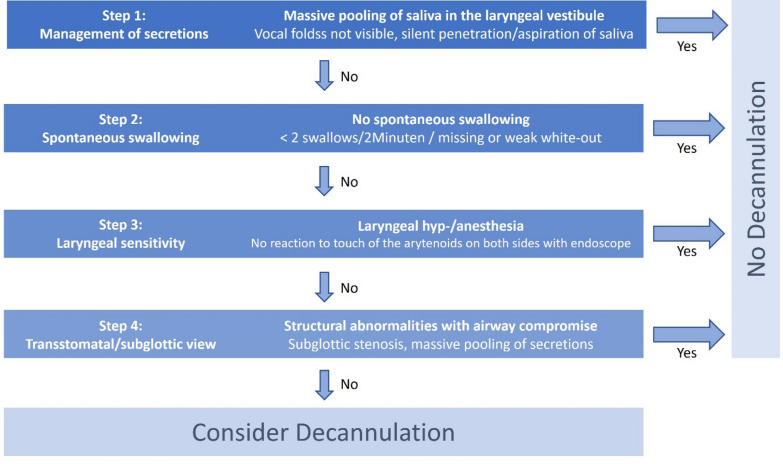
Main body: Key diagnostic strategies for assessing decannulation readiness focus on airway protection, airway patency, bronchial secretion management, and cough function. These are collectively introduced as the A2BC criteria in this review. Advanced tools such as flexible endoscopic evaluation of swallowing, endoscopic assessment of airway anatomy, measurement of cough strength, and intrathoracic pressure are essential components of a systematic evaluation. Therapeutic interventions encompass restoring physiological airflow, behavioral swallowing treatment, secretion management, and pharyngeal electrical stimulation. The proposed decannulation algorithm integrates two pathways: the "fast-track" pathway, which facilitates rapid decannulation based on relevant predictors of decannulation-success, and the "standard-track" pathway, which progressively increases cuff deflation intervals to build tolerance over time.
Conclusion: Successful decannulation in neurological patients demands a multidisciplinary, patient-centered approach that combines advanced diagnostics, targeted therapies, and structured management pathways. The proposed algorithm integrates fast-track and standard-track pathways, balancing rapid diagnostics with gradual weaning strategies. This framework promotes flexibility, enabling clinicians to tailor interventions to individual patient needs while maintaining safety and optimizing outcomes.






 京公网安备 11010802042870号
京ICP备2023020795号-1
京公网安备 11010802042870号
京ICP备2023020795号-1

 分享
分享

 求助内容:
求助内容: 应助结果提醒方式:
 扫码关注我们
