{"title":"Elucidating the role of artificial intelligence in drug development from the perspective of drug-target interactions.","authors":"Boyang Wang, Tingyu Zhang, Qingyuan Liu, Chayanis Sutcharitchan, Ziyi Zhou, Dingfan Zhang, Shao Li","doi":"10.1016/j.jpha.2024.101144","DOIUrl":null,"url":null,"abstract":"<p><p>Drug development remains a critical issue in the field of biomedicine. With the rapid advancement of information technologies such as artificial intelligence (AI) and the advent of the big data era, AI-assisted drug development has become a new trend, particularly in predicting drug-target associations. To address the challenge of drug-target prediction, AI-driven models have emerged as powerful tools, offering innovative solutions by effectively extracting features from complex biological data, accurately modeling molecular interactions, and precisely predicting potential drug-target outcomes. Traditional machine learning (ML), network-based, and advanced deep learning architectures such as convolutional neural networks (CNNs), graph convolutional networks (GCNs), and transformers play a pivotal role. This review systematically compiles and evaluates AI algorithms for drug- and drug combination-target predictions, highlighting their theoretical frameworks, strengths, and limitations. CNNs effectively identify spatial patterns and molecular features critical for drug-target interactions. GCNs provide deep insights into molecular interactions via relational data, whereas transformers increase prediction accuracy by capturing complex dependencies within biological sequences. Network-based models offer a systematic perspective by integrating diverse data sources, and traditional ML efficiently handles large datasets to improve overall predictive accuracy. Collectively, these AI-driven methods are transforming drug-target predictions and advancing the development of personalized therapy. This review summarizes the application of AI in drug development, particularly in drug-target prediction, and offers recommendations on models and algorithms for researchers engaged in biomedical research. It also provides typical cases to better illustrate how AI can further accelerate development in the fields of biomedicine and drug discovery.</p>","PeriodicalId":94338,"journal":{"name":"Journal of pharmaceutical analysis","volume":"15 3","pages":"101144"},"PeriodicalIF":8.9000,"publicationDate":"2025-03-01","publicationTypes":"Journal Article","fieldsOfStudy":null,"isOpenAccess":false,"openAccessPdf":"https://www.ncbi.nlm.nih.gov/pmc/articles/PMC11910364/pdf/","citationCount":"0","resultStr":null,"platform":"Semanticscholar","paperid":null,"PeriodicalName":"Journal of pharmaceutical analysis","FirstCategoryId":"1085","ListUrlMain":"https://doi.org/10.1016/j.jpha.2024.101144","RegionNum":0,"RegionCategory":null,"ArticlePicture":[],"TitleCN":null,"AbstractTextCN":null,"PMCID":null,"EPubDate":"2024/11/14 0:00:00","PubModel":"Epub","JCR":"","JCRName":"","Score":null,"Total":0}
引用次数: 0
Abstract
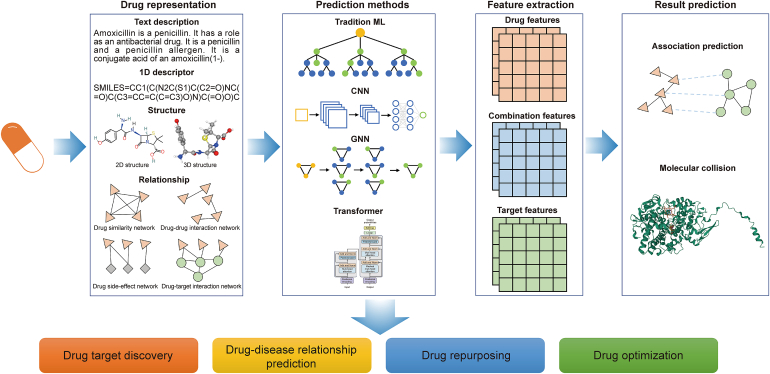
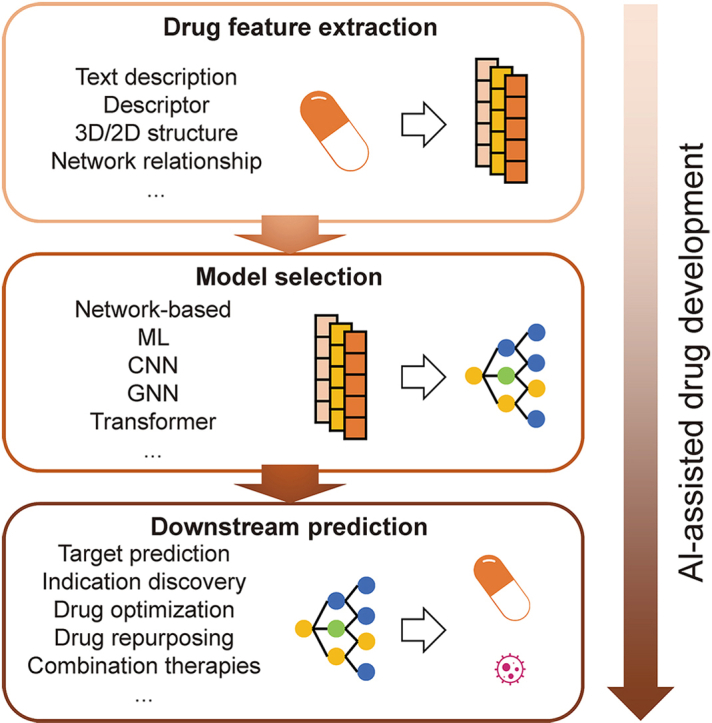
Drug development remains a critical issue in the field of biomedicine. With the rapid advancement of information technologies such as artificial intelligence (AI) and the advent of the big data era, AI-assisted drug development has become a new trend, particularly in predicting drug-target associations. To address the challenge of drug-target prediction, AI-driven models have emerged as powerful tools, offering innovative solutions by effectively extracting features from complex biological data, accurately modeling molecular interactions, and precisely predicting potential drug-target outcomes. Traditional machine learning (ML), network-based, and advanced deep learning architectures such as convolutional neural networks (CNNs), graph convolutional networks (GCNs), and transformers play a pivotal role. This review systematically compiles and evaluates AI algorithms for drug- and drug combination-target predictions, highlighting their theoretical frameworks, strengths, and limitations. CNNs effectively identify spatial patterns and molecular features critical for drug-target interactions. GCNs provide deep insights into molecular interactions via relational data, whereas transformers increase prediction accuracy by capturing complex dependencies within biological sequences. Network-based models offer a systematic perspective by integrating diverse data sources, and traditional ML efficiently handles large datasets to improve overall predictive accuracy. Collectively, these AI-driven methods are transforming drug-target predictions and advancing the development of personalized therapy. This review summarizes the application of AI in drug development, particularly in drug-target prediction, and offers recommendations on models and algorithms for researchers engaged in biomedical research. It also provides typical cases to better illustrate how AI can further accelerate development in the fields of biomedicine and drug discovery.




 京公网安备 11010802042870号
京ICP备2023020795号-1
京公网安备 11010802042870号
京ICP备2023020795号-1

 分享
分享

 求助内容:
求助内容: 应助结果提醒方式:
 扫码关注我们
