Giuseppe Dall’Agnese, Nancy M Hannett, Kalon J Overholt, Jesse M Platt, Jonathan E Henninger, Asier Marcos-Vidal, Zahraa Othman, Gilmar Salgado, Giulia Antoniali, Gianluca Tell
{"title":"APE1 condensation in nucleoli of non-cancer cells depends on rRNA transcription and forming G-quadruplex RNA structures","authors":"Giuseppe Dall’Agnese, Nancy M Hannett, Kalon J Overholt, Jesse M Platt, Jonathan E Henninger, Asier Marcos-Vidal, Zahraa Othman, Gilmar Salgado, Giulia Antoniali, Gianluca Tell","doi":"10.1093/nar/gkaf168","DOIUrl":null,"url":null,"abstract":"APE1 [apurinic/apyrimidinic (AP) endodeoxyribonuclease 1] is the main endonuclease of the base excision repair pathway acting on abasic (AP) sites in DNA. APE1 is an abundant nuclear protein, and improper expression or localization of this factor could lead to the accumulation of toxic DNA intermediates. Altered APE1 subcellular distribution and expression are associated with cancer development, suggesting the importance of a fine-tuning mechanism for APE1 activities. Recent works highlighted the presence of APE1 within nucleoli of cancer cells and the ability of APE1 to form biomolecular condensate. However, whether secondary structures of ribosomal RNA (rRNA) influence the nucleolar localization of APE1 remains poorly understood. Since protein overexpression can result in artificial nucleolar accumulation, it is imperative to have appropriate cellular models to study APE1 trafficking under physiological conditions. To address this issue, we generated a murine embryonic stem cell line expressing endogenous fluorescent-tagged APE1. Live-cell imaging demonstrates that APE1 nucleolar accumulation requires active rRNA transcription and is modulated by different genotoxicants. In vitro experiments showed that APE1 condensate formation depends on RNA-forming G-quadruplex structures and relies on critical lysine residues. This study sheds light on the mechanisms underlying APE1 trafficking to the nucleolus and the formation of RNA-dependent APE1 nucleolar condensates.","PeriodicalId":19471,"journal":{"name":"Nucleic Acids Research","volume":"214 1","pages":""},"PeriodicalIF":13.1000,"publicationDate":"2025-03-18","publicationTypes":"Journal Article","fieldsOfStudy":null,"isOpenAccess":false,"openAccessPdf":"","citationCount":"0","resultStr":null,"platform":"Semanticscholar","paperid":null,"PeriodicalName":"Nucleic Acids Research","FirstCategoryId":"99","ListUrlMain":"https://doi.org/10.1093/nar/gkaf168","RegionNum":2,"RegionCategory":"生物学","ArticlePicture":[],"TitleCN":null,"AbstractTextCN":null,"PMCID":null,"EPubDate":"","PubModel":"","JCR":"Q1","JCRName":"BIOCHEMISTRY & MOLECULAR BIOLOGY","Score":null,"Total":0}
引用次数: 0
Abstract
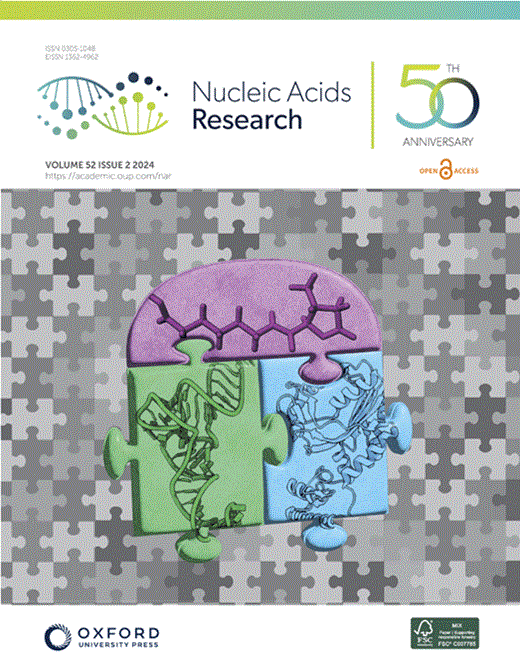
APE1 [apurinic/apyrimidinic (AP) endodeoxyribonuclease 1] is the main endonuclease of the base excision repair pathway acting on abasic (AP) sites in DNA. APE1 is an abundant nuclear protein, and improper expression or localization of this factor could lead to the accumulation of toxic DNA intermediates. Altered APE1 subcellular distribution and expression are associated with cancer development, suggesting the importance of a fine-tuning mechanism for APE1 activities. Recent works highlighted the presence of APE1 within nucleoli of cancer cells and the ability of APE1 to form biomolecular condensate. However, whether secondary structures of ribosomal RNA (rRNA) influence the nucleolar localization of APE1 remains poorly understood. Since protein overexpression can result in artificial nucleolar accumulation, it is imperative to have appropriate cellular models to study APE1 trafficking under physiological conditions. To address this issue, we generated a murine embryonic stem cell line expressing endogenous fluorescent-tagged APE1. Live-cell imaging demonstrates that APE1 nucleolar accumulation requires active rRNA transcription and is modulated by different genotoxicants. In vitro experiments showed that APE1 condensate formation depends on RNA-forming G-quadruplex structures and relies on critical lysine residues. This study sheds light on the mechanisms underlying APE1 trafficking to the nucleolus and the formation of RNA-dependent APE1 nucleolar condensates.
期刊介绍:
Nucleic Acids Research (NAR) is a scientific journal that publishes research on various aspects of nucleic acids and proteins involved in nucleic acid metabolism and interactions. It covers areas such as chemistry and synthetic biology, computational biology, gene regulation, chromatin and epigenetics, genome integrity, repair and replication, genomics, molecular biology, nucleic acid enzymes, RNA, and structural biology. The journal also includes a Survey and Summary section for brief reviews. Additionally, each year, the first issue is dedicated to biological databases, and an issue in July focuses on web-based software resources for the biological community. Nucleic Acids Research is indexed by several services including Abstracts on Hygiene and Communicable Diseases, Animal Breeding Abstracts, Agricultural Engineering Abstracts, Agbiotech News and Information, BIOSIS Previews, CAB Abstracts, and EMBASE.




 京公网安备 11010802042870号
京ICP备2023020795号-1
京公网安备 11010802042870号
京ICP备2023020795号-1

 分享
分享
 求助内容:
求助内容: 应助结果提醒方式:
 扫码关注我们
