Shivangi Sharma, Elizabeth Thomas, Sumedha Dahal, Sayak Das, Shefali Kothari, Urbi Roy, Nitu Kumari, Vidya Gopalakrishnan, Sathees C Raghavan
{"title":"Formation of multiple G-quadruplexes contributes toward BCR fragility associated with chronic myelogenous leukemia.","authors":"Shivangi Sharma, Elizabeth Thomas, Sumedha Dahal, Sayak Das, Shefali Kothari, Urbi Roy, Nitu Kumari, Vidya Gopalakrishnan, Sathees C Raghavan","doi":"10.1093/nar/gkaf167","DOIUrl":null,"url":null,"abstract":"<p><p>The Philadelphia chromosome, the translocation between BCR and ABL genes, is seen in 95% of chronic myeloid leukemia (CML) patients. Although discovered >60 years ago, the molecular mechanism of BCR fragility is unclear. Here, we have identified several G4 DNA motifs at the BCR fragile region of CML patients. Various lines of experimentation revealed that the breakpoint regions could fold into multiple intramolecular G-quadruplex structures. The sodium bisulfite modification assay revealed single strandedness in the fragile region when present on a plasmid and human genome. Circular dichroism spectroscopy revealed the parallel G4 DNA formation, leading to polymerase arrest at the BCR breakpoints. Intracellular recombination assay revealed that DNA breakage at the BCR fragile region could join with the break generated by ISceI endonuclease. Finally, purified AID could bind and deaminate cytosines when present on single-stranded DNA generated due to G4 DNA, both in vitro and inside the cells. Therefore, our results suggest that AID binds to G4 DNA present at the BCR fragile region, resulting in the deamination of cytosines to uracil and induction of DNA breaks in one of the DNA strands, which can later get converted into a double-strand break, leading to t(9;22) chromosomal translocation.</p>","PeriodicalId":19471,"journal":{"name":"Nucleic Acids Research","volume":"53 6","pages":""},"PeriodicalIF":13.1000,"publicationDate":"2025-03-20","publicationTypes":"Journal Article","fieldsOfStudy":null,"isOpenAccess":false,"openAccessPdf":"https://www.ncbi.nlm.nih.gov/pmc/articles/PMC11925732/pdf/","citationCount":"0","resultStr":null,"platform":"Semanticscholar","paperid":null,"PeriodicalName":"Nucleic Acids Research","FirstCategoryId":"99","ListUrlMain":"https://doi.org/10.1093/nar/gkaf167","RegionNum":2,"RegionCategory":"生物学","ArticlePicture":[],"TitleCN":null,"AbstractTextCN":null,"PMCID":null,"EPubDate":"","PubModel":"","JCR":"Q1","JCRName":"BIOCHEMISTRY & MOLECULAR BIOLOGY","Score":null,"Total":0}
引用次数: 0
Abstract
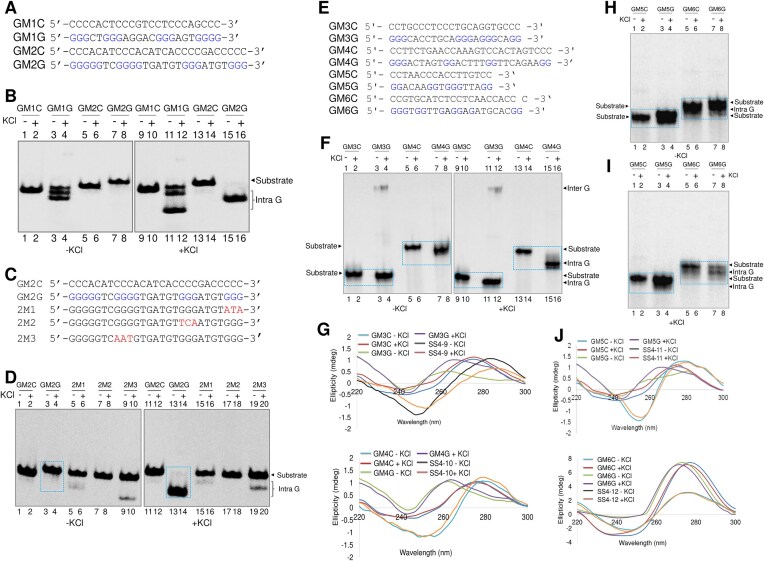
The Philadelphia chromosome, the translocation between BCR and ABL genes, is seen in 95% of chronic myeloid leukemia (CML) patients. Although discovered >60 years ago, the molecular mechanism of BCR fragility is unclear. Here, we have identified several G4 DNA motifs at the BCR fragile region of CML patients. Various lines of experimentation revealed that the breakpoint regions could fold into multiple intramolecular G-quadruplex structures. The sodium bisulfite modification assay revealed single strandedness in the fragile region when present on a plasmid and human genome. Circular dichroism spectroscopy revealed the parallel G4 DNA formation, leading to polymerase arrest at the BCR breakpoints. Intracellular recombination assay revealed that DNA breakage at the BCR fragile region could join with the break generated by ISceI endonuclease. Finally, purified AID could bind and deaminate cytosines when present on single-stranded DNA generated due to G4 DNA, both in vitro and inside the cells. Therefore, our results suggest that AID binds to G4 DNA present at the BCR fragile region, resulting in the deamination of cytosines to uracil and induction of DNA breaks in one of the DNA strands, which can later get converted into a double-strand break, leading to t(9;22) chromosomal translocation.
期刊介绍:
Nucleic Acids Research (NAR) is a scientific journal that publishes research on various aspects of nucleic acids and proteins involved in nucleic acid metabolism and interactions. It covers areas such as chemistry and synthetic biology, computational biology, gene regulation, chromatin and epigenetics, genome integrity, repair and replication, genomics, molecular biology, nucleic acid enzymes, RNA, and structural biology. The journal also includes a Survey and Summary section for brief reviews. Additionally, each year, the first issue is dedicated to biological databases, and an issue in July focuses on web-based software resources for the biological community. Nucleic Acids Research is indexed by several services including Abstracts on Hygiene and Communicable Diseases, Animal Breeding Abstracts, Agricultural Engineering Abstracts, Agbiotech News and Information, BIOSIS Previews, CAB Abstracts, and EMBASE.





 京公网安备 11010802042870号
京ICP备2023020795号-1
京公网安备 11010802042870号
京ICP备2023020795号-1

 分享
分享
 求助内容:
求助内容: 应助结果提醒方式:
 扫码关注我们
