Maryam Eslami , Vivek Pachchigar , Mohan Sankaran , Daniel V. Krogstad
{"title":"Critical influence of chemical pretreatments on the deposition and effectiveness of Zr-based conversion coating on AA2024-T3 aluminum alloy","authors":"Maryam Eslami , Vivek Pachchigar , Mohan Sankaran , Daniel V. Krogstad","doi":"10.1016/j.apsusc.2025.163018","DOIUrl":null,"url":null,"abstract":"<div><div>The critical role of chemical pretreatments on the deposition and effectiveness of Zr-based conversion coatings to protect high strength aluminum alloy is presented. Several pretreatments were tested, including mechanical grinding, alkaline etching, acid desmutting, and combinations therein. Zr-based conversion coatings were deposited on aluminum (AA2024-T3) from a solution of 0.01 M Zr<sup>4+</sup>. The corrosion behavior of the pre-treated and coated alloys was examined using potentiodynamic polarization in sodium chloride solution. The results showed that acid desmutting in nitric acid can cause localized corrosion in the form of selective magnesium dealloying and alkaline trenching around the S-Al<sub>2</sub>CuMg particles that continued during deposition and can compromise the corrosion protection. Alkaline etching in a sodium hydroxide solution removed some of the larger intermetallic particles and increased the deposition rate but resulted in a cracked coating with inadequate adhesion. Desmutting in weak acid did not cause any trenching during the pretreatment and deposition. However, uneven and cracked deposition of the coating on intermetallic particles compromised the corrosion protection. These results show the benefits and limitations of common pretreatments which can lead to the development of improved pretreatment procedures and corrosion protection.</div></div>","PeriodicalId":247,"journal":{"name":"Applied Surface Science","volume":"697 ","pages":"Article 163018"},"PeriodicalIF":6.9000,"publicationDate":"2025-07-15","publicationTypes":"Journal Article","fieldsOfStudy":null,"isOpenAccess":false,"openAccessPdf":"","citationCount":"0","resultStr":null,"platform":"Semanticscholar","paperid":null,"PeriodicalName":"Applied Surface Science","FirstCategoryId":"88","ListUrlMain":"https://www.sciencedirect.com/science/article/pii/S0169433225007329","RegionNum":2,"RegionCategory":"材料科学","ArticlePicture":[],"TitleCN":null,"AbstractTextCN":null,"PMCID":null,"EPubDate":"2025/3/18 0:00:00","PubModel":"Epub","JCR":"Q2","JCRName":"CHEMISTRY, PHYSICAL","Score":null,"Total":0}
引用次数: 0
Abstract
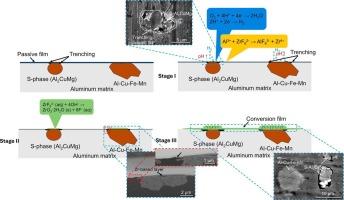
The critical role of chemical pretreatments on the deposition and effectiveness of Zr-based conversion coatings to protect high strength aluminum alloy is presented. Several pretreatments were tested, including mechanical grinding, alkaline etching, acid desmutting, and combinations therein. Zr-based conversion coatings were deposited on aluminum (AA2024-T3) from a solution of 0.01 M Zr4+. The corrosion behavior of the pre-treated and coated alloys was examined using potentiodynamic polarization in sodium chloride solution. The results showed that acid desmutting in nitric acid can cause localized corrosion in the form of selective magnesium dealloying and alkaline trenching around the S-Al2CuMg particles that continued during deposition and can compromise the corrosion protection. Alkaline etching in a sodium hydroxide solution removed some of the larger intermetallic particles and increased the deposition rate but resulted in a cracked coating with inadequate adhesion. Desmutting in weak acid did not cause any trenching during the pretreatment and deposition. However, uneven and cracked deposition of the coating on intermetallic particles compromised the corrosion protection. These results show the benefits and limitations of common pretreatments which can lead to the development of improved pretreatment procedures and corrosion protection.
介绍了化学预处理对高强度铝合金zr基转化涂层的沉积和效果的关键作用。测试了几种预处理方法,包括机械研磨、碱性蚀刻和酸脱渣,以及它们的组合。采用0.01 M Zr4+溶液在铝(AA2024-T3)表面沉积zr基转化涂层。采用动电位极化法研究了预处理和包覆合金在氯化钠溶液中的腐蚀行为。结果表明,在硝酸中,酸脱熔会导致S-Al2CuMg颗粒周围的选择性镁合金化和碱性沟蚀等局部腐蚀,并在沉积过程中持续存在,从而影响腐蚀防护。在氢氧化钠溶液中碱性蚀刻可以去除一些较大的金属间颗粒,增加沉积速率,但导致涂层开裂,附着力不足。在弱酸条件下脱毛,在预处理和沉积过程中不产生沟槽。然而,金属间颗粒镀层的不均匀和裂纹性影响了镀层的防腐蚀性能。这些结果显示了普通预处理的优点和局限性,并可能导致改进的预处理程序和防腐的发展。
期刊介绍:
Applied Surface Science covers topics contributing to a better understanding of surfaces, interfaces, nanostructures and their applications. The journal is concerned with scientific research on the atomic and molecular level of material properties determined with specific surface analytical techniques and/or computational methods, as well as the processing of such structures.





 京公网安备 11010802042870号
京ICP备2023020795号-1
京公网安备 11010802042870号
京ICP备2023020795号-1

 分享
分享
 求助内容:
求助内容: 应助结果提醒方式:
 扫码关注我们
