Onur Toprak, Florian Maudet, Markus Wollgarten, Charlotte Van Dijck, Roland Thewes, Veeresh Deshpande, Catherine Dubourdieu
{"title":"Amorphous Gallium-Oxide-Based Non-Filamentary Memristive Device with Highly Repeatable Multiple Resistance States","authors":"Onur Toprak, Florian Maudet, Markus Wollgarten, Charlotte Van Dijck, Roland Thewes, Veeresh Deshpande, Catherine Dubourdieu","doi":"10.1002/aelm.202400765","DOIUrl":null,"url":null,"abstract":"<p>A memristive device is presented based on a Ti/GaO<sub>x</sub>/W stack with an amorphous GaO<sub>x</sub> layer deposited at a low temperature (250 °C) using plasma-enhanced atomic layer deposition. The device fabrication is compatible with a standard complementary metal oxide semiconductor back-end-of-line technology. The area dependence of the resistance values for both high and low resistance states indicates that switching takes place over the entire device area via a non-filamentary-based mechanism. Evidence is provided that the switching process originates from a field-driven oxygen exchange between the interfacial TiO<sub>x</sub> layer and the GaO<sub>x</sub> one as well as from the charging/discharging of interfacial trap states. The devices reveal self-rectifying characteristics with high cycle-to-cycle reproducibility. Multiple states can be programmed with 12 distinct intermediate states during potentiation, and 11 distinct states during depression. This amorphous GaO<sub>x</sub>-based memristive device with highly reproducible multi-level resistance states shows great potential for enabling artificial synapses in neuromorphic applications.</p>","PeriodicalId":110,"journal":{"name":"Advanced Electronic Materials","volume":"11 8","pages":""},"PeriodicalIF":5.3000,"publicationDate":"2025-03-18","publicationTypes":"Journal Article","fieldsOfStudy":null,"isOpenAccess":false,"openAccessPdf":"https://onlinelibrary.wiley.com/doi/epdf/10.1002/aelm.202400765","citationCount":"0","resultStr":null,"platform":"Semanticscholar","paperid":null,"PeriodicalName":"Advanced Electronic Materials","FirstCategoryId":"88","ListUrlMain":"https://advanced.onlinelibrary.wiley.com/doi/10.1002/aelm.202400765","RegionNum":2,"RegionCategory":"材料科学","ArticlePicture":[],"TitleCN":null,"AbstractTextCN":null,"PMCID":null,"EPubDate":"","PubModel":"","JCR":"Q2","JCRName":"MATERIALS SCIENCE, MULTIDISCIPLINARY","Score":null,"Total":0}
引用次数: 0
Abstract
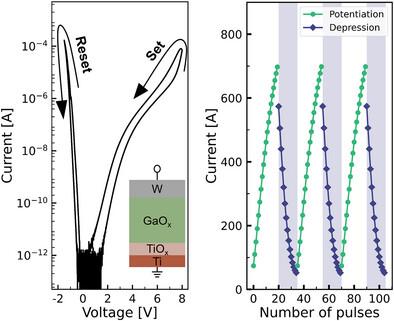
A memristive device is presented based on a Ti/GaOx/W stack with an amorphous GaOx layer deposited at a low temperature (250 °C) using plasma-enhanced atomic layer deposition. The device fabrication is compatible with a standard complementary metal oxide semiconductor back-end-of-line technology. The area dependence of the resistance values for both high and low resistance states indicates that switching takes place over the entire device area via a non-filamentary-based mechanism. Evidence is provided that the switching process originates from a field-driven oxygen exchange between the interfacial TiOx layer and the GaOx one as well as from the charging/discharging of interfacial trap states. The devices reveal self-rectifying characteristics with high cycle-to-cycle reproducibility. Multiple states can be programmed with 12 distinct intermediate states during potentiation, and 11 distinct states during depression. This amorphous GaOx-based memristive device with highly reproducible multi-level resistance states shows great potential for enabling artificial synapses in neuromorphic applications.
期刊介绍:
Advanced Electronic Materials is an interdisciplinary forum for peer-reviewed, high-quality, high-impact research in the fields of materials science, physics, and engineering of electronic and magnetic materials. It includes research on physics and physical properties of electronic and magnetic materials, spintronics, electronics, device physics and engineering, micro- and nano-electromechanical systems, and organic electronics, in addition to fundamental research.







 京公网安备 11010802042870号
京ICP备2023020795号-1
京公网安备 11010802042870号
京ICP备2023020795号-1

 分享
分享
 求助内容:
求助内容: 应助结果提醒方式:
 扫码关注我们
