Sehyun Park, Seongyeop Kim, Soojin Lee, Vladimir V. Tsukruk, SeungHyun Park, Hyo-Ryoung Lim
{"title":"Advanced Microfluidic-Based Wearable Electrochemical Sensors for Continuous Biochemical Monitoring","authors":"Sehyun Park, Seongyeop Kim, Soojin Lee, Vladimir V. Tsukruk, SeungHyun Park, Hyo-Ryoung Lim","doi":"10.1002/aelm.202500010","DOIUrl":null,"url":null,"abstract":"<p>Microfluidic-based wearable electrochemical sensors represent a transformative approach to non-invasive, real-time health monitoring through continuous biochemical analysis of body fluids such as sweat, saliva, and interstitial fluid. These systems offer significant potential for personalized healthcare and disease management by enabling real-time detection of key biomarkers. However, challenges remain in optimizing microfluidic channel design, ensuring consistent biofluid collection, balancing high-resolution fabrication with scalability, integrating flexible biocompatible materials, and establishing standardized validation protocols. This review explores advancements in microfluidic design, fabrication techniques, and integrated electrochemical sensors that have improved sensitivity, selectivity, and durability. Conventional photolithography, 3D printing, and laser-based fabrication methods are compared, highlighting their mechanisms, advantages, and trade-offs in microfluidic channel production. The application section summarizes strategies to overcome variability in biofluid composition, sensor drift, and user adaptability through innovative solutions such as hybrid material integration, self-powered systems, and AI-assisted data analysis. By analyzing recent breakthroughs, this paper outlines critical pathways for expanding wearable sensor technologies and achieving seamless operation in diverse real-world settings, paving the way for a new era of digital health.</p>","PeriodicalId":110,"journal":{"name":"Advanced Electronic Materials","volume":"11 10","pages":""},"PeriodicalIF":5.3000,"publicationDate":"2025-03-18","publicationTypes":"Journal Article","fieldsOfStudy":null,"isOpenAccess":false,"openAccessPdf":"https://onlinelibrary.wiley.com/doi/epdf/10.1002/aelm.202500010","citationCount":"0","resultStr":null,"platform":"Semanticscholar","paperid":null,"PeriodicalName":"Advanced Electronic Materials","FirstCategoryId":"88","ListUrlMain":"https://advanced.onlinelibrary.wiley.com/doi/10.1002/aelm.202500010","RegionNum":2,"RegionCategory":"材料科学","ArticlePicture":[],"TitleCN":null,"AbstractTextCN":null,"PMCID":null,"EPubDate":"","PubModel":"","JCR":"Q2","JCRName":"MATERIALS SCIENCE, MULTIDISCIPLINARY","Score":null,"Total":0}
引用次数: 0
Abstract
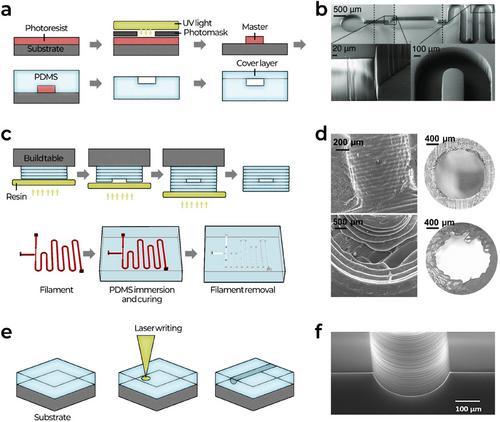
Microfluidic-based wearable electrochemical sensors represent a transformative approach to non-invasive, real-time health monitoring through continuous biochemical analysis of body fluids such as sweat, saliva, and interstitial fluid. These systems offer significant potential for personalized healthcare and disease management by enabling real-time detection of key biomarkers. However, challenges remain in optimizing microfluidic channel design, ensuring consistent biofluid collection, balancing high-resolution fabrication with scalability, integrating flexible biocompatible materials, and establishing standardized validation protocols. This review explores advancements in microfluidic design, fabrication techniques, and integrated electrochemical sensors that have improved sensitivity, selectivity, and durability. Conventional photolithography, 3D printing, and laser-based fabrication methods are compared, highlighting their mechanisms, advantages, and trade-offs in microfluidic channel production. The application section summarizes strategies to overcome variability in biofluid composition, sensor drift, and user adaptability through innovative solutions such as hybrid material integration, self-powered systems, and AI-assisted data analysis. By analyzing recent breakthroughs, this paper outlines critical pathways for expanding wearable sensor technologies and achieving seamless operation in diverse real-world settings, paving the way for a new era of digital health.
期刊介绍:
Advanced Electronic Materials is an interdisciplinary forum for peer-reviewed, high-quality, high-impact research in the fields of materials science, physics, and engineering of electronic and magnetic materials. It includes research on physics and physical properties of electronic and magnetic materials, spintronics, electronics, device physics and engineering, micro- and nano-electromechanical systems, and organic electronics, in addition to fundamental research.







 京公网安备 11010802042870号
京ICP备2023020795号-1
京公网安备 11010802042870号
京ICP备2023020795号-1

 分享
分享
 求助内容:
求助内容: 应助结果提醒方式:
 扫码关注我们
