Nan Zhao , Xiaozhen Zhang , Yahui Li , Haoyu Zhang , En Yang , Lei Ding , Yi Liu
{"title":"Associations between in utero exposure of per- and polyfluoroalkyl substances (PFAS) mixture and anthropometry measures at birth","authors":"Nan Zhao , Xiaozhen Zhang , Yahui Li , Haoyu Zhang , En Yang , Lei Ding , Yi Liu","doi":"10.1016/j.envpol.2025.126093","DOIUrl":null,"url":null,"abstract":"<div><div>In utero exposure to per- and polyfluoroalkyl substances (PFAS), which are recognized developmental toxicants, potentially leads to decreased anthropometric measures in infants at birth. We analyzed 16 PFAS in 350 cord serum samples from Jinan, China, using ultra-high-performance liquid chromatography integrated with Orbitrap mass spectrometry. Birth length, birth weight, and head circumference were extracted from medical records and converted into z-scores (BL-z, BW-z and HC-z, respectively). Multivariable linear regression (MLR) models were employed to investigate the associations between individual PFAS and these birth anthropometric z-scores. To assess the cumulative effects of PFAS, quantile g-computation (QGC) and Bayesian kernel machine regression (BKMR) models were employed. Additionally, stratified analyses were performed to derive sex-specific estimates of the associations.</div><div>MLR analysis revealed significant associations between specific PFAS and reduced birth anthropometric measures varying by infant sex. For example, log2-transformed concentration of cord serum perfluorooctanoic acid (PFOA) was associated with reduced BL-z (β = −0.12 (−0.18, −0.06), p < 0.001) and BW-z (β = −0.20 (−0.31, −0.10), p < 0.001) in all infants. Perfluoroheptanesulfonic acid (PFHpS) was inversely associated with BL-z (β = −0.07 (−0.13, −0.02), p = 0.03) and HC-z (β = −0.06 (−0.11, −0.02), p = 0.01) exclusively in males. BKMR and QGC models suggested general negative dose-response pattern between exposure to PFAS mixtures and BL-z, BW-z, and HC-z in males. Conversely, these associations were not evident in females. The key PFAS identified as contributors to the joint effects, along with the directions of their estimated impacts as determined by the mixture methods, showed marginal consistency with the results obtained from the MLR models. Our study underscored that in utero exposure to certain PFAS was associated with reduced anthropometric measures at birth. Male infants were more susceptible to PFAS exposure, particularly to combined PFAS mixture effects.</div></div>","PeriodicalId":311,"journal":{"name":"Environmental Pollution","volume":"373 ","pages":"Article 126093"},"PeriodicalIF":7.3000,"publicationDate":"2025-05-15","publicationTypes":"Journal Article","fieldsOfStudy":null,"isOpenAccess":false,"openAccessPdf":"","citationCount":"0","resultStr":null,"platform":"Semanticscholar","paperid":null,"PeriodicalName":"Environmental Pollution","FirstCategoryId":"93","ListUrlMain":"https://www.sciencedirect.com/science/article/pii/S026974912500466X","RegionNum":2,"RegionCategory":"环境科学与生态学","ArticlePicture":[],"TitleCN":null,"AbstractTextCN":null,"PMCID":null,"EPubDate":"2025/3/18 0:00:00","PubModel":"Epub","JCR":"Q1","JCRName":"ENVIRONMENTAL SCIENCES","Score":null,"Total":0}
引用次数: 0
Abstract
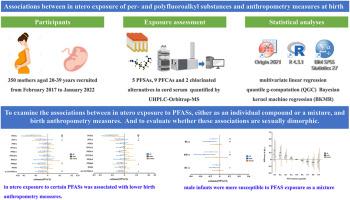
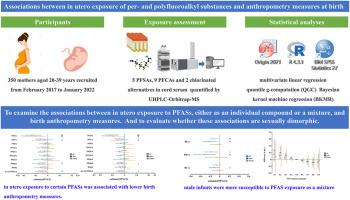
In utero exposure to per- and polyfluoroalkyl substances (PFAS), which are recognized developmental toxicants, potentially leads to decreased anthropometric measures in infants at birth. We analyzed 16 PFAS in 350 cord serum samples from Jinan, China, using ultra-high-performance liquid chromatography integrated with Orbitrap mass spectrometry. Birth length, birth weight, and head circumference were extracted from medical records and converted into z-scores (BL-z, BW-z and HC-z, respectively). Multivariable linear regression (MLR) models were employed to investigate the associations between individual PFAS and these birth anthropometric z-scores. To assess the cumulative effects of PFAS, quantile g-computation (QGC) and Bayesian kernel machine regression (BKMR) models were employed. Additionally, stratified analyses were performed to derive sex-specific estimates of the associations.
MLR analysis revealed significant associations between specific PFAS and reduced birth anthropometric measures varying by infant sex. For example, log2-transformed concentration of cord serum perfluorooctanoic acid (PFOA) was associated with reduced BL-z (β = −0.12 (−0.18, −0.06), p < 0.001) and BW-z (β = −0.20 (−0.31, −0.10), p < 0.001) in all infants. Perfluoroheptanesulfonic acid (PFHpS) was inversely associated with BL-z (β = −0.07 (−0.13, −0.02), p = 0.03) and HC-z (β = −0.06 (−0.11, −0.02), p = 0.01) exclusively in males. BKMR and QGC models suggested general negative dose-response pattern between exposure to PFAS mixtures and BL-z, BW-z, and HC-z in males. Conversely, these associations were not evident in females. The key PFAS identified as contributors to the joint effects, along with the directions of their estimated impacts as determined by the mixture methods, showed marginal consistency with the results obtained from the MLR models. Our study underscored that in utero exposure to certain PFAS was associated with reduced anthropometric measures at birth. Male infants were more susceptible to PFAS exposure, particularly to combined PFAS mixture effects.
期刊介绍:
Environmental Pollution is an international peer-reviewed journal that publishes high-quality research papers and review articles covering all aspects of environmental pollution and its impacts on ecosystems and human health.
Subject areas include, but are not limited to:
• Sources and occurrences of pollutants that are clearly defined and measured in environmental compartments, food and food-related items, and human bodies;
• Interlinks between contaminant exposure and biological, ecological, and human health effects, including those of climate change;
• Contaminants of emerging concerns (including but not limited to antibiotic resistant microorganisms or genes, microplastics/nanoplastics, electronic wastes, light, and noise) and/or their biological, ecological, or human health effects;
• Laboratory and field studies on the remediation/mitigation of environmental pollution via new techniques and with clear links to biological, ecological, or human health effects;
• Modeling of pollution processes, patterns, or trends that is of clear environmental and/or human health interest;
• New techniques that measure and examine environmental occurrences, transport, behavior, and effects of pollutants within the environment or the laboratory, provided that they can be clearly used to address problems within regional or global environmental compartments.



 京公网安备 11010802042870号
京ICP备2023020795号-1
京公网安备 11010802042870号
京ICP备2023020795号-1

 分享
分享
 求助内容:
求助内容: 应助结果提醒方式:
 扫码关注我们
