Ruyi Hou, Jiahong Li, Yali Deng, Yingying Duan, Jixiang Li, Baoyuan Wang, Wenjing Dong, Chen Xia and Xunying Wang
{"title":"Proton transport enhancement by octahedral distortion and built-in electric field at the PMN–TiO2 heterointerface†","authors":"Ruyi Hou, Jiahong Li, Yali Deng, Yingying Duan, Jixiang Li, Baoyuan Wang, Wenjing Dong, Chen Xia and Xunying Wang","doi":"10.1039/D4TA09160D","DOIUrl":null,"url":null,"abstract":"<p >Mixed ion–electron conductor-based electrolytes have shown great promise in solid oxide fuel cells (SOFCs), demonstrating attractive performance at low temperatures (<600 °C) due to their multi-interface conduction and interfacial effects. In this study, a new electrolyte composed of a PrMn<small><sub>0.5</sub></small>Ni<small><sub>0.5</sub></small>O<small><sub>3−<em>δ</em></sub></small> (PMN) perovskite and TiO<small><sub>2</sub></small> semiconductor in the form of a heterostructure was developed and evaluated in SOFCs. First-principles calculations identified the octahedral distortion and charge transfer at the PMN–TiO<small><sub>2</sub></small> interface in the heterostructure. It was found that doping and the heterostructure played important roles in facilitating proton transport in the PMN–TiO<small><sub>2</sub></small> electrolyte. Material characterization revealed that PMN–TiO<small><sub>2</sub></small> formed a bulk heterostructure with sufficient heterointerfaces, leading to enriched oxygen vacancies. The PMN–TiO<small><sub>2</sub></small> composite with a mass ratio of 9 : 1 achieved a total conductivity of 0.46 S cm<small><sup>−1</sup></small> at 550 °C. The 9PMN–1TiO<small><sub>2</sub></small> electrolyte-based SOFC demonstrated a promising peak power density of 235 mW cm<small><sup>−2</sup></small> at 450 °C. Measurements using KPFM, UPS, and UV-vis spectroscopy confirmed the presence of a built-in electric field (BIEF) in the 9PMN–1TiO<small><sub>2</sub></small> electrolyte, which enhanced ionic conduction. These findings indicate a novel electrolyte material and an optimized approach for improving SOFC performance.</p>","PeriodicalId":82,"journal":{"name":"Journal of Materials Chemistry A","volume":" 23","pages":" 17329-17339"},"PeriodicalIF":9.5000,"publicationDate":"2025-03-19","publicationTypes":"Journal Article","fieldsOfStudy":null,"isOpenAccess":false,"openAccessPdf":"","citationCount":"0","resultStr":null,"platform":"Semanticscholar","paperid":null,"PeriodicalName":"Journal of Materials Chemistry A","FirstCategoryId":"88","ListUrlMain":"https://pubs.rsc.org/en/content/articlelanding/2025/ta/d4ta09160d","RegionNum":2,"RegionCategory":"材料科学","ArticlePicture":[],"TitleCN":null,"AbstractTextCN":null,"PMCID":null,"EPubDate":"","PubModel":"","JCR":"Q1","JCRName":"CHEMISTRY, PHYSICAL","Score":null,"Total":0}
引用次数: 0
Abstract
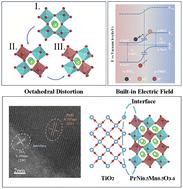
Mixed ion–electron conductor-based electrolytes have shown great promise in solid oxide fuel cells (SOFCs), demonstrating attractive performance at low temperatures (<600 °C) due to their multi-interface conduction and interfacial effects. In this study, a new electrolyte composed of a PrMn0.5Ni0.5O3−δ (PMN) perovskite and TiO2 semiconductor in the form of a heterostructure was developed and evaluated in SOFCs. First-principles calculations identified the octahedral distortion and charge transfer at the PMN–TiO2 interface in the heterostructure. It was found that doping and the heterostructure played important roles in facilitating proton transport in the PMN–TiO2 electrolyte. Material characterization revealed that PMN–TiO2 formed a bulk heterostructure with sufficient heterointerfaces, leading to enriched oxygen vacancies. The PMN–TiO2 composite with a mass ratio of 9 : 1 achieved a total conductivity of 0.46 S cm−1 at 550 °C. The 9PMN–1TiO2 electrolyte-based SOFC demonstrated a promising peak power density of 235 mW cm−2 at 450 °C. Measurements using KPFM, UPS, and UV-vis spectroscopy confirmed the presence of a built-in electric field (BIEF) in the 9PMN–1TiO2 electrolyte, which enhanced ionic conduction. These findings indicate a novel electrolyte material and an optimized approach for improving SOFC performance.
期刊介绍:
The Journal of Materials Chemistry A, B & C covers a wide range of high-quality studies in the field of materials chemistry, with each section focusing on specific applications of the materials studied. Journal of Materials Chemistry A emphasizes applications in energy and sustainability, including topics such as artificial photosynthesis, batteries, and fuel cells. Journal of Materials Chemistry B focuses on applications in biology and medicine, while Journal of Materials Chemistry C covers applications in optical, magnetic, and electronic devices. Example topic areas within the scope of Journal of Materials Chemistry A include catalysis, green/sustainable materials, sensors, and water treatment, among others.




 京公网安备 11010802042870号
京ICP备2023020795号-1
京公网安备 11010802042870号
京ICP备2023020795号-1

 分享
分享
 求助内容:
求助内容: 应助结果提醒方式:
 扫码关注我们
