Liyu Zhu, Yu Cao, Ting Xu, Hongbin Yang, Luying Wang, Lin Dai, Fusheng Pan, Chaoji Chen and Chuanling Si
{"title":"Covalent organic framework membranes for energy storage and conversion","authors":"Liyu Zhu, Yu Cao, Ting Xu, Hongbin Yang, Luying Wang, Lin Dai, Fusheng Pan, Chaoji Chen and Chuanling Si","doi":"10.1039/D5EE00494B","DOIUrl":null,"url":null,"abstract":"<p >Covalent organic frameworks (COFs) are a class of porous crystalline materials based on reticular and dynamic covalent chemistry. Flexible molecular design strategies, tunable porosity, modifiable frameworks, and atomically precise structures have made them powerful platforms for developing advanced devices in energy storage and conversion. In particular, the emergence of COF membranes has dramatically expanded the application scenarios for insoluble and un-processable COF powders and opened new doors for their utilization in the field of energy storage and conversion. In this process, exciting research activities have emerged, ranging from synthesis methods to energy-related applications of COF membranes. Therefore, in this critical review, current research progress on the utilization of COF membranes for energy devices, specifically fuel cells, rechargeable batteries, supercapacitors, and photo/osmotic energy conversion, is first comprehensively reviewed in terms of the core features, design principles, synthesis methods, properties, engineering technologies and applications of COF membranes. Meanwhile, the key challenges and prospects of COF membranes in energy-related applications are also meticulously reviewed and addressed. We sincerely expect that this review can further stimulate the research enthusiasm for COF membranes in energy-related applications and offer valuable guidance for the design and application strategies of advanced COF membranes with a focus on energy devices.</p>","PeriodicalId":72,"journal":{"name":"Energy & Environmental Science","volume":" 12","pages":" 5675-5739"},"PeriodicalIF":30.8000,"publicationDate":"2025-03-19","publicationTypes":"Journal Article","fieldsOfStudy":null,"isOpenAccess":false,"openAccessPdf":"","citationCount":"0","resultStr":null,"platform":"Semanticscholar","paperid":null,"PeriodicalName":"Energy & Environmental Science","FirstCategoryId":"88","ListUrlMain":"https://pubs.rsc.org/en/content/articlelanding/2025/ee/d5ee00494b","RegionNum":1,"RegionCategory":"材料科学","ArticlePicture":[],"TitleCN":null,"AbstractTextCN":null,"PMCID":null,"EPubDate":"","PubModel":"","JCR":"Q1","JCRName":"CHEMISTRY, MULTIDISCIPLINARY","Score":null,"Total":0}
引用次数: 0
Abstract
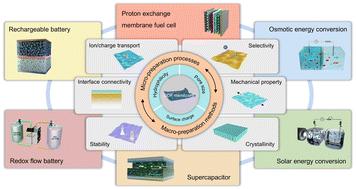
Covalent organic frameworks (COFs) are a class of porous crystalline materials based on reticular and dynamic covalent chemistry. Flexible molecular design strategies, tunable porosity, modifiable frameworks, and atomically precise structures have made them powerful platforms for developing advanced devices in energy storage and conversion. In particular, the emergence of COF membranes has dramatically expanded the application scenarios for insoluble and un-processable COF powders and opened new doors for their utilization in the field of energy storage and conversion. In this process, exciting research activities have emerged, ranging from synthesis methods to energy-related applications of COF membranes. Therefore, in this critical review, current research progress on the utilization of COF membranes for energy devices, specifically fuel cells, rechargeable batteries, supercapacitors, and photo/osmotic energy conversion, is first comprehensively reviewed in terms of the core features, design principles, synthesis methods, properties, engineering technologies and applications of COF membranes. Meanwhile, the key challenges and prospects of COF membranes in energy-related applications are also meticulously reviewed and addressed. We sincerely expect that this review can further stimulate the research enthusiasm for COF membranes in energy-related applications and offer valuable guidance for the design and application strategies of advanced COF membranes with a focus on energy devices.
期刊介绍:
Energy & Environmental Science, a peer-reviewed scientific journal, publishes original research and review articles covering interdisciplinary topics in the (bio)chemical and (bio)physical sciences, as well as chemical engineering disciplines. Published monthly by the Royal Society of Chemistry (RSC), a not-for-profit publisher, Energy & Environmental Science is recognized as a leading journal. It boasts an impressive impact factor of 8.500 as of 2009, ranking 8th among 140 journals in the category "Chemistry, Multidisciplinary," second among 71 journals in "Energy & Fuels," second among 128 journals in "Engineering, Chemical," and first among 181 scientific journals in "Environmental Sciences."
Energy & Environmental Science publishes various types of articles, including Research Papers (original scientific work), Review Articles, Perspectives, and Minireviews (feature review-type articles of broad interest), Communications (original scientific work of an urgent nature), Opinions (personal, often speculative viewpoints or hypotheses on current topics), and Analysis Articles (in-depth examination of energy-related issues).



 京公网安备 11010802042870号
京ICP备2023020795号-1
京公网安备 11010802042870号
京ICP备2023020795号-1

 分享
分享
 求助内容:
求助内容: 应助结果提醒方式:
 扫码关注我们
