Pengfei Ding, Xugang Rong, Daobin Yang, Xueliang Yu, Zhenxin Shao, Hongqian Wang, Xiaochun Liao, Xinyue Cao, Jie Wu, Lin Xie, Jintao Zhu, Fei Chen, Guo Chen, Yan Huang and Ziyi Ge
{"title":"Direct C–H arylation-derived low crystallinity guest acceptor for high efficiency organic solar cells†","authors":"Pengfei Ding, Xugang Rong, Daobin Yang, Xueliang Yu, Zhenxin Shao, Hongqian Wang, Xiaochun Liao, Xinyue Cao, Jie Wu, Lin Xie, Jintao Zhu, Fei Chen, Guo Chen, Yan Huang and Ziyi Ge","doi":"10.1039/D5EE00542F","DOIUrl":null,"url":null,"abstract":"<p >The majority of host/guest materials used in organic solar cells (OSCs) are currently synthesized <em>via</em> the Stille reaction, which suffers from poor atom/step economy, low cost-effectiveness, and environmental risks. Therefore, organic photovoltaic materials synthesized through low-cost and green methods are highly required. Here, an A–D–D–A type guest acceptor D-IDT was designed and synthesized using a tin-free direct C–H activation strategy and introduced into the classical D18:BTP-eC9 host system. Compared to the A–D–A type guest acceptor S-IDT, the D-IDT shows a greater π-conjugation but much weaker intermolecular interactions. Its low crystallinity results in good miscibility with the host acceptor BTP-eC9, which effectively promotes earlier assembly of BTP-eC9 and faster aggregation transition. This allows the formation of a smaller phase separation in the active layer, resulting in efficient exciton dissociation and charge transport. Moreover, the voltage loss of the OSC device reduces by 18 mV when D-IDT is incorporated into the binary system. As a result, the efficiency of the D-IDT-controlled device is increased to 19.92% compared to the device with S-IDT (17.66%). This work provides valuable guidelines for the exploration of guest materials <em>via</em> the C–H activation reaction, while controlling the crystallization kinetics to fine-tune the assembly behavior of the host acceptor.</p>","PeriodicalId":72,"journal":{"name":"Energy & Environmental Science","volume":" 13","pages":" 6548-6556"},"PeriodicalIF":30.8000,"publicationDate":"2025-03-19","publicationTypes":"Journal Article","fieldsOfStudy":null,"isOpenAccess":false,"openAccessPdf":"","citationCount":"0","resultStr":null,"platform":"Semanticscholar","paperid":null,"PeriodicalName":"Energy & Environmental Science","FirstCategoryId":"88","ListUrlMain":"https://pubs.rsc.org/en/content/articlelanding/2025/ee/d5ee00542f","RegionNum":1,"RegionCategory":"材料科学","ArticlePicture":[],"TitleCN":null,"AbstractTextCN":null,"PMCID":null,"EPubDate":"","PubModel":"","JCR":"Q1","JCRName":"CHEMISTRY, MULTIDISCIPLINARY","Score":null,"Total":0}
引用次数: 0
Abstract
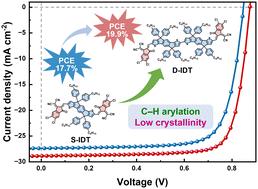
The majority of host/guest materials used in organic solar cells (OSCs) are currently synthesized via the Stille reaction, which suffers from poor atom/step economy, low cost-effectiveness, and environmental risks. Therefore, organic photovoltaic materials synthesized through low-cost and green methods are highly required. Here, an A–D–D–A type guest acceptor D-IDT was designed and synthesized using a tin-free direct C–H activation strategy and introduced into the classical D18:BTP-eC9 host system. Compared to the A–D–A type guest acceptor S-IDT, the D-IDT shows a greater π-conjugation but much weaker intermolecular interactions. Its low crystallinity results in good miscibility with the host acceptor BTP-eC9, which effectively promotes earlier assembly of BTP-eC9 and faster aggregation transition. This allows the formation of a smaller phase separation in the active layer, resulting in efficient exciton dissociation and charge transport. Moreover, the voltage loss of the OSC device reduces by 18 mV when D-IDT is incorporated into the binary system. As a result, the efficiency of the D-IDT-controlled device is increased to 19.92% compared to the device with S-IDT (17.66%). This work provides valuable guidelines for the exploration of guest materials via the C–H activation reaction, while controlling the crystallization kinetics to fine-tune the assembly behavior of the host acceptor.
目前用于有机太阳能电池(OSCs)的主/客体材料大多是通过Stille反应合成的,存在原子/步骤经济性差、成本效益低、环境风险大的问题。因此,通过低成本和绿色的方法合成有机光伏材料是非常必要的。本文采用无锡直接C-H活化策略,设计并合成了a - d - d - a型客体受体D-IDT,并将其引入经典的D18:BTP-eC9宿主体系。与a - d - a型客体受体S-IDT相比,D-IDT具有更强的π共轭作用,但分子间相互作用弱得多。其结晶度低,与宿主受体BTP-eC9具有良好的混溶性,有效促进了BTP-eC9的早期组装和更快的聚集转变。这允许在活性层中形成较小的相分离,从而产生有效的激子解离和电荷传输。此外,在二元系统中加入D-IDT后,OSCs器件的电压损失降低了18 mV。结果表明,d - idt控制器件的效率比S-IDT控制器件的效率(17.66%)提高了19.92%。这项工作为通过C-H活化反应探索客体材料提供了有价值的指导,同时控制结晶动力学以微调宿主受体的组装行为。
期刊介绍:
Energy & Environmental Science, a peer-reviewed scientific journal, publishes original research and review articles covering interdisciplinary topics in the (bio)chemical and (bio)physical sciences, as well as chemical engineering disciplines. Published monthly by the Royal Society of Chemistry (RSC), a not-for-profit publisher, Energy & Environmental Science is recognized as a leading journal. It boasts an impressive impact factor of 8.500 as of 2009, ranking 8th among 140 journals in the category "Chemistry, Multidisciplinary," second among 71 journals in "Energy & Fuels," second among 128 journals in "Engineering, Chemical," and first among 181 scientific journals in "Environmental Sciences."
Energy & Environmental Science publishes various types of articles, including Research Papers (original scientific work), Review Articles, Perspectives, and Minireviews (feature review-type articles of broad interest), Communications (original scientific work of an urgent nature), Opinions (personal, often speculative viewpoints or hypotheses on current topics), and Analysis Articles (in-depth examination of energy-related issues).



 京公网安备 11010802042870号
京ICP备2023020795号-1
京公网安备 11010802042870号
京ICP备2023020795号-1

 分享
分享
 求助内容:
求助内容: 应助结果提醒方式:
 扫码关注我们
