Zhi-Xiang Yin, Hao Chen, Sheng-Feng Yin, Dan Zhang, Xin-Gui Tang, Vellaisamy A L Roy, Qi-Jun Sun
{"title":"Recent Progress on Heterojunction-Based Memristors and Artificial Synapses for Low-Power Neural Morphological Computing","authors":"Zhi-Xiang Yin, Hao Chen, Sheng-Feng Yin, Dan Zhang, Xin-Gui Tang, Vellaisamy A L Roy, Qi-Jun Sun","doi":"10.1002/smll.202412851","DOIUrl":null,"url":null,"abstract":"<p>Memristors and artificial synapses have attracted tremendous attention due to their promising potential for application in the field of neural morphological computing, but at the same time, continuous optimization and improvement in energy consumption are also highly desirable. In recent years, it has been demonstrated that heterojunction is of great significance in improving the energy consumption of memristors and artificial synapses. By optimizing the material composition, interface characteristics, and device structure of heterojunctions, energy consumption can be reduced, and performance stability and durability can be improved, providing strong support for achieving low-power neural morphological computing systems. Herein, we review the recent progress on heterojunction-based memristors and artificial synapses by summarizing the working mechanisms and recent advances in heterojunction memristors, in terms of material selection, structure design, fabrication techniques, performance optimization strategies, etc. Then, the applications of heterojunction-based artificial synapses in neuromorphological computing and deep learning are introduced and discussed. After that, the remaining bottlenecks restricting the development of heterojunction-based memristors and artificial synapses are introduced and discussed in detail. Finally, corresponding strategies to overcome the remaining challenges are proposed. We believe this review may shed light on the development of high-performance memristors and artificial synapse devices.</p>","PeriodicalId":228,"journal":{"name":"Small","volume":"21 17","pages":""},"PeriodicalIF":12.1000,"publicationDate":"2025-03-19","publicationTypes":"Journal Article","fieldsOfStudy":null,"isOpenAccess":false,"openAccessPdf":"","citationCount":"0","resultStr":null,"platform":"Semanticscholar","paperid":null,"PeriodicalName":"Small","FirstCategoryId":"88","ListUrlMain":"https://onlinelibrary.wiley.com/doi/10.1002/smll.202412851","RegionNum":2,"RegionCategory":"材料科学","ArticlePicture":[],"TitleCN":null,"AbstractTextCN":null,"PMCID":null,"EPubDate":"","PubModel":"","JCR":"Q1","JCRName":"CHEMISTRY, MULTIDISCIPLINARY","Score":null,"Total":0}
引用次数: 0
Abstract
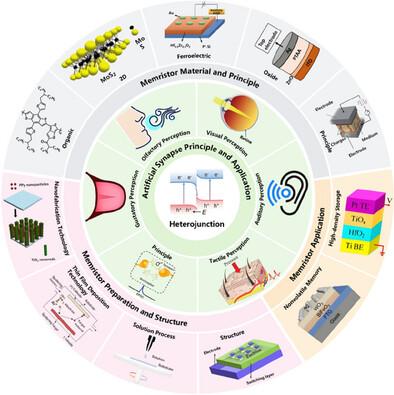
Memristors and artificial synapses have attracted tremendous attention due to their promising potential for application in the field of neural morphological computing, but at the same time, continuous optimization and improvement in energy consumption are also highly desirable. In recent years, it has been demonstrated that heterojunction is of great significance in improving the energy consumption of memristors and artificial synapses. By optimizing the material composition, interface characteristics, and device structure of heterojunctions, energy consumption can be reduced, and performance stability and durability can be improved, providing strong support for achieving low-power neural morphological computing systems. Herein, we review the recent progress on heterojunction-based memristors and artificial synapses by summarizing the working mechanisms and recent advances in heterojunction memristors, in terms of material selection, structure design, fabrication techniques, performance optimization strategies, etc. Then, the applications of heterojunction-based artificial synapses in neuromorphological computing and deep learning are introduced and discussed. After that, the remaining bottlenecks restricting the development of heterojunction-based memristors and artificial synapses are introduced and discussed in detail. Finally, corresponding strategies to overcome the remaining challenges are proposed. We believe this review may shed light on the development of high-performance memristors and artificial synapse devices.
期刊介绍:
Small serves as an exceptional platform for both experimental and theoretical studies in fundamental and applied interdisciplinary research at the nano- and microscale. The journal offers a compelling mix of peer-reviewed Research Articles, Reviews, Perspectives, and Comments.
With a remarkable 2022 Journal Impact Factor of 13.3 (Journal Citation Reports from Clarivate Analytics, 2023), Small remains among the top multidisciplinary journals, covering a wide range of topics at the interface of materials science, chemistry, physics, engineering, medicine, and biology.
Small's readership includes biochemists, biologists, biomedical scientists, chemists, engineers, information technologists, materials scientists, physicists, and theoreticians alike.




 京公网安备 11010802042870号
京ICP备2023020795号-1
京公网安备 11010802042870号
京ICP备2023020795号-1

 分享
分享
 求助内容:
求助内容: 应助结果提醒方式:
 扫码关注我们
