Xueqiu Chen, Jing-Jing Lv, Limin Zhou, Xiaoruizhuo Lin, Mingming Zhang, Zeqiang Cui, Bingtao Sun, Dan Shi, Yong Lei, Ning Wang, Huile Jin, Haibo Ke, Shun Wang, Shaoan Cheng, Zheng-Jun Wang
{"title":"3D Cu Microbuds for Electrocatalytic CO Reduction Reaction","authors":"Xueqiu Chen, Jing-Jing Lv, Limin Zhou, Xiaoruizhuo Lin, Mingming Zhang, Zeqiang Cui, Bingtao Sun, Dan Shi, Yong Lei, Ning Wang, Huile Jin, Haibo Ke, Shun Wang, Shaoan Cheng, Zheng-Jun Wang","doi":"10.1002/smll.202412672","DOIUrl":null,"url":null,"abstract":"Cu-based materials can electrocatalytically reduce CO<sub>2</sub> or CO into high-value-added multi-carbon (C<sub>2+</sub>) products. The features, including morphology, crystal plane, etc., have a great influence on their electrocatalytic performance. Herein, the 3D Cu microbuds (3D Cu MBs) are finely synthesized with enriched grain boundaries by controlling the reaction temperature, time, and pH. The obtained Cu MBs can work as an efficient catalyst for electrocatalytic CO reduction reaction (eCORR) in a flow cell. As compared to the commercial micron Cu, Cu MBs exhibit a significantly higher C<sub>2+</sub> product selectivity (≈83% at −0.58 V vs reversible hydrogen electrode-RHE), higher partial current density (410 mA cm<sup>−2</sup>), and a lower overpotential. The typical 3D hierarchical structure and polycrystalline feature endow the Cu MBs with abundant active grain boundaries for eCORR to form C<sub>2+</sub> products. This study offers a new insight into the crystalline-controlled synthesis of 3D Cu catalyst for CO electrolysis.","PeriodicalId":228,"journal":{"name":"Small","volume":"70 1","pages":""},"PeriodicalIF":12.1000,"publicationDate":"2025-03-19","publicationTypes":"Journal Article","fieldsOfStudy":null,"isOpenAccess":false,"openAccessPdf":"","citationCount":"0","resultStr":null,"platform":"Semanticscholar","paperid":null,"PeriodicalName":"Small","FirstCategoryId":"88","ListUrlMain":"https://doi.org/10.1002/smll.202412672","RegionNum":2,"RegionCategory":"材料科学","ArticlePicture":[],"TitleCN":null,"AbstractTextCN":null,"PMCID":null,"EPubDate":"","PubModel":"","JCR":"Q1","JCRName":"CHEMISTRY, MULTIDISCIPLINARY","Score":null,"Total":0}
引用次数: 0
Abstract
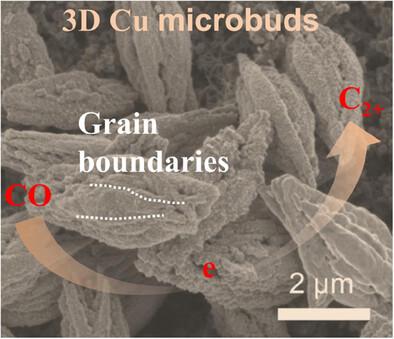
Cu-based materials can electrocatalytically reduce CO2 or CO into high-value-added multi-carbon (C2+) products. The features, including morphology, crystal plane, etc., have a great influence on their electrocatalytic performance. Herein, the 3D Cu microbuds (3D Cu MBs) are finely synthesized with enriched grain boundaries by controlling the reaction temperature, time, and pH. The obtained Cu MBs can work as an efficient catalyst for electrocatalytic CO reduction reaction (eCORR) in a flow cell. As compared to the commercial micron Cu, Cu MBs exhibit a significantly higher C2+ product selectivity (≈83% at −0.58 V vs reversible hydrogen electrode-RHE), higher partial current density (410 mA cm−2), and a lower overpotential. The typical 3D hierarchical structure and polycrystalline feature endow the Cu MBs with abundant active grain boundaries for eCORR to form C2+ products. This study offers a new insight into the crystalline-controlled synthesis of 3D Cu catalyst for CO electrolysis.
铜基材料可以电催化将CO2或CO还原成高附加值的多碳(C2+)产品。形貌、晶面等特征对其电催化性能有很大影响。通过控制反应温度、时间和ph,制备出晶粒边界富集的三维Cu微芽(3D Cu MBs)。制备的Cu MBs可作为流动电池中电催化CO还原反应(eCORR)的高效催化剂。与商业微米级Cu相比,Cu mb具有更高的C2+产物选择性(在- 0.58 V vs可逆氢电极- rhe下≈83%),更高的分电流密度(410 mA cm - 2)和更低的过电位。典型的三维层次结构和多晶特征使Cu mb具有丰富的活性晶界,有利于eCORR形成C2+产物。该研究为CO电解用三维Cu催化剂的结晶控制合成提供了新的思路。
期刊介绍:
Small serves as an exceptional platform for both experimental and theoretical studies in fundamental and applied interdisciplinary research at the nano- and microscale. The journal offers a compelling mix of peer-reviewed Research Articles, Reviews, Perspectives, and Comments.
With a remarkable 2022 Journal Impact Factor of 13.3 (Journal Citation Reports from Clarivate Analytics, 2023), Small remains among the top multidisciplinary journals, covering a wide range of topics at the interface of materials science, chemistry, physics, engineering, medicine, and biology.
Small's readership includes biochemists, biologists, biomedical scientists, chemists, engineers, information technologists, materials scientists, physicists, and theoreticians alike.



 京公网安备 11010802042870号
京ICP备2023020795号-1
京公网安备 11010802042870号
京ICP备2023020795号-1

 分享
分享
 求助内容:
求助内容: 应助结果提醒方式:
 扫码关注我们
