{"title":"Recent Progress of Covalent Organic Frameworks-Based Materials Used for CO2 Electrocatalytic Reduction: A Review","authors":"Heng-fei Cui, Feng Yang, Cong Liu, Hao-wen Zhu, Ming-yang Liu, Rui-tang Guo","doi":"10.1002/smll.202502867","DOIUrl":null,"url":null,"abstract":"<p>The excessive CO<sub>2</sub> emissions from human activities severely impact the natural environment and ecosystems. Among the various technologies available, electrocatalytic CO<sub>2</sub> reduction is regarded as one of the most promising routes due to its exceptional environmental friendliness and sustainability. Covalent organic frameworks (COFs) are crystalline, porous organic networks that are formed through thermodynamically controlled reversible covalent polymerization of organic linkers via covalent bonding. These materials exhibit high porosity, large surface area, excellent chemical and thermal stability, sustainability, high electron transfer efficiency, and surface functionalization capabilities, making them particularly effective in electrocatalytic CO<sub>2</sub> reduction. First, this review briefly introduces the fundamental principles of electrocatalysis and the mechanism of electrocatalytic CO<sub>2</sub> reduction. Next, it discusses the composition, structure, and synthesis methods of COF-based materials, as well as their applications in electrocatalytic CO<sub>2</sub> reduction. Furthermore, it reviews the research progress in this field from the perspective of different types of COF-based catalysts. Finally, in light of the current research status, the development prospects of COF-based catalysts are explored, providing a reference for the development of more efficient and stable COF electrocatalysts for CO<sub>2</sub> reduction.</p>","PeriodicalId":228,"journal":{"name":"Small","volume":"21 18","pages":""},"PeriodicalIF":12.1000,"publicationDate":"2025-03-19","publicationTypes":"Journal Article","fieldsOfStudy":null,"isOpenAccess":false,"openAccessPdf":"","citationCount":"0","resultStr":null,"platform":"Semanticscholar","paperid":null,"PeriodicalName":"Small","FirstCategoryId":"88","ListUrlMain":"https://onlinelibrary.wiley.com/doi/10.1002/smll.202502867","RegionNum":2,"RegionCategory":"材料科学","ArticlePicture":[],"TitleCN":null,"AbstractTextCN":null,"PMCID":null,"EPubDate":"","PubModel":"","JCR":"Q1","JCRName":"CHEMISTRY, MULTIDISCIPLINARY","Score":null,"Total":0}
引用次数: 0
Abstract
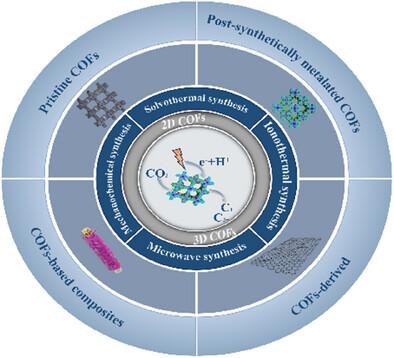
The excessive CO2 emissions from human activities severely impact the natural environment and ecosystems. Among the various technologies available, electrocatalytic CO2 reduction is regarded as one of the most promising routes due to its exceptional environmental friendliness and sustainability. Covalent organic frameworks (COFs) are crystalline, porous organic networks that are formed through thermodynamically controlled reversible covalent polymerization of organic linkers via covalent bonding. These materials exhibit high porosity, large surface area, excellent chemical and thermal stability, sustainability, high electron transfer efficiency, and surface functionalization capabilities, making them particularly effective in electrocatalytic CO2 reduction. First, this review briefly introduces the fundamental principles of electrocatalysis and the mechanism of electrocatalytic CO2 reduction. Next, it discusses the composition, structure, and synthesis methods of COF-based materials, as well as their applications in electrocatalytic CO2 reduction. Furthermore, it reviews the research progress in this field from the perspective of different types of COF-based catalysts. Finally, in light of the current research status, the development prospects of COF-based catalysts are explored, providing a reference for the development of more efficient and stable COF electrocatalysts for CO2 reduction.
期刊介绍:
Small serves as an exceptional platform for both experimental and theoretical studies in fundamental and applied interdisciplinary research at the nano- and microscale. The journal offers a compelling mix of peer-reviewed Research Articles, Reviews, Perspectives, and Comments.
With a remarkable 2022 Journal Impact Factor of 13.3 (Journal Citation Reports from Clarivate Analytics, 2023), Small remains among the top multidisciplinary journals, covering a wide range of topics at the interface of materials science, chemistry, physics, engineering, medicine, and biology.
Small's readership includes biochemists, biologists, biomedical scientists, chemists, engineers, information technologists, materials scientists, physicists, and theoreticians alike.




 京公网安备 11010802042870号
京ICP备2023020795号-1
京公网安备 11010802042870号
京ICP备2023020795号-1

 分享
分享
 求助内容:
求助内容: 应助结果提醒方式:
 扫码关注我们
