Chenghui Qian, Si Chen, Liman Chen, Chenyang Zhang, Lingyi Yang, Qiaowei Li, Binbin Kang, Xiaohong Chen, Peter Mei, Hongzhou Gu, Yan Liu, Yuehua Liu
{"title":"Tetrahedral DNA Nanostructure-Modified Nanocoating for Improved Bioaffinity and Osseointegration of Titanium","authors":"Chenghui Qian, Si Chen, Liman Chen, Chenyang Zhang, Lingyi Yang, Qiaowei Li, Binbin Kang, Xiaohong Chen, Peter Mei, Hongzhou Gu, Yan Liu, Yuehua Liu","doi":"10.1002/smll.202412747","DOIUrl":null,"url":null,"abstract":"<p>Titanium (Ti) is extensively used in the medical field because of its excellent biomechanical properties; however, how to precisely fabricate Ti surfaces at a nanoscale remains challenging. In this study, a DNA nanocoating system to functionalize Ti surfaces via a series of sequential reactions involving hydroxylation, silanization, and click chemistry is developed. Tetrahedral DNA nanostructures (TDNs) of two different sizes (≈7 and 30 nm) are assembled and characterized for subsequent surface attachment. In vitro and in vivo assays demonstrated significantly enhanced cell adhesion, spreading, proliferation, osteogenesis, and osseointegration on Ti surfaces modified with 30-nm TDNs, compared to slightly improved effects with 7-nm TDNs. Mechanistic studies showed that the focal adhesion pathway contributed to the enhanced bioaffinity of the 30-nm TDNs, as evidenced by the upregulated expression of vinculin and activation of the Akt signaling pathway. Moreover, under inflammatory or hypoxic conditions, Ti surfaces modified with 30-nm TDNs maintained excellent cellular performance comparable to that under normal conditions, suggesting a broader adaptability for DNA nanoparticles. Thus, better performance is achieved following modification with 30-nm TDNs. In summary, the proposed DNA-guided nanocoating system provides a novel and efficient strategy for the surface nanofabrication of Ti.</p>","PeriodicalId":228,"journal":{"name":"Small","volume":"21 18","pages":""},"PeriodicalIF":12.1000,"publicationDate":"2025-03-19","publicationTypes":"Journal Article","fieldsOfStudy":null,"isOpenAccess":false,"openAccessPdf":"","citationCount":"0","resultStr":null,"platform":"Semanticscholar","paperid":null,"PeriodicalName":"Small","FirstCategoryId":"88","ListUrlMain":"https://onlinelibrary.wiley.com/doi/10.1002/smll.202412747","RegionNum":2,"RegionCategory":"材料科学","ArticlePicture":[],"TitleCN":null,"AbstractTextCN":null,"PMCID":null,"EPubDate":"","PubModel":"","JCR":"Q1","JCRName":"CHEMISTRY, MULTIDISCIPLINARY","Score":null,"Total":0}
引用次数: 0
Abstract
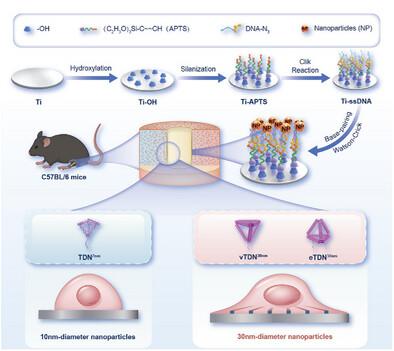
Titanium (Ti) is extensively used in the medical field because of its excellent biomechanical properties; however, how to precisely fabricate Ti surfaces at a nanoscale remains challenging. In this study, a DNA nanocoating system to functionalize Ti surfaces via a series of sequential reactions involving hydroxylation, silanization, and click chemistry is developed. Tetrahedral DNA nanostructures (TDNs) of two different sizes (≈7 and 30 nm) are assembled and characterized for subsequent surface attachment. In vitro and in vivo assays demonstrated significantly enhanced cell adhesion, spreading, proliferation, osteogenesis, and osseointegration on Ti surfaces modified with 30-nm TDNs, compared to slightly improved effects with 7-nm TDNs. Mechanistic studies showed that the focal adhesion pathway contributed to the enhanced bioaffinity of the 30-nm TDNs, as evidenced by the upregulated expression of vinculin and activation of the Akt signaling pathway. Moreover, under inflammatory or hypoxic conditions, Ti surfaces modified with 30-nm TDNs maintained excellent cellular performance comparable to that under normal conditions, suggesting a broader adaptability for DNA nanoparticles. Thus, better performance is achieved following modification with 30-nm TDNs. In summary, the proposed DNA-guided nanocoating system provides a novel and efficient strategy for the surface nanofabrication of Ti.
期刊介绍:
Small serves as an exceptional platform for both experimental and theoretical studies in fundamental and applied interdisciplinary research at the nano- and microscale. The journal offers a compelling mix of peer-reviewed Research Articles, Reviews, Perspectives, and Comments.
With a remarkable 2022 Journal Impact Factor of 13.3 (Journal Citation Reports from Clarivate Analytics, 2023), Small remains among the top multidisciplinary journals, covering a wide range of topics at the interface of materials science, chemistry, physics, engineering, medicine, and biology.
Small's readership includes biochemists, biologists, biomedical scientists, chemists, engineers, information technologists, materials scientists, physicists, and theoreticians alike.




 京公网安备 11010802042870号
京ICP备2023020795号-1
京公网安备 11010802042870号
京ICP备2023020795号-1

 分享
分享
 求助内容:
求助内容: 应助结果提醒方式:
 扫码关注我们
