Lei Zhang, Xu-Yang Wang, Li Yang, Haozhi Wang, Qian-You Wang
{"title":"Balancing the Trade-Off Between Detonation Power and Safety by Spatially Anchoring Copper Azide on Nitrogen-Doped Reduced Graphene Oxide","authors":"Lei Zhang, Xu-Yang Wang, Li Yang, Haozhi Wang, Qian-You Wang","doi":"10.1002/smll.202500341","DOIUrl":null,"url":null,"abstract":"<p>Developing an effective tailoring approach to overcome the intrinsic trade-off between detonation power and safety in energetic materials is crucial for micro-electromechanical detonation systems but remains challenging. Herein, the anchoring of the high-energy-density yet highly sensitive primary explosive copper azide (CA) onto an N-doped reduced graphene oxide (NrGO) shell (denoted as CA@NrGO) is reported via electronic interactions. This approach simultaneously achieves a three-fold enhancement in mechanical safety, a ≈36-fold improvement in electrostatic safety compared to pure CA, and high detonation capacity. Theoretical calculations reveal that the electronic interaction between NrGO and CA not only facilitate energy dissipation from mechanical forces acting on CA—via intralayer compression and slip, thereby enhancing mechanical safety—but also promote interfacial electron transfer from CA to NrGO, preventing charge accumulation in CA and improving electrostatic safety. Furthermore, the excellent detonation power of CA@NrGO is demonstrated in a micro-detonation device, where 6 mg of CA@NrGO reliably initiated 20 mg of the secondary explosive CL-20. This work highlights how manipulating electronic interactions between energetic materials and their supports contributes to the design of high-energy-density yet safe energetic materials for miniaturized detonation devices.</p>","PeriodicalId":228,"journal":{"name":"Small","volume":"21 17","pages":""},"PeriodicalIF":12.1000,"publicationDate":"2025-03-19","publicationTypes":"Journal Article","fieldsOfStudy":null,"isOpenAccess":false,"openAccessPdf":"","citationCount":"0","resultStr":null,"platform":"Semanticscholar","paperid":null,"PeriodicalName":"Small","FirstCategoryId":"88","ListUrlMain":"https://onlinelibrary.wiley.com/doi/10.1002/smll.202500341","RegionNum":2,"RegionCategory":"材料科学","ArticlePicture":[],"TitleCN":null,"AbstractTextCN":null,"PMCID":null,"EPubDate":"","PubModel":"","JCR":"Q1","JCRName":"CHEMISTRY, MULTIDISCIPLINARY","Score":null,"Total":0}
引用次数: 0
Abstract
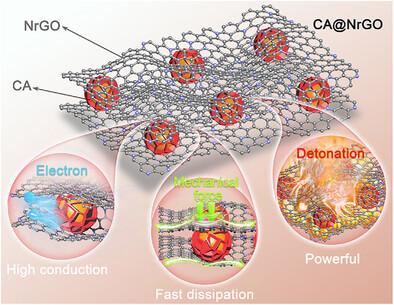
Developing an effective tailoring approach to overcome the intrinsic trade-off between detonation power and safety in energetic materials is crucial for micro-electromechanical detonation systems but remains challenging. Herein, the anchoring of the high-energy-density yet highly sensitive primary explosive copper azide (CA) onto an N-doped reduced graphene oxide (NrGO) shell (denoted as CA@NrGO) is reported via electronic interactions. This approach simultaneously achieves a three-fold enhancement in mechanical safety, a ≈36-fold improvement in electrostatic safety compared to pure CA, and high detonation capacity. Theoretical calculations reveal that the electronic interaction between NrGO and CA not only facilitate energy dissipation from mechanical forces acting on CA—via intralayer compression and slip, thereby enhancing mechanical safety—but also promote interfacial electron transfer from CA to NrGO, preventing charge accumulation in CA and improving electrostatic safety. Furthermore, the excellent detonation power of CA@NrGO is demonstrated in a micro-detonation device, where 6 mg of CA@NrGO reliably initiated 20 mg of the secondary explosive CL-20. This work highlights how manipulating electronic interactions between energetic materials and their supports contributes to the design of high-energy-density yet safe energetic materials for miniaturized detonation devices.
期刊介绍:
Small serves as an exceptional platform for both experimental and theoretical studies in fundamental and applied interdisciplinary research at the nano- and microscale. The journal offers a compelling mix of peer-reviewed Research Articles, Reviews, Perspectives, and Comments.
With a remarkable 2022 Journal Impact Factor of 13.3 (Journal Citation Reports from Clarivate Analytics, 2023), Small remains among the top multidisciplinary journals, covering a wide range of topics at the interface of materials science, chemistry, physics, engineering, medicine, and biology.
Small's readership includes biochemists, biologists, biomedical scientists, chemists, engineers, information technologists, materials scientists, physicists, and theoreticians alike.





 京公网安备 11010802042870号
京ICP备2023020795号-1
京公网安备 11010802042870号
京ICP备2023020795号-1

 分享
分享
 求助内容:
求助内容: 应助结果提醒方式:
 扫码关注我们
