S. Charis Caroline, Athulya Ravindran, Kaushik Ghosh, Sudip K Batabyal
{"title":"Growth of Succulent Shaped Fluorine Incorporated Ni─Co LDH (F-NiCo(OH)2): Elevating Supercapacitor Efficiency","authors":"S. Charis Caroline, Athulya Ravindran, Kaushik Ghosh, Sudip K Batabyal","doi":"10.1002/smll.202411641","DOIUrl":null,"url":null,"abstract":"<p>The unparalleled morphological tuning of layered double hydroxides (LDHs), specifically NiCo(OH)<sub>2</sub>, through fluorine doping, is systematically investigated. The unique morphological tuning is achieved by precisely modulating the fluorine dopant concentration using a straightforward solvothermal approach. Field Emission Scanning Electron Microscopy (FESEM) results show distinct succulent-like morphologies in the samples, influencing the surface area and electrochemical performance. Electrochemical studies of the fabricated asymmetric supercapacitor consisting of 2F-NiCo(OH)<sub>2</sub>|Activated Carbon(AC) electrodes exhibit very high charge storage capacity as high as 402 C g<sup>−1</sup>. Further, the X-ray photoelectron spectroscopy analysis confirms the incorporation and chemisorption of fluorine within the LDH layers, thereby corroborating its presence influencing the electronic environment and enhancing the electrochemical performance. The device shows an exceptionally high energy density, of 67 Wh kg<sup>−1</sup> with power density of 10.6 kW kg<sup>−1</sup> while retaining 95% specific capacity after 13 000 cycles at 10 mA cm<sup>−2</sup> current density. The practical applicability of the developed supercapacitor is demonstrated by successfully powering an LED and a calculator, underscoring its potential for real-world energy storage solutions.</p>","PeriodicalId":228,"journal":{"name":"Small","volume":"21 34","pages":""},"PeriodicalIF":12.1000,"publicationDate":"2025-03-19","publicationTypes":"Journal Article","fieldsOfStudy":null,"isOpenAccess":false,"openAccessPdf":"","citationCount":"0","resultStr":null,"platform":"Semanticscholar","paperid":null,"PeriodicalName":"Small","FirstCategoryId":"88","ListUrlMain":"https://onlinelibrary.wiley.com/doi/10.1002/smll.202411641","RegionNum":2,"RegionCategory":"材料科学","ArticlePicture":[],"TitleCN":null,"AbstractTextCN":null,"PMCID":null,"EPubDate":"","PubModel":"","JCR":"Q1","JCRName":"CHEMISTRY, MULTIDISCIPLINARY","Score":null,"Total":0}
引用次数: 0
Abstract
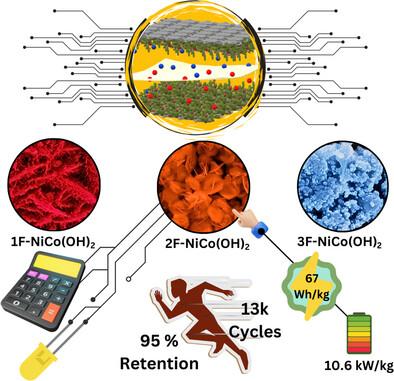
The unparalleled morphological tuning of layered double hydroxides (LDHs), specifically NiCo(OH)2, through fluorine doping, is systematically investigated. The unique morphological tuning is achieved by precisely modulating the fluorine dopant concentration using a straightforward solvothermal approach. Field Emission Scanning Electron Microscopy (FESEM) results show distinct succulent-like morphologies in the samples, influencing the surface area and electrochemical performance. Electrochemical studies of the fabricated asymmetric supercapacitor consisting of 2F-NiCo(OH)2|Activated Carbon(AC) electrodes exhibit very high charge storage capacity as high as 402 C g−1. Further, the X-ray photoelectron spectroscopy analysis confirms the incorporation and chemisorption of fluorine within the LDH layers, thereby corroborating its presence influencing the electronic environment and enhancing the electrochemical performance. The device shows an exceptionally high energy density, of 67 Wh kg−1 with power density of 10.6 kW kg−1 while retaining 95% specific capacity after 13 000 cycles at 10 mA cm−2 current density. The practical applicability of the developed supercapacitor is demonstrated by successfully powering an LED and a calculator, underscoring its potential for real-world energy storage solutions.
期刊介绍:
Small serves as an exceptional platform for both experimental and theoretical studies in fundamental and applied interdisciplinary research at the nano- and microscale. The journal offers a compelling mix of peer-reviewed Research Articles, Reviews, Perspectives, and Comments.
With a remarkable 2022 Journal Impact Factor of 13.3 (Journal Citation Reports from Clarivate Analytics, 2023), Small remains among the top multidisciplinary journals, covering a wide range of topics at the interface of materials science, chemistry, physics, engineering, medicine, and biology.
Small's readership includes biochemists, biologists, biomedical scientists, chemists, engineers, information technologists, materials scientists, physicists, and theoreticians alike.





 京公网安备 11010802042870号
京ICP备2023020795号-1
京公网安备 11010802042870号
京ICP备2023020795号-1

 分享
分享
 求助内容:
求助内容: 应助结果提醒方式:
 扫码关注我们
