Sohan Singh, Nisha Yadav, Suman Mahala, Jatin Yadav, Kamalakanta Behera, Gyandshwar Kumar Rao, Hemant Joshi and Kamal Nayan Sharma
{"title":"Metal complexes featuring organotellurium ligands: synthesis, coordination behavior, and applications†","authors":"Sohan Singh, Nisha Yadav, Suman Mahala, Jatin Yadav, Kamalakanta Behera, Gyandshwar Kumar Rao, Hemant Joshi and Kamal Nayan Sharma","doi":"10.1039/D4DT03502J","DOIUrl":null,"url":null,"abstract":"<p >Organotellurium ligand-facilitated metal structures are known for their catalytic activity, anti-cancer activities, and nanomaterial applications. A wide range of organotellurium ligands, including telluroethers, pincer-based frameworks, and tellurolates, have been extensively explored for their coordination with diverse metal centers. These ligands have been successfully complexed with base metals, platinum group metals, rare earth elements, and representative metals, providing a unified resource of literature on metal complexes of organotellurium ligands. The resulting metal–organotellurium complexes exhibit intriguing structural diversities and potential applications in catalysis, materials science, and coordination chemistry. A comprehensive review on various applications of organotellurium ligands has not been available since 2005. Moreover, within the broader field of chalcogen chemistry, organotellurium ligands remain relatively less explored. Hence, this review focuses on the synthetic strategies and various applications of metal complexes containing organotellurium ligands, addressing a significant and critical gap existing in the literature. This review provides a comprehensive analysis of organotellurium ligands, focusing on their synthesis, structural diversity, and coordination chemistry. Beyond their fundamental significance, these ligands play a vital role in life sciences, nanochemistry, and materials science. Their catalytic proficiency is evident in essential organic reactions, including the Suzuki–Miyaura and Mizoroki–Heck couplings, alcohol oxidation, C–N bond formation, aldehyde activation, and nitrophenol reduction.</p>","PeriodicalId":71,"journal":{"name":"Dalton Transactions","volume":" 20","pages":" 7970-8014"},"PeriodicalIF":3.3000,"publicationDate":"2025-03-19","publicationTypes":"Journal Article","fieldsOfStudy":null,"isOpenAccess":false,"openAccessPdf":"","citationCount":"0","resultStr":null,"platform":"Semanticscholar","paperid":null,"PeriodicalName":"Dalton Transactions","FirstCategoryId":"92","ListUrlMain":"https://pubs.rsc.org/en/content/articlelanding/2025/dt/d4dt03502j","RegionNum":3,"RegionCategory":"化学","ArticlePicture":[],"TitleCN":null,"AbstractTextCN":null,"PMCID":null,"EPubDate":"","PubModel":"","JCR":"Q2","JCRName":"CHEMISTRY, INORGANIC & NUCLEAR","Score":null,"Total":0}
引用次数: 0
Abstract
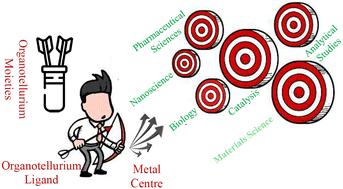
Organotellurium ligand-facilitated metal structures are known for their catalytic activity, anti-cancer activities, and nanomaterial applications. A wide range of organotellurium ligands, including telluroethers, pincer-based frameworks, and tellurolates, have been extensively explored for their coordination with diverse metal centers. These ligands have been successfully complexed with base metals, platinum group metals, rare earth elements, and representative metals, providing a unified resource of literature on metal complexes of organotellurium ligands. The resulting metal–organotellurium complexes exhibit intriguing structural diversities and potential applications in catalysis, materials science, and coordination chemistry. A comprehensive review on various applications of organotellurium ligands has not been available since 2005. Moreover, within the broader field of chalcogen chemistry, organotellurium ligands remain relatively less explored. Hence, this review focuses on the synthetic strategies and various applications of metal complexes containing organotellurium ligands, addressing a significant and critical gap existing in the literature. This review provides a comprehensive analysis of organotellurium ligands, focusing on their synthesis, structural diversity, and coordination chemistry. Beyond their fundamental significance, these ligands play a vital role in life sciences, nanochemistry, and materials science. Their catalytic proficiency is evident in essential organic reactions, including the Suzuki–Miyaura and Mizoroki–Heck couplings, alcohol oxidation, C–N bond formation, aldehyde activation, and nitrophenol reduction.
期刊介绍:
Dalton Transactions is a journal for all areas of inorganic chemistry, which encompasses the organometallic, bioinorganic and materials chemistry of the elements, with applications including synthesis, catalysis, energy conversion/storage, electrical devices and medicine. Dalton Transactions welcomes high-quality, original submissions in all of these areas and more, where the advancement of knowledge in inorganic chemistry is significant.



 京公网安备 11010802042870号
京ICP备2023020795号-1
京公网安备 11010802042870号
京ICP备2023020795号-1

 分享
分享
 求助内容:
求助内容: 应助结果提醒方式:
 扫码关注我们
