Abdelrazek Elnashar , Shahab Aldin Shojaeezadeh , Tobias Karl David Weber
{"title":"A Multi-model approach for remote sensing-based actual evapotranspiration mapping using Google Earth Engine (ETMapper-GEE)","authors":"Abdelrazek Elnashar , Shahab Aldin Shojaeezadeh , Tobias Karl David Weber","doi":"10.1016/j.jhydrol.2025.133062","DOIUrl":null,"url":null,"abstract":"<div><div>Accurate estimation of actual evapotranspiration (ET<sub>a</sub>) through remote sensing (RS) is essential for effective large-scale water management. We developed an EvapoTranspiration Mapper in the Google Earth Engine environment (ETMapper-GEE) to estimate RS-ET<sub>a</sub> using Landsat satellite data employing four models: Surface Energy Balance Algorithm for Land (SEBAL), Mapping EvapoTranspiration at high Resolution with Internalized Calibration (METRIC), surface temperature-vegetation-based triangle (TriAng), and Operational Simplified Surface Energy Balance (SSEBop). The estimation integrates extrapolation approaches (Evaporative Fraction (EF) and EvapoTranspiration Fraction (ETF)), reference ET types (grass (ET<sub>o</sub>) and alfalfa (ET<sub>r</sub>)), and climate forcing datasets (the fifth generation of the European ReAnalysis (ERA5-Land) and the Climate Forecast System version 2 (CFSv2)). The ETMapper was evaluated against observed data from flux towers in Germany for the period 2020 to 2022. The results showed that EF outperformed the ETF approach, with a more than an 8 % higher correlation of determination (R<sup>2</sup>) and 35 % lower Root Mean Square Error (RMSE) compared to the other approaches. Among the EF approaches, TriAng (RMSE = 1.38 mm d<sup>-1</sup>) exhibited the best performance, followed by METRIC (1.69 mm d<sup>-1</sup>) and SEBAL (2.07 mm d<sup>-1</sup>). Using ETMapper with ET<sub>o</sub> resulted in at least 4 % higher R<sup>2</sup> and reduction in RMSE by at least 29 % compared to ET<sub>r</sub>. Forcing ETMapper with ERA5 yielded better accuracy (R<sup>2</sup> > 4 %, RMSE < 12 %) than when using CFSv2. This study provides an integrated framework for RS-ET<sub>a</sub> estimation, supporting water-related Sustainable Development Goals, especially in agricultural contexts.</div></div>","PeriodicalId":362,"journal":{"name":"Journal of Hydrology","volume":"657 ","pages":"Article 133062"},"PeriodicalIF":6.3000,"publicationDate":"2025-08-01","publicationTypes":"Journal Article","fieldsOfStudy":null,"isOpenAccess":false,"openAccessPdf":"","citationCount":"0","resultStr":null,"platform":"Semanticscholar","paperid":null,"PeriodicalName":"Journal of Hydrology","FirstCategoryId":"89","ListUrlMain":"https://www.sciencedirect.com/science/article/pii/S0022169425004007","RegionNum":1,"RegionCategory":"地球科学","ArticlePicture":[],"TitleCN":null,"AbstractTextCN":null,"PMCID":null,"EPubDate":"2025/3/13 0:00:00","PubModel":"Epub","JCR":"Q1","JCRName":"ENGINEERING, CIVIL","Score":null,"Total":0}
引用次数: 0
Abstract
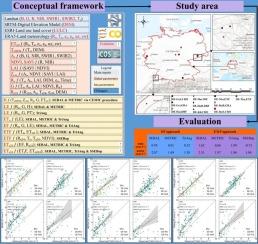
Accurate estimation of actual evapotranspiration (ETa) through remote sensing (RS) is essential for effective large-scale water management. We developed an EvapoTranspiration Mapper in the Google Earth Engine environment (ETMapper-GEE) to estimate RS-ETa using Landsat satellite data employing four models: Surface Energy Balance Algorithm for Land (SEBAL), Mapping EvapoTranspiration at high Resolution with Internalized Calibration (METRIC), surface temperature-vegetation-based triangle (TriAng), and Operational Simplified Surface Energy Balance (SSEBop). The estimation integrates extrapolation approaches (Evaporative Fraction (EF) and EvapoTranspiration Fraction (ETF)), reference ET types (grass (ETo) and alfalfa (ETr)), and climate forcing datasets (the fifth generation of the European ReAnalysis (ERA5-Land) and the Climate Forecast System version 2 (CFSv2)). The ETMapper was evaluated against observed data from flux towers in Germany for the period 2020 to 2022. The results showed that EF outperformed the ETF approach, with a more than an 8 % higher correlation of determination (R2) and 35 % lower Root Mean Square Error (RMSE) compared to the other approaches. Among the EF approaches, TriAng (RMSE = 1.38 mm d-1) exhibited the best performance, followed by METRIC (1.69 mm d-1) and SEBAL (2.07 mm d-1). Using ETMapper with ETo resulted in at least 4 % higher R2 and reduction in RMSE by at least 29 % compared to ETr. Forcing ETMapper with ERA5 yielded better accuracy (R2 > 4 %, RMSE < 12 %) than when using CFSv2. This study provides an integrated framework for RS-ETa estimation, supporting water-related Sustainable Development Goals, especially in agricultural contexts.
期刊介绍:
The Journal of Hydrology publishes original research papers and comprehensive reviews in all the subfields of the hydrological sciences including water based management and policy issues that impact on economics and society. These comprise, but are not limited to the physical, chemical, biogeochemical, stochastic and systems aspects of surface and groundwater hydrology, hydrometeorology and hydrogeology. Relevant topics incorporating the insights and methodologies of disciplines such as climatology, water resource systems, hydraulics, agrohydrology, geomorphology, soil science, instrumentation and remote sensing, civil and environmental engineering are included. Social science perspectives on hydrological problems such as resource and ecological economics, environmental sociology, psychology and behavioural science, management and policy analysis are also invited. Multi-and interdisciplinary analyses of hydrological problems are within scope. The science published in the Journal of Hydrology is relevant to catchment scales rather than exclusively to a local scale or site.




 京公网安备 11010802042870号
京ICP备2023020795号-1
京公网安备 11010802042870号
京ICP备2023020795号-1

 分享
分享
 求助内容:
求助内容: 应助结果提醒方式:
 扫码关注我们
