Shuai Jiang , Mengyang Hu , Shaofan Duan , Kecheng Guan , Pengfei Zhang , Haifeng Shi , Xiaokun Liu , Hideto Matsuyama
{"title":"High-performance organic solvent nanofiltration membrane enabled by polar cross-linked sulfonated polyaniline separation layer","authors":"Shuai Jiang , Mengyang Hu , Shaofan Duan , Kecheng Guan , Pengfei Zhang , Haifeng Shi , Xiaokun Liu , Hideto Matsuyama","doi":"10.1016/j.desal.2025.118819","DOIUrl":null,"url":null,"abstract":"<div><div>Achieving high-efficiency treatment with organic solvents is essential for the fine chemicals and pharmaceutical industries. Organic solvent nanofiltration (OSN) membrane technology is highly anticipated due to its low cost, low energy consumption, and high effectiveness. Polyamide (PA) membranes prepared by interfacial polymerization (IP) are commonly used as separation layer materials with high selectivity and chemical stability. However, their inherently dense structure seriously weakens their separation efficiency. In this study, cross-linked sulfonated polyaniline (SPANI) was designed and synthesized according to the characteristics of the OSN separation process. A composite membrane with SPANI as the separation layer was prepared on a polyimide (PI) ultrafiltration (UF) membrane using the simple spin-coating method. Due to the loose internal structure and high polarity of the SPANI separation layer, the prepared PI-SPANI-0.05 membrane displays high methanol permeance at 5.6 L m<sup>−2</sup> h<sup>−1</sup> bar<sup>−1</sup> which is 8 times of PA membrane (0.7 L m<sup>−2</sup> h<sup>−1</sup> bar<sup>−1</sup>), and it also maintains satisfactory dye rejection towards methyl orange (Mw = 327 g mol<sup>−1</sup>) at 95.6 % and complete rejection towards rose bengal (Mw = 1018 g mol<sup>−1</sup>). In addition, even when operated under a strong corrosive <em>N</em>, <em>N</em>-dimethylformamide environment, the PI-SPANI membrane still exhibits stable permeance and ultra-high dye rejection for 960 h. According to our knowledge, this is the first report of SPANI utilized as the separation layer in the OSN membrane. It offers a new alternative to PA layer, possessing the potential for enhanced efficiency in organic solvent treatment and demonstrating promising prospects for practical application.</div></div>","PeriodicalId":299,"journal":{"name":"Desalination","volume":"607 ","pages":"Article 118819"},"PeriodicalIF":9.8000,"publicationDate":"2025-07-15","publicationTypes":"Journal Article","fieldsOfStudy":null,"isOpenAccess":false,"openAccessPdf":"","citationCount":"0","resultStr":null,"platform":"Semanticscholar","paperid":null,"PeriodicalName":"Desalination","FirstCategoryId":"5","ListUrlMain":"https://www.sciencedirect.com/science/article/pii/S0011916425002942","RegionNum":1,"RegionCategory":"工程技术","ArticlePicture":[],"TitleCN":null,"AbstractTextCN":null,"PMCID":null,"EPubDate":"2025/3/17 0:00:00","PubModel":"Epub","JCR":"Q1","JCRName":"ENGINEERING, CHEMICAL","Score":null,"Total":0}
引用次数: 0
Abstract
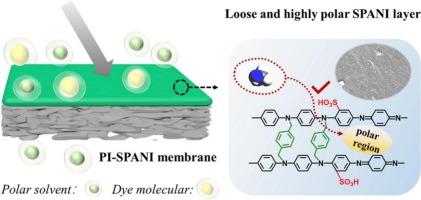
Achieving high-efficiency treatment with organic solvents is essential for the fine chemicals and pharmaceutical industries. Organic solvent nanofiltration (OSN) membrane technology is highly anticipated due to its low cost, low energy consumption, and high effectiveness. Polyamide (PA) membranes prepared by interfacial polymerization (IP) are commonly used as separation layer materials with high selectivity and chemical stability. However, their inherently dense structure seriously weakens their separation efficiency. In this study, cross-linked sulfonated polyaniline (SPANI) was designed and synthesized according to the characteristics of the OSN separation process. A composite membrane with SPANI as the separation layer was prepared on a polyimide (PI) ultrafiltration (UF) membrane using the simple spin-coating method. Due to the loose internal structure and high polarity of the SPANI separation layer, the prepared PI-SPANI-0.05 membrane displays high methanol permeance at 5.6 L m−2 h−1 bar−1 which is 8 times of PA membrane (0.7 L m−2 h−1 bar−1), and it also maintains satisfactory dye rejection towards methyl orange (Mw = 327 g mol−1) at 95.6 % and complete rejection towards rose bengal (Mw = 1018 g mol−1). In addition, even when operated under a strong corrosive N, N-dimethylformamide environment, the PI-SPANI membrane still exhibits stable permeance and ultra-high dye rejection for 960 h. According to our knowledge, this is the first report of SPANI utilized as the separation layer in the OSN membrane. It offers a new alternative to PA layer, possessing the potential for enhanced efficiency in organic solvent treatment and demonstrating promising prospects for practical application.
实现有机溶剂的高效处理对精细化工和制药工业至关重要。有机溶剂纳滤(OSN)膜技术因其低成本、低能耗、高效等优点而备受期待。界面聚合法制备的聚酰胺(PA)膜具有高选择性和化学稳定性,是常用的分离层材料。然而,它们固有的致密结构严重削弱了它们的分离效率。本研究根据OSN分离工艺的特点,设计合成了交联磺化聚苯胺(SPANI)。在聚酰亚胺(PI)超滤(UF)膜上采用简单旋涂法制备了以氨纶为分离层的复合膜。由于SPANI分离层内部结构松散,极性较高,所制备的PI-SPANI-0.05膜具有较高的甲醇渗透率(5.6 L m−2 h−1 bar−1),是PA膜(0.7 L m−2 h−1 bar−1)的8倍,对甲基橙(Mw = 327 g mol−1)的截留率为95.6%,对粉红红(Mw = 1018 g mol−1)的截留率较高。此外,即使在强腐蚀性的N, N-二甲基甲酰胺环境下操作,PI-SPANI膜在960 h内仍然具有稳定的渗透性和超高阻染性。据我们所知,这是首次报道将SPANI用作OSN膜的分离层。它为PA层提供了一种新的替代方案,具有提高有机溶剂处理效率的潜力,具有良好的实际应用前景。
期刊介绍:
Desalination is a scholarly journal that focuses on the field of desalination materials, processes, and associated technologies. It encompasses a wide range of disciplines and aims to publish exceptional papers in this area.
The journal invites submissions that explicitly revolve around water desalting and its applications to various sources such as seawater, groundwater, and wastewater. It particularly encourages research on diverse desalination methods including thermal, membrane, sorption, and hybrid processes.
By providing a platform for innovative studies, Desalination aims to advance the understanding and development of desalination technologies, promoting sustainable solutions for water scarcity challenges.




 京公网安备 11010802042870号
京ICP备2023020795号-1
京公网安备 11010802042870号
京ICP备2023020795号-1

 分享
分享
 求助内容:
求助内容: 应助结果提醒方式:
 扫码关注我们
