Jianhao Wang, Huan Liu, Hong Li, Fan Wang, Songguang Yang, Lin Yue, Shuangrong Liu, Baohui Liu, Mingkun Huang, Fanjiang Kong, Zhihui Sun
{"title":"The LUX–SWI3C module regulates photoperiod sensitivity in Arabidopsis thaliana","authors":"Jianhao Wang, Huan Liu, Hong Li, Fan Wang, Songguang Yang, Lin Yue, Shuangrong Liu, Baohui Liu, Mingkun Huang, Fanjiang Kong, Zhihui Sun","doi":"10.1111/jipb.13889","DOIUrl":null,"url":null,"abstract":"<div>\n \n <p>In plants, the photoperiod sensitivity directly influences flowering time, which in turn affects latitudinal adaptation and yield. However, research into the mechanisms underlying photoperiod sensitivity, particularly those mediated by epigenetic regulation, is still in its nascent stages. In this study, we analyzed the regulation of photoperiod sensitivity in <i>Arabidopsis thaliana</i>. We demonstrate that the evening complex LUX ARRYTHMO (LUX) and the chromatin remodeling factor SWITCH/SUCROSE NONFERMENTING 3C (SWI3C) regulate <i>GI</i> locus chromatin compaction and H3K4me3 modification levels at the <i>GIGANTEA</i> locus under different photoperiod conditions. This mechanism is one of the key factors that allow plants to distinguish between long-day and short-day photoperiods. Our study provides insight into how the LUX–SWI3C module regulates photoperiod sensitivity at the epigenetic level.</p></div>","PeriodicalId":195,"journal":{"name":"Journal of Integrative Plant Biology","volume":"67 6","pages":"1551-1567"},"PeriodicalIF":9.3000,"publicationDate":"2025-03-19","publicationTypes":"Journal Article","fieldsOfStudy":null,"isOpenAccess":false,"openAccessPdf":"","citationCount":"0","resultStr":null,"platform":"Semanticscholar","paperid":null,"PeriodicalName":"Journal of Integrative Plant Biology","FirstCategoryId":"99","ListUrlMain":"https://onlinelibrary.wiley.com/doi/10.1111/jipb.13889","RegionNum":1,"RegionCategory":"生物学","ArticlePicture":[],"TitleCN":null,"AbstractTextCN":null,"PMCID":null,"EPubDate":"","PubModel":"","JCR":"Q1","JCRName":"BIOCHEMISTRY & MOLECULAR BIOLOGY","Score":null,"Total":0}
引用次数: 0
Abstract
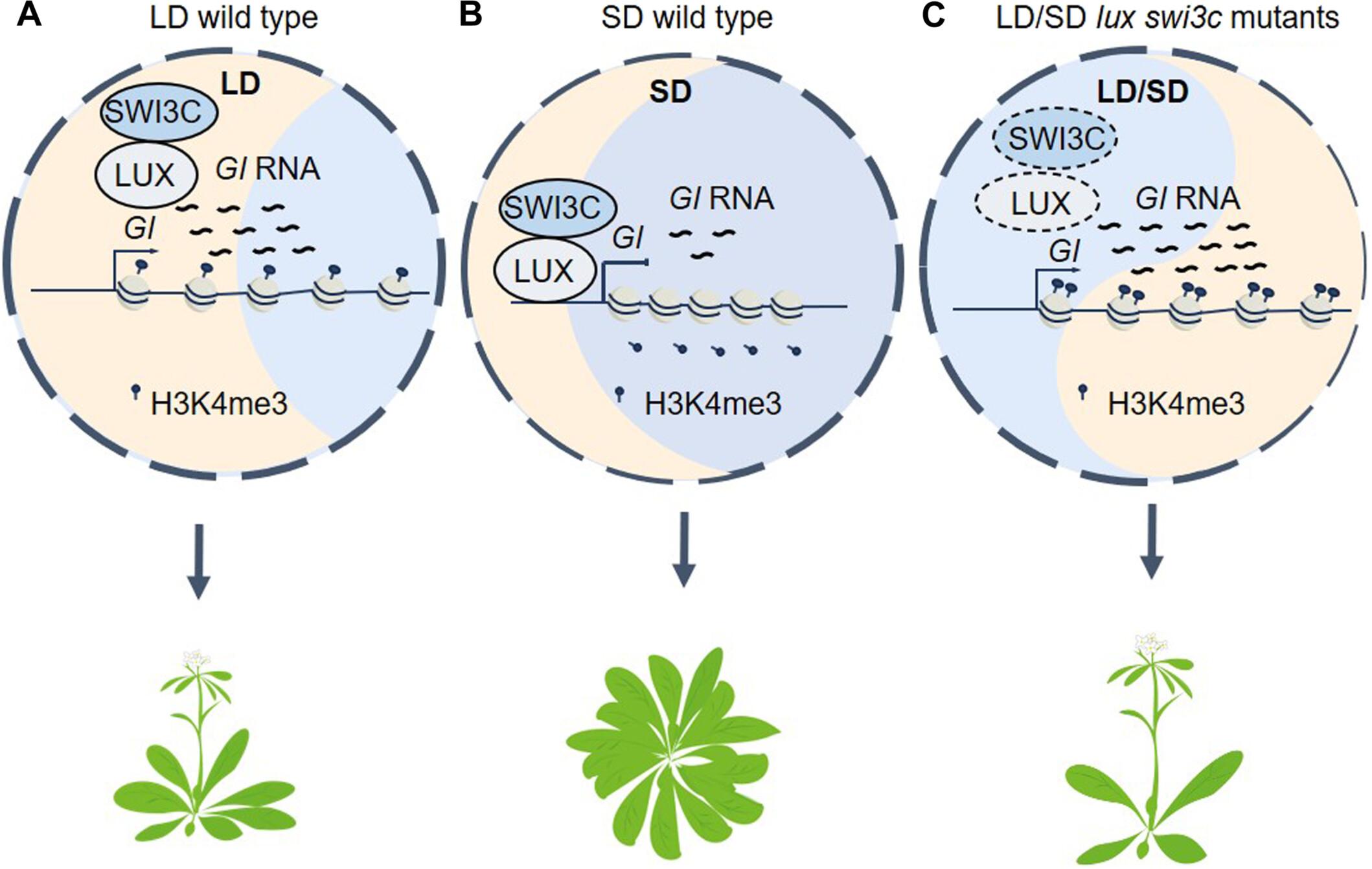
In plants, the photoperiod sensitivity directly influences flowering time, which in turn affects latitudinal adaptation and yield. However, research into the mechanisms underlying photoperiod sensitivity, particularly those mediated by epigenetic regulation, is still in its nascent stages. In this study, we analyzed the regulation of photoperiod sensitivity in Arabidopsis thaliana. We demonstrate that the evening complex LUX ARRYTHMO (LUX) and the chromatin remodeling factor SWITCH/SUCROSE NONFERMENTING 3C (SWI3C) regulate GI locus chromatin compaction and H3K4me3 modification levels at the GIGANTEA locus under different photoperiod conditions. This mechanism is one of the key factors that allow plants to distinguish between long-day and short-day photoperiods. Our study provides insight into how the LUX–SWI3C module regulates photoperiod sensitivity at the epigenetic level.
期刊介绍:
Journal of Integrative Plant Biology is a leading academic journal reporting on the latest discoveries in plant biology.Enjoy the latest news and developments in the field, understand new and improved methods and research tools, and explore basic biological questions through reproducible experimental design, using genetic, biochemical, cell and molecular biological methods, and statistical analyses.




 京公网安备 11010802042870号
京ICP备2023020795号-1
京公网安备 11010802042870号
京ICP备2023020795号-1

 分享
分享
 求助内容:
求助内容: 应助结果提醒方式:
 扫码关注我们
