{"title":"Wildfires and Respiratory Allergy","authors":"Gennaro D'Amato, Ioana Agache, Kari Nadeau, Vanitha Sampath, Cezmi Akdis, Isabella Annesi-Maesano","doi":"10.1111/all.16527","DOIUrl":null,"url":null,"abstract":"<p>The Los Angeles wildfire is a critical reminder of the respiratory effects of wildfire smoke exposure.</p><p>Bush, vegetation, forest, and grass fires are widely prevalent around the world, and their incidence and severity are increasing. Their cause may be deliberate or accidental in relation to global warming. Wildfires are strongly associated with the incidence of drought and heat waves, whose occurrence and intensity are accelerated by climate change [<span>1-5</span>]. In Europe, there are on average 70,000 forest fires annually, especially common in countries with warmer climates such as Portugal, Italy, Greece, and France [<span>1</span>].</p><p>Wildland fires release a complex mix of air pollutants in large quantities, often in an intense and uncontrolled manner. During the last wildfires near Los Angeles in December 2024 and January 2025, Air Quality Index (AQI) levels soared to 400, and in some cases exceeded 500. A “normal” or “good” AQI value typically falls within the 0–50 range, indicating minimal to no health risks for the general population. For comparison, a typical day in the region sees AQI levels around 50 or 60. An AQI higher than 301+ is considered hazardous because it is related to serious health effects; in this case, the entire population is at risk. An AQI of 400 is roughly equivalent to smoking a pack of cigarettes per day, highlighting the severe health risks posed by wildfire smoke.</p><p>Wildfires emit greenhouse gases (GHG) (carbon dioxide [CO<sub>2</sub>], methane [CH<sub>4</sub>], nitrous oxide [N<sub>2</sub>O]), photochemically reactive compounds (e.g., carbon monoxide [CO], nonmethane volatile organic carbon [NMVOC], nitrogen oxides [NOx]), and ultrafine, fine, and coarse particulate matter (PM). The air quality is further impacted by the production of secondary pollutants such as ozone (O<sub>3</sub>) or secondary organic aerosols when NMVOC and NOx released by fires undergo photochemical processing [<span>3</span>]. Photochemical processing refers to a series of chemical reactions driven by solar radiation, which lead to the transformation of primary pollutants into more complex and hazardous secondary compounds in the atmosphere. To these, air pollutants other substances from coolant fluid, furniture, construction material, cleaning products, fiberglass, plastics, tires, and gasoline from that burn during the fire. Some of these contaminants contain metals such as lead, arsenic, and asbestos. The amount and composition of fire emissions depend on a wide range of variables related to fuel characteristics (type, structure, loading, chemistry, and moisture) and fire behavior [<span>3</span>]. Wildfires pollutant mix can travel long distances and impact human health. In the spring and summer of 2023, Canada experienced an unprecedented number and intensity of wildfires, particularly in Quebec and other eastern provinces. Prevailing weather patterns carried the smoke plumes southward and eastward, affecting large portions of the eastern United States. Cities like New York City, Philadelphia, and Washington D.C. experienced significant air quality degradation and a consequent increase in hospitalizations and emergency room visits. It can also cause habitat destruction, loss of biodiversity, and disruptions to ecosystems, threatening wildlife survival and altering food chains.</p><p>Despite growing evidence of the health impacts of wildfires, significant research gaps remain in understanding the full extent of their effects, including long-term consequences, interactions with preexisting health conditions, and the influence of repeated exposures.</p><p>Experimental studies have shown that air pollutants driven from wildfires damage the epithelial barriers, trigger the innate and adaptive inflammatory responses, induce oxidative stress, genotoxicity and epigenetic changes, apoptosis and autophagy [<span>4-9</span>] (Figure 1). In essence, the complex nature of wildfire smoke, combined with individual susceptibility, can lead to a mixed inflammatory response, highlighting the need for further research in this area. PM can lead to the release of pro-inflammatory mediators that attract neutrophils, resulting in neutrophilic inflammation. PM can also act as an adjuvant, which means it enhances the response to other inhaled allergens through eosinophilic inflammation. Fire combustion byproducts have been shown to act as adjuvants, enhancing the immune response to allergens and increasing allergic sensitization. In patients with asthma, sputum eosinophils might increase. High-intensity exposure to wildfire smoke can also alter host immune system function in general. Among others, this makes individuals more prone to prolonged allergic reactions. These translate into airway hyperreactivity and neutrophilic and eosinophilic inflammation in the airways [<span>5</span>]. Finally, recurrent exposure to wildfire pollutants has been linked to heightened allergic responses, potentially leading to worsening asthma over time, as well as persistent airway remodeling.</p><p>At the population level, wildfire effects have been evaluated through several exposure assessment methods [<span>1</span>] including self-reported questionnaires, routine data (number of wildfires), air quality monitoring stations, and satellite data with visibility or aerosol optical depth (AOD), etc. Aside from obvious burns and physical trauma caused by wildfires, experts warn that smoke, ash, and debris released by the fires can pose short- and long-term health risks in terms of respiratory and cardiovascular effects, neurological impacts as well as induce disruption to healthcare. Respiratory issues include respiratory symptoms like cough, phlegm, wheeze, and dyspnea, as well as asthma and chronic obstructive pulmonary disease (COPD) exacerbations, increased risk of respiratory infections, including pneumonia and reduced lung function [<span>1, 3</span>]. Delayed health effects have been rarely investigated. One study looking at health effects after the 2003 Canadian wildfires showed that there was a peak in respiratory consultations 5 weeks after the fires. This may be because of delayed respiratory health effects of wildfire smoke [<span>1, 3</span>]. Emergency Department (ED) visits for all respiratory and cardiopulmonary diagnoses were increased in the exposed counties [<span>1, 4</span>]. Interestingly, PM from wildfires appears to have different effects on health compared to urban PM [<span>4, 5</span>]. An 8-year study [<span>4, 5</span>] investigating air pollution levels, including those from bushfires, and hospital admissions showed that a 10 μg/m<sup>3</sup> increase in bushfire (but not urban) PM<sub>10</sub> was associated with a 1.24% increase in all respiratory admissions, a 3.80% increase in COPD admissions, and a 5.02% increase in adult asthma admissions.</p><p>In individuals with preexisting allergic and respiratory conditions such as allergic rhinitis and asthma, wildfires may contribute to increased allergen exposure. Wildfire smoke can carry pollen, mold spores, and other aeroallergens over long distances, exacerbating allergic responses [<span>1, 3, 8</span>]. Fire disturbances can also lead to the release of fungal spores from burned vegetation, increasing the burden of airborne allergens. These phenomena lead to increased allergic and asthma morbidity.</p><p>What can be done to mitigate the potential health <i>sequelae</i> of exposure to wildfire smoke? When there is a threat of wildfires due to extreme climatic conditions or an outbreak has occurred unexpectedly, there are a number of measures that can be taken by health authorities to reduce the impact of the fire upon healthy people, asthmatics, or COPD patients [<span>1, 3-6</span>]. These include simple public health advice on avoiding exposure and encouraging sheltering. Wearing N95 masks, evacuating air, using air filters and purifiers, and reducing GHGs are all part of adapting to and mitigating wildfires and their effects on health [<span>9</span>].</p><p>With the current global increase in wildfires and in the destruction of forests by deliberate burning, all health-care workers, particularly general practitioners, respiratory, and emergency physicians, need to understand more about the associated health risks and the requirements for prevention and early recognition of effects, and treatment, and a careful identification and follow-up of those exposed could help in the management process.</p><p>To conclude, wildfires pose a significant threat to respiratory health, particularly for individuals with allergic airway diseases. The interplay between airborne pollutants, allergens, and immune responses highlights the need for proactive management and policy interventions to mitigate health risks in vulnerable populations [<span>1, 3</span>].</p><p>The authors declare no conflicts of interest.</p>","PeriodicalId":122,"journal":{"name":"Allergy","volume":"80 6","pages":"1569-1571"},"PeriodicalIF":12.0000,"publicationDate":"2025-03-19","publicationTypes":"Journal Article","fieldsOfStudy":null,"isOpenAccess":false,"openAccessPdf":"https://onlinelibrary.wiley.com/doi/epdf/10.1111/all.16527","citationCount":"0","resultStr":null,"platform":"Semanticscholar","paperid":null,"PeriodicalName":"Allergy","FirstCategoryId":"3","ListUrlMain":"https://onlinelibrary.wiley.com/doi/10.1111/all.16527","RegionNum":1,"RegionCategory":"医学","ArticlePicture":[],"TitleCN":null,"AbstractTextCN":null,"PMCID":null,"EPubDate":"","PubModel":"","JCR":"Q1","JCRName":"ALLERGY","Score":null,"Total":0}
引用次数: 0
Abstract
The Los Angeles wildfire is a critical reminder of the respiratory effects of wildfire smoke exposure.
Bush, vegetation, forest, and grass fires are widely prevalent around the world, and their incidence and severity are increasing. Their cause may be deliberate or accidental in relation to global warming. Wildfires are strongly associated with the incidence of drought and heat waves, whose occurrence and intensity are accelerated by climate change [1-5]. In Europe, there are on average 70,000 forest fires annually, especially common in countries with warmer climates such as Portugal, Italy, Greece, and France [1].
Wildland fires release a complex mix of air pollutants in large quantities, often in an intense and uncontrolled manner. During the last wildfires near Los Angeles in December 2024 and January 2025, Air Quality Index (AQI) levels soared to 400, and in some cases exceeded 500. A “normal” or “good” AQI value typically falls within the 0–50 range, indicating minimal to no health risks for the general population. For comparison, a typical day in the region sees AQI levels around 50 or 60. An AQI higher than 301+ is considered hazardous because it is related to serious health effects; in this case, the entire population is at risk. An AQI of 400 is roughly equivalent to smoking a pack of cigarettes per day, highlighting the severe health risks posed by wildfire smoke.
Wildfires emit greenhouse gases (GHG) (carbon dioxide [CO2], methane [CH4], nitrous oxide [N2O]), photochemically reactive compounds (e.g., carbon monoxide [CO], nonmethane volatile organic carbon [NMVOC], nitrogen oxides [NOx]), and ultrafine, fine, and coarse particulate matter (PM). The air quality is further impacted by the production of secondary pollutants such as ozone (O3) or secondary organic aerosols when NMVOC and NOx released by fires undergo photochemical processing [3]. Photochemical processing refers to a series of chemical reactions driven by solar radiation, which lead to the transformation of primary pollutants into more complex and hazardous secondary compounds in the atmosphere. To these, air pollutants other substances from coolant fluid, furniture, construction material, cleaning products, fiberglass, plastics, tires, and gasoline from that burn during the fire. Some of these contaminants contain metals such as lead, arsenic, and asbestos. The amount and composition of fire emissions depend on a wide range of variables related to fuel characteristics (type, structure, loading, chemistry, and moisture) and fire behavior [3]. Wildfires pollutant mix can travel long distances and impact human health. In the spring and summer of 2023, Canada experienced an unprecedented number and intensity of wildfires, particularly in Quebec and other eastern provinces. Prevailing weather patterns carried the smoke plumes southward and eastward, affecting large portions of the eastern United States. Cities like New York City, Philadelphia, and Washington D.C. experienced significant air quality degradation and a consequent increase in hospitalizations and emergency room visits. It can also cause habitat destruction, loss of biodiversity, and disruptions to ecosystems, threatening wildlife survival and altering food chains.
Despite growing evidence of the health impacts of wildfires, significant research gaps remain in understanding the full extent of their effects, including long-term consequences, interactions with preexisting health conditions, and the influence of repeated exposures.
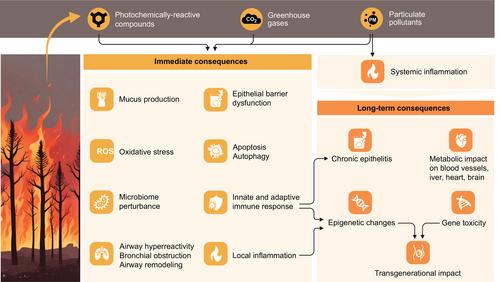
Experimental studies have shown that air pollutants driven from wildfires damage the epithelial barriers, trigger the innate and adaptive inflammatory responses, induce oxidative stress, genotoxicity and epigenetic changes, apoptosis and autophagy [4-9] (Figure 1). In essence, the complex nature of wildfire smoke, combined with individual susceptibility, can lead to a mixed inflammatory response, highlighting the need for further research in this area. PM can lead to the release of pro-inflammatory mediators that attract neutrophils, resulting in neutrophilic inflammation. PM can also act as an adjuvant, which means it enhances the response to other inhaled allergens through eosinophilic inflammation. Fire combustion byproducts have been shown to act as adjuvants, enhancing the immune response to allergens and increasing allergic sensitization. In patients with asthma, sputum eosinophils might increase. High-intensity exposure to wildfire smoke can also alter host immune system function in general. Among others, this makes individuals more prone to prolonged allergic reactions. These translate into airway hyperreactivity and neutrophilic and eosinophilic inflammation in the airways [5]. Finally, recurrent exposure to wildfire pollutants has been linked to heightened allergic responses, potentially leading to worsening asthma over time, as well as persistent airway remodeling.
At the population level, wildfire effects have been evaluated through several exposure assessment methods [1] including self-reported questionnaires, routine data (number of wildfires), air quality monitoring stations, and satellite data with visibility or aerosol optical depth (AOD), etc. Aside from obvious burns and physical trauma caused by wildfires, experts warn that smoke, ash, and debris released by the fires can pose short- and long-term health risks in terms of respiratory and cardiovascular effects, neurological impacts as well as induce disruption to healthcare. Respiratory issues include respiratory symptoms like cough, phlegm, wheeze, and dyspnea, as well as asthma and chronic obstructive pulmonary disease (COPD) exacerbations, increased risk of respiratory infections, including pneumonia and reduced lung function [1, 3]. Delayed health effects have been rarely investigated. One study looking at health effects after the 2003 Canadian wildfires showed that there was a peak in respiratory consultations 5 weeks after the fires. This may be because of delayed respiratory health effects of wildfire smoke [1, 3]. Emergency Department (ED) visits for all respiratory and cardiopulmonary diagnoses were increased in the exposed counties [1, 4]. Interestingly, PM from wildfires appears to have different effects on health compared to urban PM [4, 5]. An 8-year study [4, 5] investigating air pollution levels, including those from bushfires, and hospital admissions showed that a 10 μg/m3 increase in bushfire (but not urban) PM10 was associated with a 1.24% increase in all respiratory admissions, a 3.80% increase in COPD admissions, and a 5.02% increase in adult asthma admissions.
In individuals with preexisting allergic and respiratory conditions such as allergic rhinitis and asthma, wildfires may contribute to increased allergen exposure. Wildfire smoke can carry pollen, mold spores, and other aeroallergens over long distances, exacerbating allergic responses [1, 3, 8]. Fire disturbances can also lead to the release of fungal spores from burned vegetation, increasing the burden of airborne allergens. These phenomena lead to increased allergic and asthma morbidity.
What can be done to mitigate the potential health sequelae of exposure to wildfire smoke? When there is a threat of wildfires due to extreme climatic conditions or an outbreak has occurred unexpectedly, there are a number of measures that can be taken by health authorities to reduce the impact of the fire upon healthy people, asthmatics, or COPD patients [1, 3-6]. These include simple public health advice on avoiding exposure and encouraging sheltering. Wearing N95 masks, evacuating air, using air filters and purifiers, and reducing GHGs are all part of adapting to and mitigating wildfires and their effects on health [9].
With the current global increase in wildfires and in the destruction of forests by deliberate burning, all health-care workers, particularly general practitioners, respiratory, and emergency physicians, need to understand more about the associated health risks and the requirements for prevention and early recognition of effects, and treatment, and a careful identification and follow-up of those exposed could help in the management process.
To conclude, wildfires pose a significant threat to respiratory health, particularly for individuals with allergic airway diseases. The interplay between airborne pollutants, allergens, and immune responses highlights the need for proactive management and policy interventions to mitigate health risks in vulnerable populations [1, 3].
期刊介绍:
Allergy is an international and multidisciplinary journal that aims to advance, impact, and communicate all aspects of the discipline of Allergy/Immunology. It publishes original articles, reviews, position papers, guidelines, editorials, news and commentaries, letters to the editors, and correspondences. The journal accepts articles based on their scientific merit and quality.
Allergy seeks to maintain contact between basic and clinical Allergy/Immunology and encourages contributions from contributors and readers from all countries. In addition to its publication, Allergy also provides abstracting and indexing information. Some of the databases that include Allergy abstracts are Abstracts on Hygiene & Communicable Disease, Academic Search Alumni Edition, AgBiotech News & Information, AGRICOLA Database, Biological Abstracts, PubMed Dietary Supplement Subset, and Global Health, among others.



 京公网安备 11010802042870号
京ICP备2023020795号-1
京公网安备 11010802042870号
京ICP备2023020795号-1

 分享
分享
 求助内容:
求助内容: 应助结果提醒方式:
 扫码关注我们
