{"title":"Gait spatio-temporal characteristics during obstacle crossing as predictors of fall risk in stroke patients.","authors":"Zihao Zhu, Feng Xu, Qiujie Li, Xianglin Wan","doi":"10.1186/s12883-025-04131-6","DOIUrl":null,"url":null,"abstract":"<p><strong>Background: </strong>Spatio-temporal parameters provide reference information for the gait variations of stroke patients during obstacle crossing. Analyzing these gait spatio-temporal characteristics of patients during obstacle crossing can assist in assessing the risk of falls. The aim of this study was to analyze the variances in gait spatio-temporal characteristics during obstacle crossing between stroke patients with and without a history of falls, to explore spatio-temporal parameters for assessing fall risk, and to construct a regression model for predicting patients' fall risk.</p><p><strong>Methods: </strong>Thirty-three patients with unilateral brain injury from stroke who were discharged from rehabilitation were included. These patients were categorized into a falls group (with a history of falls) and a non-falls group (without a history of falls) based on whether they had experienced a fall in the previous six months. A Qualisys motion capture system was used to record the marker positions when crossing an obstacle 4 cm in height with the affected leg as the leading limb, and gait spatio-temporal parameters were calculated and obtained. Univariate analysis and logistic regression models were used to compare the gait spatio-temporal parameters of the two groups.</p><p><strong>Results: </strong>17 participants were categorised into the falls group and 16 into the non-falls group. The single support phase of leading limb, post-obstacle swing phase of trailing limb, obstacle-heel distance of leading limb, and obstacle-heel distance of trailing limb were significantly smaller in the fall group compared to the non-fall group (P < 0.05). The gait spatio-temporal parameter ultimately included in the fall risk prediction model was the obstacle-heel distance of leading limb (OR = 0.819, 95%CI = 0.688-0.973, P = 0.023). The overall correct classification rate from this model was 69.7%, and the area under the curve (AUC) was 0.750 (P = 0.014).</p><p><strong>Conclusion: </strong>Abnormalities in gait spatio-temporal parameters during obstacle crossing in stroke patients can contribute to an increased risk of falls. The fall risk prediction model developed in this study demonstrated excellent predictive performance, indicating its potential utility in clinical settings.</p>","PeriodicalId":9170,"journal":{"name":"BMC Neurology","volume":"25 1","pages":"111"},"PeriodicalIF":2.2000,"publicationDate":"2025-03-18","publicationTypes":"Journal Article","fieldsOfStudy":null,"isOpenAccess":false,"openAccessPdf":"https://www.ncbi.nlm.nih.gov/pmc/articles/PMC11916317/pdf/","citationCount":"0","resultStr":null,"platform":"Semanticscholar","paperid":null,"PeriodicalName":"BMC Neurology","FirstCategoryId":"3","ListUrlMain":"https://doi.org/10.1186/s12883-025-04131-6","RegionNum":3,"RegionCategory":"医学","ArticlePicture":[],"TitleCN":null,"AbstractTextCN":null,"PMCID":null,"EPubDate":"","PubModel":"","JCR":"Q3","JCRName":"CLINICAL NEUROLOGY","Score":null,"Total":0}
引用次数: 0
Abstract
Background: Spatio-temporal parameters provide reference information for the gait variations of stroke patients during obstacle crossing. Analyzing these gait spatio-temporal characteristics of patients during obstacle crossing can assist in assessing the risk of falls. The aim of this study was to analyze the variances in gait spatio-temporal characteristics during obstacle crossing between stroke patients with and without a history of falls, to explore spatio-temporal parameters for assessing fall risk, and to construct a regression model for predicting patients' fall risk.
Methods: Thirty-three patients with unilateral brain injury from stroke who were discharged from rehabilitation were included. These patients were categorized into a falls group (with a history of falls) and a non-falls group (without a history of falls) based on whether they had experienced a fall in the previous six months. A Qualisys motion capture system was used to record the marker positions when crossing an obstacle 4 cm in height with the affected leg as the leading limb, and gait spatio-temporal parameters were calculated and obtained. Univariate analysis and logistic regression models were used to compare the gait spatio-temporal parameters of the two groups.
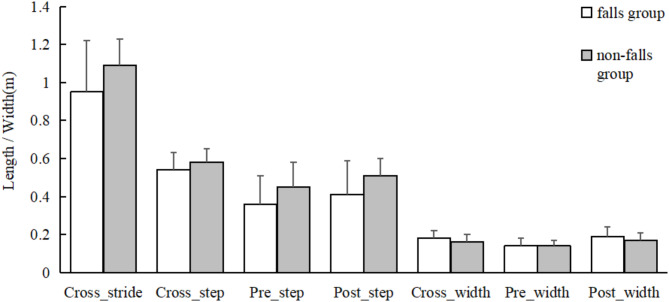
Results: 17 participants were categorised into the falls group and 16 into the non-falls group. The single support phase of leading limb, post-obstacle swing phase of trailing limb, obstacle-heel distance of leading limb, and obstacle-heel distance of trailing limb were significantly smaller in the fall group compared to the non-fall group (P < 0.05). The gait spatio-temporal parameter ultimately included in the fall risk prediction model was the obstacle-heel distance of leading limb (OR = 0.819, 95%CI = 0.688-0.973, P = 0.023). The overall correct classification rate from this model was 69.7%, and the area under the curve (AUC) was 0.750 (P = 0.014).
Conclusion: Abnormalities in gait spatio-temporal parameters during obstacle crossing in stroke patients can contribute to an increased risk of falls. The fall risk prediction model developed in this study demonstrated excellent predictive performance, indicating its potential utility in clinical settings.
期刊介绍:
BMC Neurology is an open access, peer-reviewed journal that considers articles on all aspects of the prevention, diagnosis and management of neurological disorders, as well as related molecular genetics, pathophysiology, and epidemiology.





 京公网安备 11010802042870号
京ICP备2023020795号-1
京公网安备 11010802042870号
京ICP备2023020795号-1

 分享
分享
 求助内容:
求助内容: 应助结果提醒方式:
 扫码关注我们
