Huiyong Cheng, Dawson Miller, Nneka Southwell, Paola Porcari, Joshua L Fischer, Isobel Taylor, J Michael Salbaum, Claudia Kappen, Fenghua Hu, Cha Yang, Kayvan R Keshari, Steven S Gross, Marilena D'Aurelio, Qiuying Chen
{"title":"Untargeted pixel-by-pixel metabolite ratio imaging as a novel tool for biomedical discovery in mass spectrometry imaging.","authors":"Huiyong Cheng, Dawson Miller, Nneka Southwell, Paola Porcari, Joshua L Fischer, Isobel Taylor, J Michael Salbaum, Claudia Kappen, Fenghua Hu, Cha Yang, Kayvan R Keshari, Steven S Gross, Marilena D'Aurelio, Qiuying Chen","doi":"10.7554/eLife.96892","DOIUrl":null,"url":null,"abstract":"<p><p>Mass spectrometry imaging (MSI) is a powerful technology used to define the spatial distribution and relative abundance of metabolites across tissue cryosections. While software packages exist for pixel-by-pixel individual metabolite and limited target pairs of ratio imaging, the research community lacks an easy computing and application tool that images any metabolite abundance ratio pairs. Importantly, recognition of correlated metabolite pairs may contribute to the discovery of unanticipated molecules in shared metabolic pathways. Here, we describe the development and implementation of an untargeted R package workflow for pixel-by-pixel ratio imaging of all metabolites detected in an MSI experiment. Considering untargeted MSI studies of murine brain and embryogenesis, we demonstrate that ratio imaging minimizes systematic data variation introduced by sample handling, markedly enhances spatial image contrast, and reveals previously unrecognized metabotype-distinct tissue regions. Furthermore, ratio imaging facilitates identification of novel regional biomarkers and provides anatomical information regarding spatial distribution of metabolite-linked biochemical pathways. The algorithm described herein is applicable to any MSI dataset containing spatial information for metabolites, peptides or proteins, offering a potent hypothesis generation tool to enhance knowledge obtained from current spatial metabolite profiling technologies.</p>","PeriodicalId":11640,"journal":{"name":"eLife","volume":"13 ","pages":""},"PeriodicalIF":6.4000,"publicationDate":"2025-03-18","publicationTypes":"Journal Article","fieldsOfStudy":null,"isOpenAccess":false,"openAccessPdf":"https://www.ncbi.nlm.nih.gov/pmc/articles/PMC11919253/pdf/","citationCount":"0","resultStr":null,"platform":"Semanticscholar","paperid":null,"PeriodicalName":"eLife","FirstCategoryId":"99","ListUrlMain":"https://doi.org/10.7554/eLife.96892","RegionNum":1,"RegionCategory":"生物学","ArticlePicture":[],"TitleCN":null,"AbstractTextCN":null,"PMCID":null,"EPubDate":"","PubModel":"","JCR":"Q1","JCRName":"BIOLOGY","Score":null,"Total":0}
引用次数: 0
Abstract
Mass spectrometry imaging (MSI) is a powerful technology used to define the spatial distribution and relative abundance of metabolites across tissue cryosections. While software packages exist for pixel-by-pixel individual metabolite and limited target pairs of ratio imaging, the research community lacks an easy computing and application tool that images any metabolite abundance ratio pairs. Importantly, recognition of correlated metabolite pairs may contribute to the discovery of unanticipated molecules in shared metabolic pathways. Here, we describe the development and implementation of an untargeted R package workflow for pixel-by-pixel ratio imaging of all metabolites detected in an MSI experiment. Considering untargeted MSI studies of murine brain and embryogenesis, we demonstrate that ratio imaging minimizes systematic data variation introduced by sample handling, markedly enhances spatial image contrast, and reveals previously unrecognized metabotype-distinct tissue regions. Furthermore, ratio imaging facilitates identification of novel regional biomarkers and provides anatomical information regarding spatial distribution of metabolite-linked biochemical pathways. The algorithm described herein is applicable to any MSI dataset containing spatial information for metabolites, peptides or proteins, offering a potent hypothesis generation tool to enhance knowledge obtained from current spatial metabolite profiling technologies.
期刊介绍:
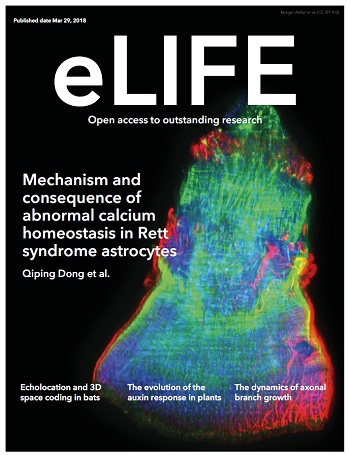
eLife is a distinguished, not-for-profit, peer-reviewed open access scientific journal that specializes in the fields of biomedical and life sciences. eLife is known for its selective publication process, which includes a variety of article types such as:
Research Articles: Detailed reports of original research findings.
Short Reports: Concise presentations of significant findings that do not warrant a full-length research article.
Tools and Resources: Descriptions of new tools, technologies, or resources that facilitate scientific research.
Research Advances: Brief reports on significant scientific advancements that have immediate implications for the field.
Scientific Correspondence: Short communications that comment on or provide additional information related to published articles.
Review Articles: Comprehensive overviews of a specific topic or field within the life sciences.




 京公网安备 11010802042870号
京ICP备2023020795号-1
京公网安备 11010802042870号
京ICP备2023020795号-1

 分享
分享
 求助内容:
求助内容: 应助结果提醒方式:
 扫码关注我们
