{"title":"Combining diffusion and transformer models for enhanced promoter synthesis and strength prediction in deep learning.","authors":"Xin Lei, Xing Wang, Guanlin Chen, Ce Liang, Quhuan Li, Huaiguang Jiang, Wei Xiong","doi":"10.1128/msystems.00183-25","DOIUrl":null,"url":null,"abstract":"<p><p>In the field of synthetic biology, the engineering of synthetic promoters that outperform their natural counterparts is of paramount importance, which can optimize the expression of exogenous genes, enhance the efficiency of metabolic pathways, and possess substantial commercial value. Research indicates that some synthetic promoters have higher transcriptional activity compared to strong natural promoters. However, with the exponential increase in complexity due to the 4<sup><i>n</i></sup> potential combinations in a promoter sequence of length <i>n</i>, identifying effective synthetic promoters remains a formidable challenge. Deep learning models, by adaptively learning from extensive data sets, have become instrumental in analyzing biological data. This study introduces a diffusion model-based approach for designing promoters viable in model bacteria such as <i>Escherichia coli</i> and cyanobacteria. This model proficiently assimilates and utilizes inherent biological features from natural promoter sequences to engineer synthetic variants. Additionally, we employed a transformer model to evaluate the efficacy of these synthetic promoters, aiming at screening those with high performance. The experimental findings suggest that the synthetic promoters by the diffusion model not only share key biological features with their natural counterparts but also demonstrate greater similarity to natural promoters than those generated by a variational autoencoder. In predicting promoter strength, the transformer model demonstrated improved performance over the convolutional neural network. Finally, we developed an integrated platform for generating promoters and predicting their strength.</p><p><strong>Importance: </strong>We demonstrated that diffusion models are superior in accomplishing the promoter synthesis task compared to other state-of-the-art deep learning models. The effectiveness of our method was validated using data sets of <i>Escherichia coli</i> and cyanobacteria promoters, showing more stable and prompt convergence and more natural-like promoters than the variational autoencoder model. We extracted sequence information, dimer information, and position information from promoters and combined them with a transformer model to predict promoter strength. Our prediction results were more accurate than those obtained with a convolutional neural network model. Our <i>in silico</i> experiments systematically introduced mutations in promoter sequences and explored their contribution to promoter strength, highlighting the depth of learning in our model.</p>","PeriodicalId":18819,"journal":{"name":"mSystems","volume":" ","pages":"e0018325"},"PeriodicalIF":4.6000,"publicationDate":"2025-04-22","publicationTypes":"Journal Article","fieldsOfStudy":null,"isOpenAccess":false,"openAccessPdf":"https://www.ncbi.nlm.nih.gov/pmc/articles/PMC12013266/pdf/","citationCount":"0","resultStr":null,"platform":"Semanticscholar","paperid":null,"PeriodicalName":"mSystems","FirstCategoryId":"99","ListUrlMain":"https://doi.org/10.1128/msystems.00183-25","RegionNum":2,"RegionCategory":"生物学","ArticlePicture":[],"TitleCN":null,"AbstractTextCN":null,"PMCID":null,"EPubDate":"2025/3/19 0:00:00","PubModel":"Epub","JCR":"Q1","JCRName":"MICROBIOLOGY","Score":null,"Total":0}
引用次数: 0
Abstract
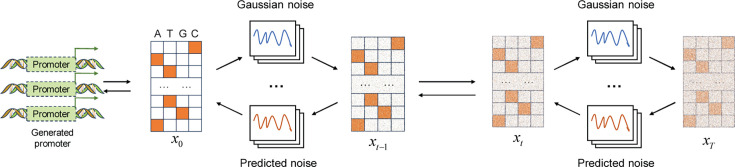
In the field of synthetic biology, the engineering of synthetic promoters that outperform their natural counterparts is of paramount importance, which can optimize the expression of exogenous genes, enhance the efficiency of metabolic pathways, and possess substantial commercial value. Research indicates that some synthetic promoters have higher transcriptional activity compared to strong natural promoters. However, with the exponential increase in complexity due to the 4n potential combinations in a promoter sequence of length n, identifying effective synthetic promoters remains a formidable challenge. Deep learning models, by adaptively learning from extensive data sets, have become instrumental in analyzing biological data. This study introduces a diffusion model-based approach for designing promoters viable in model bacteria such as Escherichia coli and cyanobacteria. This model proficiently assimilates and utilizes inherent biological features from natural promoter sequences to engineer synthetic variants. Additionally, we employed a transformer model to evaluate the efficacy of these synthetic promoters, aiming at screening those with high performance. The experimental findings suggest that the synthetic promoters by the diffusion model not only share key biological features with their natural counterparts but also demonstrate greater similarity to natural promoters than those generated by a variational autoencoder. In predicting promoter strength, the transformer model demonstrated improved performance over the convolutional neural network. Finally, we developed an integrated platform for generating promoters and predicting their strength.
Importance: We demonstrated that diffusion models are superior in accomplishing the promoter synthesis task compared to other state-of-the-art deep learning models. The effectiveness of our method was validated using data sets of Escherichia coli and cyanobacteria promoters, showing more stable and prompt convergence and more natural-like promoters than the variational autoencoder model. We extracted sequence information, dimer information, and position information from promoters and combined them with a transformer model to predict promoter strength. Our prediction results were more accurate than those obtained with a convolutional neural network model. Our in silico experiments systematically introduced mutations in promoter sequences and explored their contribution to promoter strength, highlighting the depth of learning in our model.
mSystemsBiochemistry, Genetics and Molecular Biology-Biochemistry
CiteScore
10.50
自引率
3.10%
发文量
308
审稿时长
13 weeks
期刊介绍:
mSystems™ will publish preeminent work that stems from applying technologies for high-throughput analyses to achieve insights into the metabolic and regulatory systems at the scale of both the single cell and microbial communities. The scope of mSystems™ encompasses all important biological and biochemical findings drawn from analyses of large data sets, as well as new computational approaches for deriving these insights. mSystems™ will welcome submissions from researchers who focus on the microbiome, genomics, metagenomics, transcriptomics, metabolomics, proteomics, glycomics, bioinformatics, and computational microbiology. mSystems™ will provide streamlined decisions, while carrying on ASM''s tradition of rigorous peer review.





 京公网安备 11010802042870号
京ICP备2023020795号-1
京公网安备 11010802042870号
京ICP备2023020795号-1

 分享
分享
 求助内容:
求助内容: 应助结果提醒方式:
 扫码关注我们
