Zhilei Shang, Na Zhou, Buhang Xu, Han Diao, Suhui Cheng, Yanpu Jia, Lili Wu, Wenjie Yan, Weizhi Liu, Geyu Chen
{"title":"The role of attachment styles in post-traumatic stress disorder and posttraumatic growth in the Shidu parents of China.","authors":"Zhilei Shang, Na Zhou, Buhang Xu, Han Diao, Suhui Cheng, Yanpu Jia, Lili Wu, Wenjie Yan, Weizhi Liu, Geyu Chen","doi":"10.1177/20503121251324990","DOIUrl":null,"url":null,"abstract":"<p><strong>Background: </strong>The number of Shidu parents in China is significant and expected to continue increasing. The psychological status of Shidu parents deserves more attention.</p><p><strong>Objective: </strong>Our objective is to investigate the impact of post-traumatic stress disorder and attachment styles among Shidu parents on post-traumatic growth, with the aim of providing valuable insights for alleviating post-traumatic stress disorder symptoms and enhancing levels of post-traumatic growth following trauma.</p><p><strong>Design: </strong>Demographic data, the Revised Adult Attachment Scale, the Posttraumatic Stress Disorder Checklist for DSM-5, and the post traumatic growth inventory were used to investigated 297 Shidu parents.</p><p><strong>Method: </strong>Two samples <i>t</i>-test was employed to evaluate disparities in post-traumatic growth inventory scores based on post-traumatic stress disorder and diverse attachment styles. Pearson's correlation analysis was used to investigate the association between Post-traumatic Stress Disorder Checklist for DSM-5 scores and post-traumatic growth inventory scores, as well as the association between different attachment styles and post-traumatic growth inventory scores. We performed multiple mediator analyses to further confirm the influence of post-traumatic stress disorder and attachment styles on post-traumatic growth inventory.</p><p><strong>Results: </strong>(1) A total of 35% of the people tested positive for post-traumatic stress disorder; (2) A total of 56.9% of the participants exhibited secure attachment, while 43.1% exhibited insecure attachment; (3) The results unveiled a substantial negative correlation between the Posttraumatic Stress Disorder Checklist for DSM-5 scores and the post traumatic growth inventory scores; (4) A significant positive correlation was evident in relation to attachment dependence/closeness and post-traumatic growth inventory, while a significant negative correlation was established between attachment anxiety and post-traumatic growth inventory.</p><p><strong>Conclusion: </strong>Our study suggests that post-traumatic growth inventory is associated with post-traumatic stress disorder and attachment styles in Shidu parents. It might offer new insights into influencing levels of post-traumatic growth through post-traumatic stress disorder intervention.</p>","PeriodicalId":21398,"journal":{"name":"SAGE Open Medicine","volume":"13 ","pages":"20503121251324990"},"PeriodicalIF":2.1000,"publicationDate":"2025-03-18","publicationTypes":"Journal Article","fieldsOfStudy":null,"isOpenAccess":false,"openAccessPdf":"https://www.ncbi.nlm.nih.gov/pmc/articles/PMC11915255/pdf/","citationCount":"0","resultStr":null,"platform":"Semanticscholar","paperid":null,"PeriodicalName":"SAGE Open Medicine","FirstCategoryId":"1085","ListUrlMain":"https://doi.org/10.1177/20503121251324990","RegionNum":0,"RegionCategory":null,"ArticlePicture":[],"TitleCN":null,"AbstractTextCN":null,"PMCID":null,"EPubDate":"2025/1/1 0:00:00","PubModel":"eCollection","JCR":"Q2","JCRName":"MEDICINE, GENERAL & INTERNAL","Score":null,"Total":0}
引用次数: 0
Abstract
Background: The number of Shidu parents in China is significant and expected to continue increasing. The psychological status of Shidu parents deserves more attention.
Objective: Our objective is to investigate the impact of post-traumatic stress disorder and attachment styles among Shidu parents on post-traumatic growth, with the aim of providing valuable insights for alleviating post-traumatic stress disorder symptoms and enhancing levels of post-traumatic growth following trauma.
Design: Demographic data, the Revised Adult Attachment Scale, the Posttraumatic Stress Disorder Checklist for DSM-5, and the post traumatic growth inventory were used to investigated 297 Shidu parents.
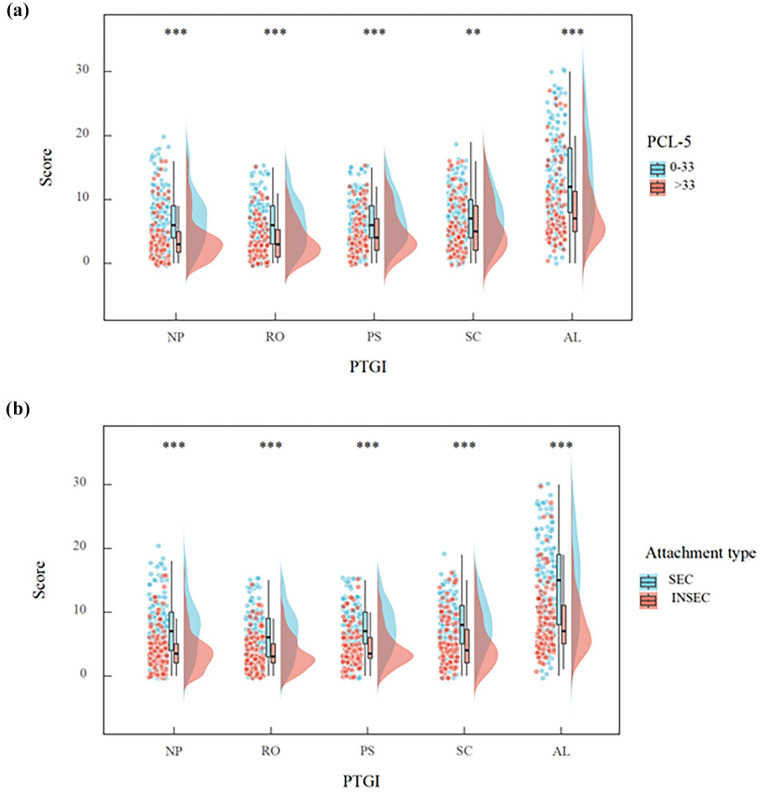
Method: Two samples t-test was employed to evaluate disparities in post-traumatic growth inventory scores based on post-traumatic stress disorder and diverse attachment styles. Pearson's correlation analysis was used to investigate the association between Post-traumatic Stress Disorder Checklist for DSM-5 scores and post-traumatic growth inventory scores, as well as the association between different attachment styles and post-traumatic growth inventory scores. We performed multiple mediator analyses to further confirm the influence of post-traumatic stress disorder and attachment styles on post-traumatic growth inventory.
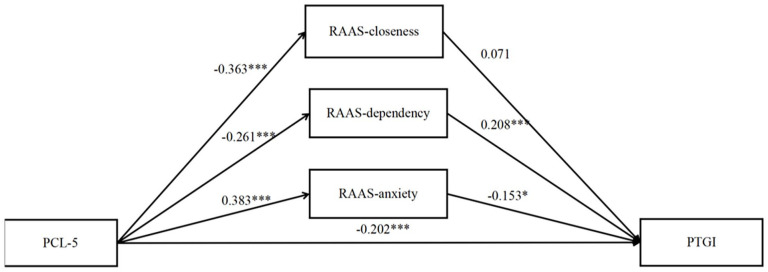
Results: (1) A total of 35% of the people tested positive for post-traumatic stress disorder; (2) A total of 56.9% of the participants exhibited secure attachment, while 43.1% exhibited insecure attachment; (3) The results unveiled a substantial negative correlation between the Posttraumatic Stress Disorder Checklist for DSM-5 scores and the post traumatic growth inventory scores; (4) A significant positive correlation was evident in relation to attachment dependence/closeness and post-traumatic growth inventory, while a significant negative correlation was established between attachment anxiety and post-traumatic growth inventory.
Conclusion: Our study suggests that post-traumatic growth inventory is associated with post-traumatic stress disorder and attachment styles in Shidu parents. It might offer new insights into influencing levels of post-traumatic growth through post-traumatic stress disorder intervention.






 京公网安备 11010802042870号
京ICP备2023020795号-1
京公网安备 11010802042870号
京ICP备2023020795号-1

 分享
分享
 求助内容:
求助内容: 应助结果提醒方式:
 扫码关注我们
