Abhishek Sau, Sebastian Schnorrenberg, Ziqiang Huang, Debolina Bandyopadhyay, Ankith Sharma, Clara-Marie Gürth, Sandeep Dave, Siegfried M. Musser
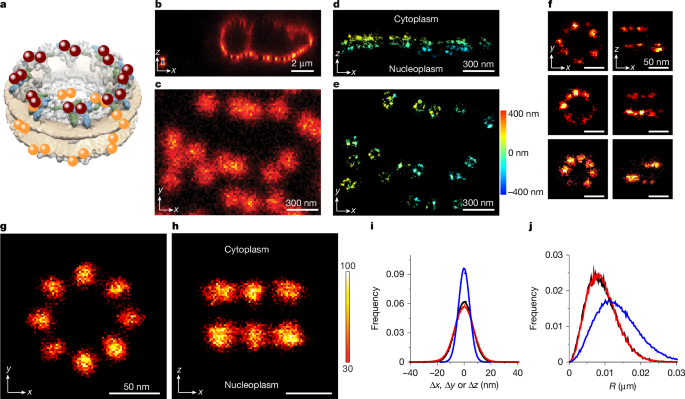
{"title":"Overlapping nuclear import and export paths unveiled by two-colour MINFLUX","authors":"Abhishek Sau, Sebastian Schnorrenberg, Ziqiang Huang, Debolina Bandyopadhyay, Ankith Sharma, Clara-Marie Gürth, Sandeep Dave, Siegfried M. Musser","doi":"10.1038/s41586-025-08738-0","DOIUrl":null,"url":null,"abstract":"The nuclear pore complex (NPC) mediates nucleocytoplasmic exchange, catalysing a massive flux of protein and nucleic acid material in both directions1. Distinct trafficking pathways for import and export would be an elegant solution to avoid unproductive collisions and opposing movements. However, the three-dimensional (3D) nanoscale spatiotemporal dynamics of macromolecules traversing the NPC remains challenging to visualize on the timescale of millisecond-scale transport events. Here we used 3D MINFLUX2 to identify the nuclear pore scaffold and then to simultaneously monitor both nuclear import and nuclear export, thereby establishing that both transport processes occur in overlapping regions of the central pore. Whereas translocation-arrested import complexes bound at the pore periphery, tracks of translocating complexes within the central pore region revealed a preference for an approximately 40- to 50-nm diameter annulus with minimal circumferential movement, indicating activity-dependent confinement within the permeability barrier. Movement within the pore was approximately 1,000-fold slower than in solution and was interspersed with pauses, indicating a highly restricted environment with structural constraints and/or transient binding events during transport. These results demonstrate that high spatiotemporal precision with reduced photobleaching is a major advantage of MINFLUX tracking, and that the NPC permeability barrier is divided into annular rings with distinct functional properties. High spatiotemporal precision tracking using 3D MINFLUX shows that nuclear import and export occur in overlapping regions of the central pore, providing insight into transport across the nuclear pore complex.","PeriodicalId":18787,"journal":{"name":"Nature","volume":"640 8059","pages":"821-827"},"PeriodicalIF":48.5000,"publicationDate":"2025-03-19","publicationTypes":"Journal Article","fieldsOfStudy":null,"isOpenAccess":false,"openAccessPdf":"https://www.nature.com/articles/s41586-025-08738-0.pdf","citationCount":"0","resultStr":null,"platform":"Semanticscholar","paperid":null,"PeriodicalName":"Nature","FirstCategoryId":"103","ListUrlMain":"https://www.nature.com/articles/s41586-025-08738-0","RegionNum":1,"RegionCategory":"综合性期刊","ArticlePicture":[],"TitleCN":null,"AbstractTextCN":null,"PMCID":null,"EPubDate":"","PubModel":"","JCR":"Q1","JCRName":"MULTIDISCIPLINARY SCIENCES","Score":null,"Total":0}
引用次数: 0
Abstract
The nuclear pore complex (NPC) mediates nucleocytoplasmic exchange, catalysing a massive flux of protein and nucleic acid material in both directions1. Distinct trafficking pathways for import and export would be an elegant solution to avoid unproductive collisions and opposing movements. However, the three-dimensional (3D) nanoscale spatiotemporal dynamics of macromolecules traversing the NPC remains challenging to visualize on the timescale of millisecond-scale transport events. Here we used 3D MINFLUX2 to identify the nuclear pore scaffold and then to simultaneously monitor both nuclear import and nuclear export, thereby establishing that both transport processes occur in overlapping regions of the central pore. Whereas translocation-arrested import complexes bound at the pore periphery, tracks of translocating complexes within the central pore region revealed a preference for an approximately 40- to 50-nm diameter annulus with minimal circumferential movement, indicating activity-dependent confinement within the permeability barrier. Movement within the pore was approximately 1,000-fold slower than in solution and was interspersed with pauses, indicating a highly restricted environment with structural constraints and/or transient binding events during transport. These results demonstrate that high spatiotemporal precision with reduced photobleaching is a major advantage of MINFLUX tracking, and that the NPC permeability barrier is divided into annular rings with distinct functional properties. High spatiotemporal precision tracking using 3D MINFLUX shows that nuclear import and export occur in overlapping regions of the central pore, providing insight into transport across the nuclear pore complex.
期刊介绍:
Nature is a prestigious international journal that publishes peer-reviewed research in various scientific and technological fields. The selection of articles is based on criteria such as originality, importance, interdisciplinary relevance, timeliness, accessibility, elegance, and surprising conclusions. In addition to showcasing significant scientific advances, Nature delivers rapid, authoritative, insightful news, and interpretation of current and upcoming trends impacting science, scientists, and the broader public. The journal serves a dual purpose: firstly, to promptly share noteworthy scientific advances and foster discussions among scientists, and secondly, to ensure the swift dissemination of scientific results globally, emphasizing their significance for knowledge, culture, and daily life.




 京公网安备 11010802042870号
京ICP备2023020795号-1
京公网安备 11010802042870号
京ICP备2023020795号-1

 分享
分享
 求助内容:
求助内容: 应助结果提醒方式:
 扫码关注我们
