Qiushi Guo, Iliya Esin, Cheng Li, Chen Chen, Guanyu Han, Song Liu, James H. Edgar, Selina Zhou, Eugene Demler, Gil Refael, Fengnian Xia
{"title":"Hyperbolic phonon-polariton electroluminescence in 2D heterostructures","authors":"Qiushi Guo, Iliya Esin, Cheng Li, Chen Chen, Guanyu Han, Song Liu, James H. Edgar, Selina Zhou, Eugene Demler, Gil Refael, Fengnian Xia","doi":"10.1038/s41586-025-08686-9","DOIUrl":null,"url":null,"abstract":"Phonon polaritons are quasiparticles resulting from the coherent coupling of photons with optical phonons in polar dielectrics1. Owing to their exceptional ability to confine electric fields to deep-subwavelength scales with low loss, they are uniquely poised to enable a suite of applications beyond the reach of conventional photonics, such as subdiffraction imaging2 and near-field energy transfer3–5. The conventional approach to exciting phonon polaritons through optical methods, however, involves costly light sources along with near-field schemes6,7, and generally leads to low excitation efficiency owing to substantial momentum mismatch between phonon polaritons and free-space photons. Here we demonstrate that under proper conditions, phonon polaritons can be excited all-electrically by drifting charge carriers. Specifically, in hexagonal boron nitride (hBN)/graphene heterostructures, by electrically driving charge carriers in ultrahigh-mobility graphene out of equilibrium, we observe bright electroluminescence of hBN’s hyperbolic phonon polaritons (HPhPs) at mid-infrared frequencies, which shows a temperature and carrier density dependence distinct from black-body thermal emission. Moreover, the carrier density dependence of the HPhP electroluminescence spectra reveals that HPhP electroluminescence can arise from both interband transition and intraband Cherenkov radiation8 of charge carriers in graphene. The HPhP electroluminescence offers avenues for realizing electrically pumped mid-infrared and terahertz phonon-polariton light sources. All-electrical excitation of the hyperbolic phonon polaritons in hexagonal boron nitride by drifting charge carriers in nearby graphene results in electroluminescence at mid-infrared frequencies.","PeriodicalId":18787,"journal":{"name":"Nature","volume":"639 8056","pages":"915-921"},"PeriodicalIF":48.5000,"publicationDate":"2025-03-19","publicationTypes":"Journal Article","fieldsOfStudy":null,"isOpenAccess":false,"openAccessPdf":"https://www.nature.com/articles/s41586-025-08686-9.pdf","citationCount":"0","resultStr":null,"platform":"Semanticscholar","paperid":null,"PeriodicalName":"Nature","FirstCategoryId":"103","ListUrlMain":"https://www.nature.com/articles/s41586-025-08686-9","RegionNum":1,"RegionCategory":"综合性期刊","ArticlePicture":[],"TitleCN":null,"AbstractTextCN":null,"PMCID":null,"EPubDate":"","PubModel":"","JCR":"Q1","JCRName":"MULTIDISCIPLINARY SCIENCES","Score":null,"Total":0}
引用次数: 0
Abstract
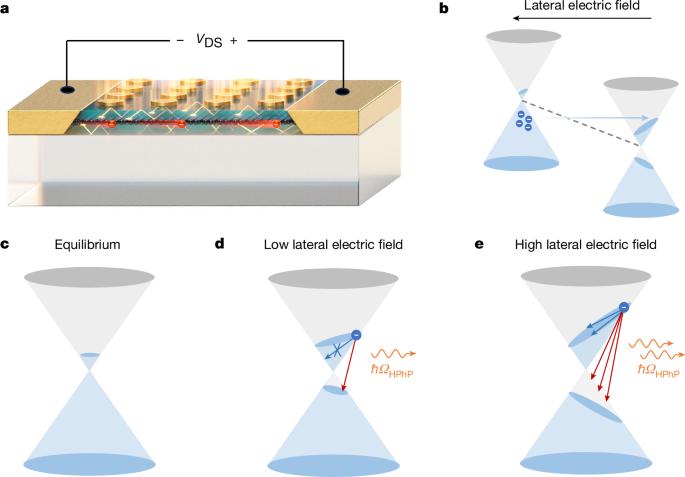
Phonon polaritons are quasiparticles resulting from the coherent coupling of photons with optical phonons in polar dielectrics1. Owing to their exceptional ability to confine electric fields to deep-subwavelength scales with low loss, they are uniquely poised to enable a suite of applications beyond the reach of conventional photonics, such as subdiffraction imaging2 and near-field energy transfer3–5. The conventional approach to exciting phonon polaritons through optical methods, however, involves costly light sources along with near-field schemes6,7, and generally leads to low excitation efficiency owing to substantial momentum mismatch between phonon polaritons and free-space photons. Here we demonstrate that under proper conditions, phonon polaritons can be excited all-electrically by drifting charge carriers. Specifically, in hexagonal boron nitride (hBN)/graphene heterostructures, by electrically driving charge carriers in ultrahigh-mobility graphene out of equilibrium, we observe bright electroluminescence of hBN’s hyperbolic phonon polaritons (HPhPs) at mid-infrared frequencies, which shows a temperature and carrier density dependence distinct from black-body thermal emission. Moreover, the carrier density dependence of the HPhP electroluminescence spectra reveals that HPhP electroluminescence can arise from both interband transition and intraband Cherenkov radiation8 of charge carriers in graphene. The HPhP electroluminescence offers avenues for realizing electrically pumped mid-infrared and terahertz phonon-polariton light sources. All-electrical excitation of the hyperbolic phonon polaritons in hexagonal boron nitride by drifting charge carriers in nearby graphene results in electroluminescence at mid-infrared frequencies.
期刊介绍:
Nature is a prestigious international journal that publishes peer-reviewed research in various scientific and technological fields. The selection of articles is based on criteria such as originality, importance, interdisciplinary relevance, timeliness, accessibility, elegance, and surprising conclusions. In addition to showcasing significant scientific advances, Nature delivers rapid, authoritative, insightful news, and interpretation of current and upcoming trends impacting science, scientists, and the broader public. The journal serves a dual purpose: firstly, to promptly share noteworthy scientific advances and foster discussions among scientists, and secondly, to ensure the swift dissemination of scientific results globally, emphasizing their significance for knowledge, culture, and daily life.





 京公网安备 11010802042870号
京ICP备2023020795号-1
京公网安备 11010802042870号
京ICP备2023020795号-1

 分享
分享
 求助内容:
求助内容: 应助结果提醒方式:
 扫码关注我们
