Jason L. Guo, Michelle Griffin, Jung-Ki Yoon, David M. Lopez, Yili Zhu, John M. Lu, Georgios Mikos, Jennifer B. L. Parker, Shamik Mascharak, Camille Brenac, Nicholas J. Guardino, Darren B. Abbas, Dayan J. Li, Caleb Valencia, Norah E. Liang, Michael Januszyk, Howard Y. Chang, Derrick C. Wan, Tushar J. Desai, Michael T. Longaker
{"title":"Histological signatures map anti-fibrotic factors in mouse and human lungs","authors":"Jason L. Guo, Michelle Griffin, Jung-Ki Yoon, David M. Lopez, Yili Zhu, John M. Lu, Georgios Mikos, Jennifer B. L. Parker, Shamik Mascharak, Camille Brenac, Nicholas J. Guardino, Darren B. Abbas, Dayan J. Li, Caleb Valencia, Norah E. Liang, Michael Januszyk, Howard Y. Chang, Derrick C. Wan, Tushar J. Desai, Michael T. Longaker","doi":"10.1038/s41586-025-08727-3","DOIUrl":null,"url":null,"abstract":"Fibrosis, the replacement of healthy tissue with collagen-rich matrix, can occur following injury in almost every organ1,2. Mouse lungs follow a stereotyped sequence of fibrogenesis-to-resolution after bleomycin injury3, and we reasoned that profiling post-injury histological stages could uncover pro-fibrotic versus anti-fibrotic features with functional value for human fibrosis. Here we quantified spatiotemporally resolved matrix transformations for integration with multi-omic data. First, we charted stepwise trajectories of matrix aberration versus resolution, derived from a high-dimensional set of histological fibre features, that denoted a reversible transition in uniform-to-disordered histological architecture. Single-cell sequencing along these trajectories identified temporally enriched ‘ECM-secreting’ (Csmd1-expressing) and ‘pro-resolving’ (Cd248-expressing) fibroblasts at the respective post-injury stages. Visium-based spatial analysis further suggested divergent matrix architectures and spatial–transcriptional neighbourhoods by fibroblast subtype, identifying distinct fibrotic versus non-fibrotic biomolecular milieu. Critically, pro-resolving fibroblast instillation helped to ameliorate fibrosis in vivo. Furthermore, the fibroblast neighbourhood-associated factors SERPINE2 and PI16 functionally modulated human lung fibrosis ex vivo. Spatial phenotyping of idiopathic pulmonary fibrosis at protein level additionally uncovered analogous fibroblast subtypes and neighbourhoods in human disease. Collectively, these findings establish an atlas of pro- and anti-fibrotic factors that underlie lung matrix architecture and implicate fibroblast-associated biological features in modulating fibrotic progression versus resolution. Transcriptomic and proteomic analyses of cells and matrix along the fibrotic trajectory in mouse lung identified PI16 as an anti-fibrotic factor with potential for therapeutic application in humans.","PeriodicalId":18787,"journal":{"name":"Nature","volume":"641 8064","pages":"993-1004"},"PeriodicalIF":48.5000,"publicationDate":"2025-03-19","publicationTypes":"Journal Article","fieldsOfStudy":null,"isOpenAccess":false,"openAccessPdf":"","citationCount":"0","resultStr":null,"platform":"Semanticscholar","paperid":null,"PeriodicalName":"Nature","FirstCategoryId":"103","ListUrlMain":"https://www.nature.com/articles/s41586-025-08727-3","RegionNum":1,"RegionCategory":"综合性期刊","ArticlePicture":[],"TitleCN":null,"AbstractTextCN":null,"PMCID":null,"EPubDate":"","PubModel":"","JCR":"Q1","JCRName":"MULTIDISCIPLINARY SCIENCES","Score":null,"Total":0}
引用次数: 0
Abstract
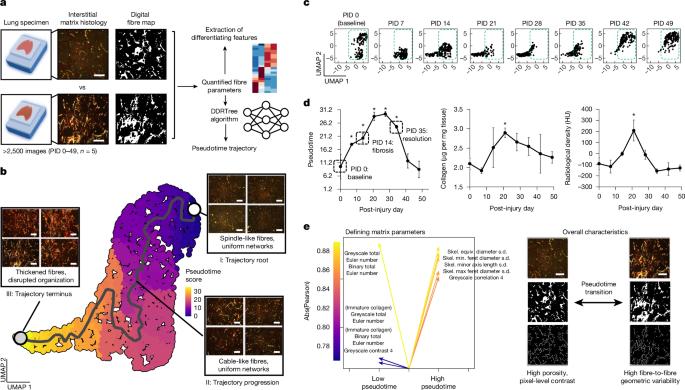
Fibrosis, the replacement of healthy tissue with collagen-rich matrix, can occur following injury in almost every organ1,2. Mouse lungs follow a stereotyped sequence of fibrogenesis-to-resolution after bleomycin injury3, and we reasoned that profiling post-injury histological stages could uncover pro-fibrotic versus anti-fibrotic features with functional value for human fibrosis. Here we quantified spatiotemporally resolved matrix transformations for integration with multi-omic data. First, we charted stepwise trajectories of matrix aberration versus resolution, derived from a high-dimensional set of histological fibre features, that denoted a reversible transition in uniform-to-disordered histological architecture. Single-cell sequencing along these trajectories identified temporally enriched ‘ECM-secreting’ (Csmd1-expressing) and ‘pro-resolving’ (Cd248-expressing) fibroblasts at the respective post-injury stages. Visium-based spatial analysis further suggested divergent matrix architectures and spatial–transcriptional neighbourhoods by fibroblast subtype, identifying distinct fibrotic versus non-fibrotic biomolecular milieu. Critically, pro-resolving fibroblast instillation helped to ameliorate fibrosis in vivo. Furthermore, the fibroblast neighbourhood-associated factors SERPINE2 and PI16 functionally modulated human lung fibrosis ex vivo. Spatial phenotyping of idiopathic pulmonary fibrosis at protein level additionally uncovered analogous fibroblast subtypes and neighbourhoods in human disease. Collectively, these findings establish an atlas of pro- and anti-fibrotic factors that underlie lung matrix architecture and implicate fibroblast-associated biological features in modulating fibrotic progression versus resolution. Transcriptomic and proteomic analyses of cells and matrix along the fibrotic trajectory in mouse lung identified PI16 as an anti-fibrotic factor with potential for therapeutic application in humans.
期刊介绍:
Nature is a prestigious international journal that publishes peer-reviewed research in various scientific and technological fields. The selection of articles is based on criteria such as originality, importance, interdisciplinary relevance, timeliness, accessibility, elegance, and surprising conclusions. In addition to showcasing significant scientific advances, Nature delivers rapid, authoritative, insightful news, and interpretation of current and upcoming trends impacting science, scientists, and the broader public. The journal serves a dual purpose: firstly, to promptly share noteworthy scientific advances and foster discussions among scientists, and secondly, to ensure the swift dissemination of scientific results globally, emphasizing their significance for knowledge, culture, and daily life.



 京公网安备 11010802042870号
京ICP备2023020795号-1
京公网安备 11010802042870号
京ICP备2023020795号-1

 分享
分享
 求助内容:
求助内容: 应助结果提醒方式:
 扫码关注我们
