David A. Duchêne, Al-Aabid Chowdhury, Jingyi Yang, Maider Iglesias-Carrasco, Josefin Stiller, Shaohong Feng, Samir Bhatt, M. Thomas P. Gilbert, Guojie Zhang, Joseph A. Tobias, Simon Y. W. Ho
{"title":"Drivers of avian genomic change revealed by evolutionary rate decomposition","authors":"David A. Duchêne, Al-Aabid Chowdhury, Jingyi Yang, Maider Iglesias-Carrasco, Josefin Stiller, Shaohong Feng, Samir Bhatt, M. Thomas P. Gilbert, Guojie Zhang, Joseph A. Tobias, Simon Y. W. Ho","doi":"10.1038/s41586-025-08777-7","DOIUrl":null,"url":null,"abstract":"Modern birds have diversified into a striking array of forms, behaviours and ecological roles. Analyses of molecular evolutionary rates can reveal the links between genomic and phenotypic change1–4, but disentangling the drivers of rate variation at the whole-genome scale has been difficult. Using comprehensive estimates of traits and evolutionary rates across a family-level phylogeny of birds5,6, we find that genome-wide mutation rates across lineages are predominantly explained by clutch size and generation length, whereas rate variation across genes is driven by the content of guanine and cytosine. Here, to find the subsets of genes and lineages that dominate evolutionary rate variation in birds, we estimated the influence of individual lineages on decomposed axes of gene-specific evolutionary rates. We find that most of the rate variation occurs along recent branches of the tree, associated with present-day families of birds. Additional tests on axes of rate variation show rapid changes in microchromosomes immediately after the Cretaceous–Palaeogene transition. These apparent pulses of evolution are consistent with major changes in the genetic machineries for meiosis, heart performance, and RNA splicing, surveillance and translation, and correlate with the ecological diversity reflected in increased tarsus length. Collectively, our analyses paint a nuanced picture of avian evolution, revealing that the ancestors of the most diverse lineages of birds underwent major genomic changes related to mutation, gene usage and niche expansion in the early Palaeogene period. Genomic evolutionary rates are decomposed to identify the dominant lineages and genes driving rate variation across the phylogeny of birds.","PeriodicalId":18787,"journal":{"name":"Nature","volume":"641 8065","pages":"1208-1216"},"PeriodicalIF":48.5000,"publicationDate":"2025-03-19","publicationTypes":"Journal Article","fieldsOfStudy":null,"isOpenAccess":false,"openAccessPdf":"https://www.nature.com/articles/s41586-025-08777-7.pdf","citationCount":"0","resultStr":null,"platform":"Semanticscholar","paperid":null,"PeriodicalName":"Nature","FirstCategoryId":"103","ListUrlMain":"https://www.nature.com/articles/s41586-025-08777-7","RegionNum":1,"RegionCategory":"综合性期刊","ArticlePicture":[],"TitleCN":null,"AbstractTextCN":null,"PMCID":null,"EPubDate":"","PubModel":"","JCR":"Q1","JCRName":"MULTIDISCIPLINARY SCIENCES","Score":null,"Total":0}
引用次数: 0
Abstract
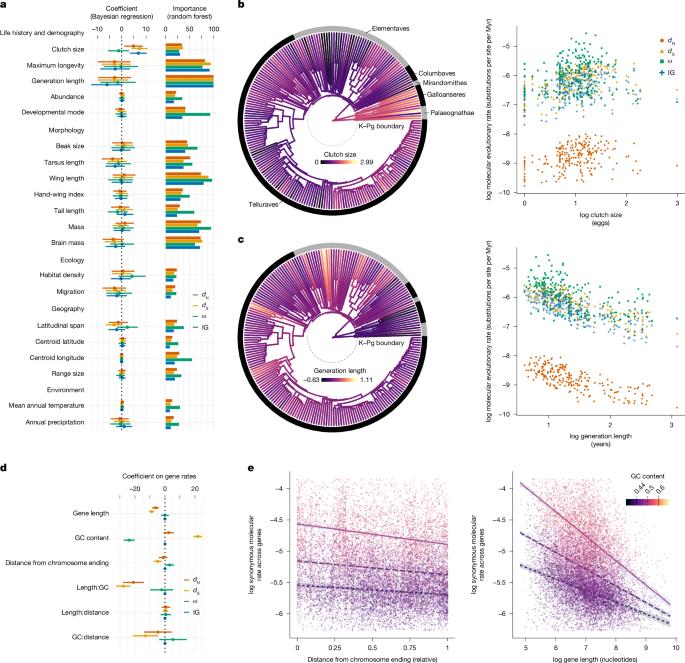
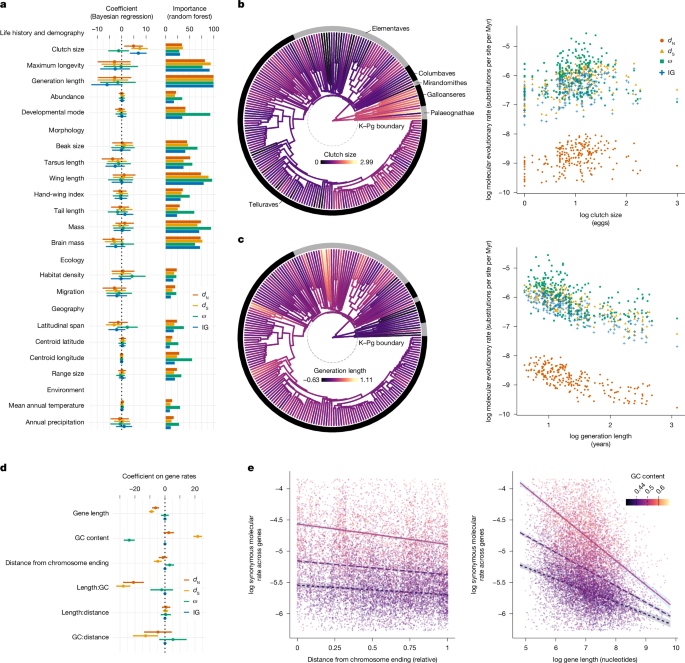
Modern birds have diversified into a striking array of forms, behaviours and ecological roles. Analyses of molecular evolutionary rates can reveal the links between genomic and phenotypic change1–4, but disentangling the drivers of rate variation at the whole-genome scale has been difficult. Using comprehensive estimates of traits and evolutionary rates across a family-level phylogeny of birds5,6, we find that genome-wide mutation rates across lineages are predominantly explained by clutch size and generation length, whereas rate variation across genes is driven by the content of guanine and cytosine. Here, to find the subsets of genes and lineages that dominate evolutionary rate variation in birds, we estimated the influence of individual lineages on decomposed axes of gene-specific evolutionary rates. We find that most of the rate variation occurs along recent branches of the tree, associated with present-day families of birds. Additional tests on axes of rate variation show rapid changes in microchromosomes immediately after the Cretaceous–Palaeogene transition. These apparent pulses of evolution are consistent with major changes in the genetic machineries for meiosis, heart performance, and RNA splicing, surveillance and translation, and correlate with the ecological diversity reflected in increased tarsus length. Collectively, our analyses paint a nuanced picture of avian evolution, revealing that the ancestors of the most diverse lineages of birds underwent major genomic changes related to mutation, gene usage and niche expansion in the early Palaeogene period. Genomic evolutionary rates are decomposed to identify the dominant lineages and genes driving rate variation across the phylogeny of birds.
期刊介绍:
Nature is a prestigious international journal that publishes peer-reviewed research in various scientific and technological fields. The selection of articles is based on criteria such as originality, importance, interdisciplinary relevance, timeliness, accessibility, elegance, and surprising conclusions. In addition to showcasing significant scientific advances, Nature delivers rapid, authoritative, insightful news, and interpretation of current and upcoming trends impacting science, scientists, and the broader public. The journal serves a dual purpose: firstly, to promptly share noteworthy scientific advances and foster discussions among scientists, and secondly, to ensure the swift dissemination of scientific results globally, emphasizing their significance for knowledge, culture, and daily life.




 京公网安备 11010802042870号
京ICP备2023020795号-1
京公网安备 11010802042870号
京ICP备2023020795号-1

 分享
分享
 求助内容:
求助内容: 应助结果提醒方式:
 扫码关注我们
