{"title":"Superconductivity controlled by twist angle in monolayer NbSe2 on graphene","authors":"Masahiro Naritsuka, Tadashi Machida, Shun Asano, Youichi Yanase, Tetsuo Hanaguri","doi":"10.1038/s41567-025-02828-6","DOIUrl":null,"url":null,"abstract":"Superconductivity serves as a basis for non-trivial quantum phenomena and devices, but they often require artificial control of the superconducting gap. In real space, there are various ways to tailor the superconducting gap, such as by introducing interfaces and defects. However, it is challenging to manipulate the superconducting gap in momentum space. Here we demonstrate that the superconducting gap of NbSe2 monolayers on graphene can be modified at specific momenta by changing the twist angle between the layers. Our spectroscopic-imaging-based scanning tunnelling microscopy experiments reveal the interference patterns of Bogoliubov quasiparticles that are twisted with respect to NbSe2 and graphene lattices. We find that these chiral interference patterns originate from the twist-dependent sextet of regions in momentum space in which the Fermi surfaces of the NbSe2 monolayer and graphene overlap. This finding not only broadens our understanding of superconductivity in twisted bilayer systems but also opens up possibilities for designing artificial superconducting materials and devices with tunable properties. Rotating material layers with respect to each other can change their electronic properties. Now, superconducting quasiparticles with a twisted configuration are demonstrated in a NbSe2 monolayer on graphene by controlling the twist angle.","PeriodicalId":19100,"journal":{"name":"Nature Physics","volume":"21 5","pages":"746-753"},"PeriodicalIF":18.4000,"publicationDate":"2025-03-20","publicationTypes":"Journal Article","fieldsOfStudy":null,"isOpenAccess":false,"openAccessPdf":"","citationCount":"0","resultStr":null,"platform":"Semanticscholar","paperid":null,"PeriodicalName":"Nature Physics","FirstCategoryId":"101","ListUrlMain":"https://www.nature.com/articles/s41567-025-02828-6","RegionNum":1,"RegionCategory":"物理与天体物理","ArticlePicture":[],"TitleCN":null,"AbstractTextCN":null,"PMCID":null,"EPubDate":"","PubModel":"","JCR":"Q1","JCRName":"PHYSICS, MULTIDISCIPLINARY","Score":null,"Total":0}
引用次数: 0
Abstract
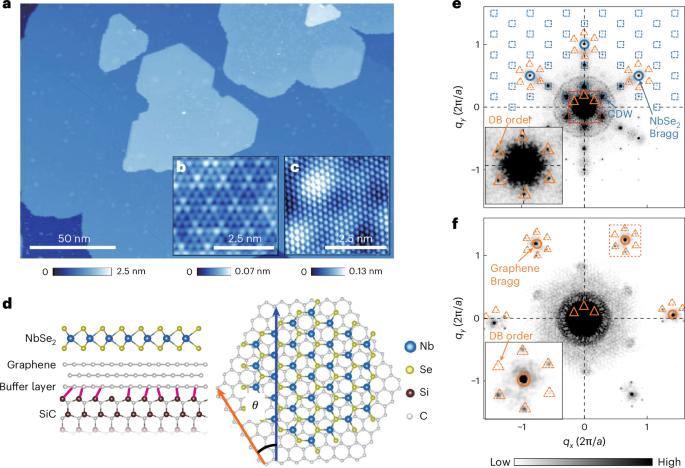
Superconductivity serves as a basis for non-trivial quantum phenomena and devices, but they often require artificial control of the superconducting gap. In real space, there are various ways to tailor the superconducting gap, such as by introducing interfaces and defects. However, it is challenging to manipulate the superconducting gap in momentum space. Here we demonstrate that the superconducting gap of NbSe2 monolayers on graphene can be modified at specific momenta by changing the twist angle between the layers. Our spectroscopic-imaging-based scanning tunnelling microscopy experiments reveal the interference patterns of Bogoliubov quasiparticles that are twisted with respect to NbSe2 and graphene lattices. We find that these chiral interference patterns originate from the twist-dependent sextet of regions in momentum space in which the Fermi surfaces of the NbSe2 monolayer and graphene overlap. This finding not only broadens our understanding of superconductivity in twisted bilayer systems but also opens up possibilities for designing artificial superconducting materials and devices with tunable properties. Rotating material layers with respect to each other can change their electronic properties. Now, superconducting quasiparticles with a twisted configuration are demonstrated in a NbSe2 monolayer on graphene by controlling the twist angle.
期刊介绍:
Nature Physics is dedicated to publishing top-tier original research in physics with a fair and rigorous review process. It provides high visibility and access to a broad readership, maintaining high standards in copy editing and production, ensuring rapid publication, and maintaining independence from academic societies and other vested interests.
The journal presents two main research paper formats: Letters and Articles. Alongside primary research, Nature Physics serves as a central source for valuable information within the physics community through Review Articles, News & Views, Research Highlights covering crucial developments across the physics literature, Commentaries, Book Reviews, and Correspondence.




 京公网安备 11010802042870号
京ICP备2023020795号-1
京公网安备 11010802042870号
京ICP备2023020795号-1

 分享
分享
 求助内容:
求助内容: 应助结果提醒方式:
 扫码关注我们
