Margot Sanchez, Thomas Paris, Anthony Martinez, Gaëtan Assemat and Serge Akoka
{"title":"The R2D3 approach towards fast quantitative NMR: maintaining accuracy and reducing the experimental time†","authors":"Margot Sanchez, Thomas Paris, Anthony Martinez, Gaëtan Assemat and Serge Akoka","doi":"10.1039/D4AN01369G","DOIUrl":null,"url":null,"abstract":"<p >Quantitative NMR experiments, especially on low-abundance nuclei such as <small><sup>13</sup></small>C, can be extremely time-consuming due to the various constraints to ensure the quality of the results: a high number of scans and a long recovery delay. We propose the combination of the DEFT pulse sequence and the R<small><sup>2</sup></small>D<small><sup>2</sup></small> method, hereafter referred to as R<small><sup>2</sup></small>D<small><sup>3</sup></small>. The addition of DEFT to the R<small><sup>2</sup></small>D<small><sup>2</sup></small> method reduces the quantitative limitations imposed by partial saturation. The parameters influencing the accuracy were evaluated with simulations and the quantitative performance of R<small><sup>2</sup></small>D<small><sup>3</sup></small> was assessed by observing the trueness and precision for three different samples. The effects of different processing steps – the number of added rows and apodization – are also discussed. A precision of 1% or less was obtained in almost all the cases, showing that the R<small><sup>2</sup></small>D<small><sup>3</sup></small> approach can drastically decrease the experimental time while retaining the key aspects of a quantitative experiment. A high time gain factor can be achieved, close to that of INEPT and without its drawbacks, when trueness is less critical than precision. The R<small><sup>2</sup></small>D<small><sup>3</sup></small> method will particularly benefit qNMR applications based on the observation of heteronuclei and the analysis of a large sample series.</p>","PeriodicalId":63,"journal":{"name":"Analyst","volume":" 9","pages":" 1939-1951"},"PeriodicalIF":3.3000,"publicationDate":"2025-03-20","publicationTypes":"Journal Article","fieldsOfStudy":null,"isOpenAccess":false,"openAccessPdf":"","citationCount":"0","resultStr":null,"platform":"Semanticscholar","paperid":null,"PeriodicalName":"Analyst","FirstCategoryId":"92","ListUrlMain":"https://pubs.rsc.org/en/content/articlelanding/2025/an/d4an01369g","RegionNum":3,"RegionCategory":"化学","ArticlePicture":[],"TitleCN":null,"AbstractTextCN":null,"PMCID":null,"EPubDate":"","PubModel":"","JCR":"Q2","JCRName":"CHEMISTRY, ANALYTICAL","Score":null,"Total":0}
引用次数: 0
Abstract
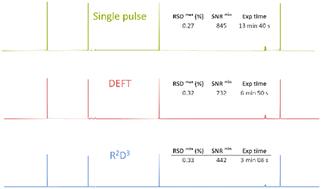
Quantitative NMR experiments, especially on low-abundance nuclei such as 13C, can be extremely time-consuming due to the various constraints to ensure the quality of the results: a high number of scans and a long recovery delay. We propose the combination of the DEFT pulse sequence and the R2D2 method, hereafter referred to as R2D3. The addition of DEFT to the R2D2 method reduces the quantitative limitations imposed by partial saturation. The parameters influencing the accuracy were evaluated with simulations and the quantitative performance of R2D3 was assessed by observing the trueness and precision for three different samples. The effects of different processing steps – the number of added rows and apodization – are also discussed. A precision of 1% or less was obtained in almost all the cases, showing that the R2D3 approach can drastically decrease the experimental time while retaining the key aspects of a quantitative experiment. A high time gain factor can be achieved, close to that of INEPT and without its drawbacks, when trueness is less critical than precision. The R2D3 method will particularly benefit qNMR applications based on the observation of heteronuclei and the analysis of a large sample series.



 京公网安备 11010802042870号
京ICP备2023020795号-1
京公网安备 11010802042870号
京ICP备2023020795号-1

 分享
分享
 求助内容:
求助内容: 应助结果提醒方式:
 扫码关注我们
