Ran Zhang, Jiyun Chen, Yihe Huang, Jianai Tang, Rongxia Zhao, Yuxiang Liu, Lei Lei, Degao Wang, Lin Li, Zhu Liu
{"title":"One-Step Laser Synthesis of Dual-Atom Alloy Catalysts for Hydrogen Evolution Reaction","authors":"Ran Zhang, Jiyun Chen, Yihe Huang, Jianai Tang, Rongxia Zhao, Yuxiang Liu, Lei Lei, Degao Wang, Lin Li, Zhu Liu","doi":"10.1002/adfm.202502205","DOIUrl":null,"url":null,"abstract":"<p>Recently, dual-atom alloy (DAA, also named diatomic alloy) catalysts with active metal dimers supported by a less active host metal have attracted considerable interest owing to their distinctive geometric and electrical configurations. Despite developing many ways for synthesizing DAA catalysts, most contemporary methods depend on high-temperature pyrolysis, costly apparatus, and intricate procedures. This study presents, for the first time, a one-step laser solid-phase synthesis of (PtRu)<sub>1</sub>Co DAAs on low-defect graphene support via ultraviolet (UV) laser irradiation of mixed metal precursors on a ZIF-67@PBI composite support. The special structure enhances the catalytic performance for hydrogen evolution reaction (HER) in an alkaline solution. An overpotential of 27 mV is reached at a current density of -10 mA cm⁻<sup>2</sup>. The mass activity at 200 mV is 19.6 times more than that of the commercial Pt/C catalyst. Moreover, the catalytic activity sustained stability over 100 h at -200 mA cm<sup>−2</sup>. The results demonstrated the potential of laser solid-phase synthesis as a viable method for synthesizing DAA catalysts via precise controlling defect formations on metal nanoparticles and carbon support. This one-step laser technique is rapid and cost-effective and opens up a new avenue toward large-scale synthesis of DAA catalysts.</p>","PeriodicalId":112,"journal":{"name":"Advanced Functional Materials","volume":"35 34","pages":""},"PeriodicalIF":19.0000,"publicationDate":"2025-03-20","publicationTypes":"Journal Article","fieldsOfStudy":null,"isOpenAccess":false,"openAccessPdf":"","citationCount":"0","resultStr":null,"platform":"Semanticscholar","paperid":null,"PeriodicalName":"Advanced Functional Materials","FirstCategoryId":"88","ListUrlMain":"https://advanced.onlinelibrary.wiley.com/doi/10.1002/adfm.202502205","RegionNum":1,"RegionCategory":"材料科学","ArticlePicture":[],"TitleCN":null,"AbstractTextCN":null,"PMCID":null,"EPubDate":"","PubModel":"","JCR":"Q1","JCRName":"CHEMISTRY, MULTIDISCIPLINARY","Score":null,"Total":0}
引用次数: 0
Abstract
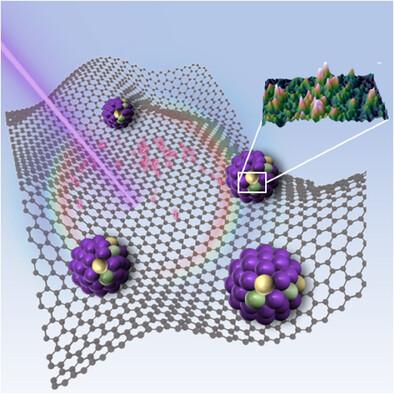
Recently, dual-atom alloy (DAA, also named diatomic alloy) catalysts with active metal dimers supported by a less active host metal have attracted considerable interest owing to their distinctive geometric and electrical configurations. Despite developing many ways for synthesizing DAA catalysts, most contemporary methods depend on high-temperature pyrolysis, costly apparatus, and intricate procedures. This study presents, for the first time, a one-step laser solid-phase synthesis of (PtRu)1Co DAAs on low-defect graphene support via ultraviolet (UV) laser irradiation of mixed metal precursors on a ZIF-67@PBI composite support. The special structure enhances the catalytic performance for hydrogen evolution reaction (HER) in an alkaline solution. An overpotential of 27 mV is reached at a current density of -10 mA cm⁻2. The mass activity at 200 mV is 19.6 times more than that of the commercial Pt/C catalyst. Moreover, the catalytic activity sustained stability over 100 h at -200 mA cm−2. The results demonstrated the potential of laser solid-phase synthesis as a viable method for synthesizing DAA catalysts via precise controlling defect formations on metal nanoparticles and carbon support. This one-step laser technique is rapid and cost-effective and opens up a new avenue toward large-scale synthesis of DAA catalysts.
期刊介绍:
Firmly established as a top-tier materials science journal, Advanced Functional Materials reports breakthrough research in all aspects of materials science, including nanotechnology, chemistry, physics, and biology every week.
Advanced Functional Materials is known for its rapid and fair peer review, quality content, and high impact, making it the first choice of the international materials science community.







 京公网安备 11010802042870号
京ICP备2023020795号-1
京公网安备 11010802042870号
京ICP备2023020795号-1

 分享
分享
 求助内容:
求助内容: 应助结果提醒方式:
 扫码关注我们
