Sustainable Waterborne Polyurethane Adhesive With Superstrong Adhesion Performance and Excellent Weatherability from Biomass Lignin and CO2-Based Polyols
{"title":"Sustainable Waterborne Polyurethane Adhesive With Superstrong Adhesion Performance and Excellent Weatherability from Biomass Lignin and CO2-Based Polyols","authors":"Rui Li, Lifeng Li, Wenlian Qiu, Dong Yu Zhu, Xueqing Qiu, Rongxian Ou, Baohua Liu, Weifeng Liu","doi":"10.1002/adfm.202422605","DOIUrl":null,"url":null,"abstract":"<p>Utilizing biomass and CO<sub>2</sub> to synthesize biodegradable and reusable polymeric materials is critical for addressing the dual challenges of petrochemical resource depletion and environmental pollution. Among emerging alternatives, CO<sub>2</sub>-based polyols (PPC) exhibit exceptional promise in replacing petroleum-based polyols; while, lignin stands as the most abundant aromatic biomass resource. However, integrating these feedstocks to produce high-performance polymeric materials with combined biodegradability, recyclability, and reusability remains technically demanding. In this work, a lignin-based waterborne polyurethane adhesive (LWPU) is developed using PPC and low-molecular-weight lignin (AOH), achieving a high solid content (53.2%) and outstanding overall properties. The incorporation of lignin strengthens hydrogen-bonding networks and increases crosslinking density, thereby enhancing cohesive energy density. The optimized LWPU demonstrates robust adhesion on diverse substrates, with lap shear strengths reaching 14.7 MPa (wood), 10.6 MPa (steel), and 9.0 MPa (aluminum). Notably, it maintains structural integrity under extreme thermal variations (–30 °C to 100 °C), high-humidity (95% ± 5% RH), and prolonged ultraviolet (UV) irradiation conditions. Further, the lignin-reinforced dynamic covalent and hydrogen bonds impart exceptional recyclability and reusability to the adhesives. This methodology establishes a sustainable pathway for designing high-performance bio-adhesives that synergistically utilize biomass and CO₂-derived feedstocks.</p>","PeriodicalId":112,"journal":{"name":"Advanced Functional Materials","volume":"35 34","pages":""},"PeriodicalIF":19.0000,"publicationDate":"2025-03-20","publicationTypes":"Journal Article","fieldsOfStudy":null,"isOpenAccess":false,"openAccessPdf":"","citationCount":"0","resultStr":null,"platform":"Semanticscholar","paperid":null,"PeriodicalName":"Advanced Functional Materials","FirstCategoryId":"88","ListUrlMain":"https://advanced.onlinelibrary.wiley.com/doi/10.1002/adfm.202422605","RegionNum":1,"RegionCategory":"材料科学","ArticlePicture":[],"TitleCN":null,"AbstractTextCN":null,"PMCID":null,"EPubDate":"","PubModel":"","JCR":"Q1","JCRName":"CHEMISTRY, MULTIDISCIPLINARY","Score":null,"Total":0}
引用次数: 0
Abstract
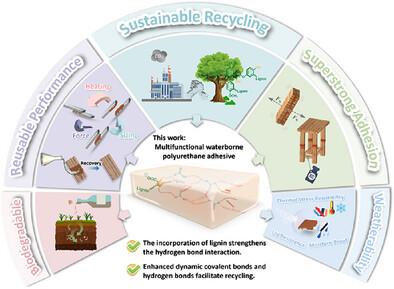
Utilizing biomass and CO2 to synthesize biodegradable and reusable polymeric materials is critical for addressing the dual challenges of petrochemical resource depletion and environmental pollution. Among emerging alternatives, CO2-based polyols (PPC) exhibit exceptional promise in replacing petroleum-based polyols; while, lignin stands as the most abundant aromatic biomass resource. However, integrating these feedstocks to produce high-performance polymeric materials with combined biodegradability, recyclability, and reusability remains technically demanding. In this work, a lignin-based waterborne polyurethane adhesive (LWPU) is developed using PPC and low-molecular-weight lignin (AOH), achieving a high solid content (53.2%) and outstanding overall properties. The incorporation of lignin strengthens hydrogen-bonding networks and increases crosslinking density, thereby enhancing cohesive energy density. The optimized LWPU demonstrates robust adhesion on diverse substrates, with lap shear strengths reaching 14.7 MPa (wood), 10.6 MPa (steel), and 9.0 MPa (aluminum). Notably, it maintains structural integrity under extreme thermal variations (–30 °C to 100 °C), high-humidity (95% ± 5% RH), and prolonged ultraviolet (UV) irradiation conditions. Further, the lignin-reinforced dynamic covalent and hydrogen bonds impart exceptional recyclability and reusability to the adhesives. This methodology establishes a sustainable pathway for designing high-performance bio-adhesives that synergistically utilize biomass and CO₂-derived feedstocks.
期刊介绍:
Firmly established as a top-tier materials science journal, Advanced Functional Materials reports breakthrough research in all aspects of materials science, including nanotechnology, chemistry, physics, and biology every week.
Advanced Functional Materials is known for its rapid and fair peer review, quality content, and high impact, making it the first choice of the international materials science community.







 京公网安备 11010802042870号
京ICP备2023020795号-1
京公网安备 11010802042870号
京ICP备2023020795号-1

 分享
分享
 求助内容:
求助内容: 应助结果提醒方式:
 扫码关注我们
