Moses C. Wambulwa, Guang-Fu Zhu, Ya-Huang Luo, Zeng-Yuan Wu, Jim Provan, Marc W. Cadotte, Alistair S. Jump, Francis N. Wachira, Lian-Ming Gao, Ting-Shuang Yi, Jie Cai, Hong Wang, De-Zhu Li, Jie Liu
{"title":"Incorporating Genetic Diversity to Optimize the Plant Conservation Network in the Third Pole","authors":"Moses C. Wambulwa, Guang-Fu Zhu, Ya-Huang Luo, Zeng-Yuan Wu, Jim Provan, Marc W. Cadotte, Alistair S. Jump, Francis N. Wachira, Lian-Ming Gao, Ting-Shuang Yi, Jie Cai, Hong Wang, De-Zhu Li, Jie Liu","doi":"10.1111/gcb.70122","DOIUrl":null,"url":null,"abstract":"<p>Climate change poses a significant threat to the survival of many species. Although protected areas can slow down biodiversity loss, they often lack systematic planning and do not integrate genetic diversity. Genetic diversity is a key prerequisite for species survival and the ability to tolerate new conditions. Using population genetic and distribution data from 96 plant species in the Third Pole (encompassing the Tibetan Plateau and adjacent mountains), we mapped patterns of genetic diversity, projected climate-driven range dynamics and future genetic erosion, and designed an optimal conservation framework for the region. We identified several patches of high haplotype diversity (<i>H</i><sub>D</sub>), with a relatively high number of haplotypes in southeastern Third Pole. Regression models revealed that climate and topography have interacted to shape patterns of genetic diversity, with latitude and precipitation being the best predictors for <i>H</i><sub>D</sub> of cpDNA and nrDNA, respectively. Ecological niche modeling predicted an approximate 43 km northwestward and 86 m upward shift in suitable habitats under future climate scenarios, likely leading to a significant loss of up to 13.19% and 15.49% of cpDNA and nrDNA genetic diversity, respectively. Alarmingly, 71.20% of the newly identified conservation priority areas fall outside of the existing protected areas and planned National Park Clusters. Therefore, we recommend expanding the network by 2.02 × 10<sup>5</sup> km<sup>2</sup> (5.91%) in the Third Pole, increasing the total conserved area to 1.36 × 10<sup>6</sup> km<sup>2</sup> (39.93%) to effectively preserve the evolutionary potential of plants. This study represents an innovative attempt to incorporate genetic diversity into biodiversity conservation efforts.</p>","PeriodicalId":175,"journal":{"name":"Global Change Biology","volume":"31 3","pages":""},"PeriodicalIF":12.0000,"publicationDate":"2025-03-20","publicationTypes":"Journal Article","fieldsOfStudy":null,"isOpenAccess":false,"openAccessPdf":"https://onlinelibrary.wiley.com/doi/epdf/10.1111/gcb.70122","citationCount":"0","resultStr":null,"platform":"Semanticscholar","paperid":null,"PeriodicalName":"Global Change Biology","FirstCategoryId":"93","ListUrlMain":"https://onlinelibrary.wiley.com/doi/10.1111/gcb.70122","RegionNum":1,"RegionCategory":"环境科学与生态学","ArticlePicture":[],"TitleCN":null,"AbstractTextCN":null,"PMCID":null,"EPubDate":"","PubModel":"","JCR":"Q1","JCRName":"BIODIVERSITY CONSERVATION","Score":null,"Total":0}
引用次数: 0
Abstract
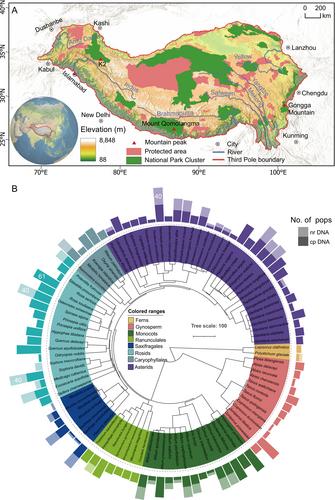
Climate change poses a significant threat to the survival of many species. Although protected areas can slow down biodiversity loss, they often lack systematic planning and do not integrate genetic diversity. Genetic diversity is a key prerequisite for species survival and the ability to tolerate new conditions. Using population genetic and distribution data from 96 plant species in the Third Pole (encompassing the Tibetan Plateau and adjacent mountains), we mapped patterns of genetic diversity, projected climate-driven range dynamics and future genetic erosion, and designed an optimal conservation framework for the region. We identified several patches of high haplotype diversity (HD), with a relatively high number of haplotypes in southeastern Third Pole. Regression models revealed that climate and topography have interacted to shape patterns of genetic diversity, with latitude and precipitation being the best predictors for HD of cpDNA and nrDNA, respectively. Ecological niche modeling predicted an approximate 43 km northwestward and 86 m upward shift in suitable habitats under future climate scenarios, likely leading to a significant loss of up to 13.19% and 15.49% of cpDNA and nrDNA genetic diversity, respectively. Alarmingly, 71.20% of the newly identified conservation priority areas fall outside of the existing protected areas and planned National Park Clusters. Therefore, we recommend expanding the network by 2.02 × 10⁵ km2 (5.91%) in the Third Pole, increasing the total conserved area to 1.36 × 10⁶ km2 (39.93%) to effectively preserve the evolutionary potential of plants. This study represents an innovative attempt to incorporate genetic diversity into biodiversity conservation efforts.
期刊介绍:
Global Change Biology is an environmental change journal committed to shaping the future and addressing the world's most pressing challenges, including sustainability, climate change, environmental protection, food and water safety, and global health.
Dedicated to fostering a profound understanding of the impacts of global change on biological systems and offering innovative solutions, the journal publishes a diverse range of content, including primary research articles, technical advances, research reviews, reports, opinions, perspectives, commentaries, and letters. Starting with the 2024 volume, Global Change Biology will transition to an online-only format, enhancing accessibility and contributing to the evolution of scholarly communication.




 京公网安备 11010802042870号
京ICP备2023020795号-1
京公网安备 11010802042870号
京ICP备2023020795号-1

 分享
分享
 求助内容:
求助内容: 应助结果提醒方式:
 扫码关注我们
