{"title":"Multitrack Boosted Hard Carbon Anodes: Innovative Paths and Advanced Performances in Sodium-Ion Batteries","authors":"Mingyang Li, Zijian Li, Fangyuan Bai, Haw Jiunn Woo, Zurina Osman, Bin Fei","doi":"10.1002/smll.202500645","DOIUrl":null,"url":null,"abstract":"<p>Sodium-ion batteries (SIBs) are emerging as a potential alternative to traditional lithium-ion batteries due to the abundant sodium resources. Carbon anodes, with their stable structure, wide availability, low cost, excellent conductivity, and tunable morphology and pore structure, exhibit outstanding performance in SIBs. This review summarizes the research progress of hard carbon anodes in SIBs, emphasizing the innovative paths and advanced performances achieved through multitrack optimization, including dimensional engineering, heteroatom doping, and microstructural tailoring. Each dimension of carbon material—0D, 1D, 2D, and 3D—offers unique advantages: 0D materials ensure uniform dispersion, 1D materials have short Na<sup>+</sup> diffusion paths, 2D materials possess large specific surface areas, and 3D materials provide e<sup>−</sup>/Na<sup>+</sup> conductive networks. Heteroatom doping with elements such as N, S, and P can tune electronic distribution, expand interlayer spacing of carbon, and induce Fermi level shifts, thereby enhancing sodium storage capability. In addition, defect engineering improves electrochemical performance by modifying graphitic crystal structure. Furthermore, suitable pore structure design, particularly closed pore structures, can increase capacity, minimizes side reactions, and suppress degradation. In future studies, optimizing morphology design, exploring heteroatom co-doping, and developing environmentally friendly, low-cost carbon anode methods will drive the application of high-performance and long cycle life SIBs.</p>","PeriodicalId":228,"journal":{"name":"Small","volume":"21 17","pages":""},"PeriodicalIF":12.1000,"publicationDate":"2025-03-20","publicationTypes":"Journal Article","fieldsOfStudy":null,"isOpenAccess":false,"openAccessPdf":"https://onlinelibrary.wiley.com/doi/epdf/10.1002/smll.202500645","citationCount":"0","resultStr":null,"platform":"Semanticscholar","paperid":null,"PeriodicalName":"Small","FirstCategoryId":"88","ListUrlMain":"https://onlinelibrary.wiley.com/doi/10.1002/smll.202500645","RegionNum":2,"RegionCategory":"材料科学","ArticlePicture":[],"TitleCN":null,"AbstractTextCN":null,"PMCID":null,"EPubDate":"","PubModel":"","JCR":"Q1","JCRName":"CHEMISTRY, MULTIDISCIPLINARY","Score":null,"Total":0}
引用次数: 0
Abstract
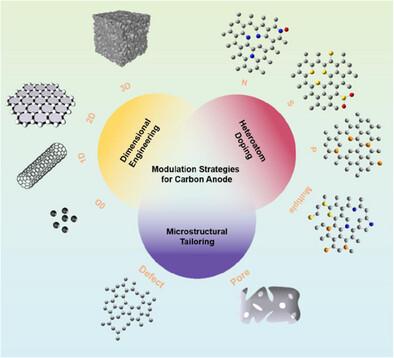
Sodium-ion batteries (SIBs) are emerging as a potential alternative to traditional lithium-ion batteries due to the abundant sodium resources. Carbon anodes, with their stable structure, wide availability, low cost, excellent conductivity, and tunable morphology and pore structure, exhibit outstanding performance in SIBs. This review summarizes the research progress of hard carbon anodes in SIBs, emphasizing the innovative paths and advanced performances achieved through multitrack optimization, including dimensional engineering, heteroatom doping, and microstructural tailoring. Each dimension of carbon material—0D, 1D, 2D, and 3D—offers unique advantages: 0D materials ensure uniform dispersion, 1D materials have short Na+ diffusion paths, 2D materials possess large specific surface areas, and 3D materials provide e−/Na+ conductive networks. Heteroatom doping with elements such as N, S, and P can tune electronic distribution, expand interlayer spacing of carbon, and induce Fermi level shifts, thereby enhancing sodium storage capability. In addition, defect engineering improves electrochemical performance by modifying graphitic crystal structure. Furthermore, suitable pore structure design, particularly closed pore structures, can increase capacity, minimizes side reactions, and suppress degradation. In future studies, optimizing morphology design, exploring heteroatom co-doping, and developing environmentally friendly, low-cost carbon anode methods will drive the application of high-performance and long cycle life SIBs.
期刊介绍:
Small serves as an exceptional platform for both experimental and theoretical studies in fundamental and applied interdisciplinary research at the nano- and microscale. The journal offers a compelling mix of peer-reviewed Research Articles, Reviews, Perspectives, and Comments.
With a remarkable 2022 Journal Impact Factor of 13.3 (Journal Citation Reports from Clarivate Analytics, 2023), Small remains among the top multidisciplinary journals, covering a wide range of topics at the interface of materials science, chemistry, physics, engineering, medicine, and biology.
Small's readership includes biochemists, biologists, biomedical scientists, chemists, engineers, information technologists, materials scientists, physicists, and theoreticians alike.




 京公网安备 11010802042870号
京ICP备2023020795号-1
京公网安备 11010802042870号
京ICP备2023020795号-1

 分享
分享
 求助内容:
求助内容: 应助结果提醒方式:
 扫码关注我们
