Lining Xu, Yingyu Zhang, Dingding Wang, Quanzhong Ren, Yi Wang, Zetong Zang, Anyi Guo, Jianxun Guo, Ling Wang, Renxian Wang, Yajun Liu
{"title":"Nanoparticle-Driven Skeletal Muscle Repair and Regeneration Through Macrophage-Muscle Stem Cell Interaction","authors":"Lining Xu, Yingyu Zhang, Dingding Wang, Quanzhong Ren, Yi Wang, Zetong Zang, Anyi Guo, Jianxun Guo, Ling Wang, Renxian Wang, Yajun Liu","doi":"10.1002/smll.202412611","DOIUrl":null,"url":null,"abstract":"<p>Macrophages are key innate immune cells in the muscle environment of sarcopenia patients, significantly influencing muscle stem cell (MuSC) proliferation and differentiation. However, prolonged activation of macrophages can hinder muscle recovery. In this study, it synthesizes lipoic acid-modified gold nanoparticles (LA-Au NPs) of varying sizes to evaluate their biocompatibility and immunomodulatory effects. The findings demonstrate that LA-Au NPs exhibit excellent biocompatibility with macrophages and promoted M2 polarization in a size-dependent manner. Mechanistically, LA-Au NPs facilitated metabolic reprogramming in macrophages by enhancing lysosomal autophagy and mitochondrial oxidative phosphorylation. Furthermore, macrophages are shown to chemotax toward MuSCs, regulating their proliferation via the chemokine system, inhibiting MuSC apoptosis, and enhancing differentiation under inflammatory conditions. In vivo studies have confirmed the safety and efficacy of LA-Au NPs in sarcopenia mice. To further enhance the effectiveness of LA-Au NPs, it investigates a delivery strategy that involves preconditioning macrophages with LA-Au NPs (Mac@Au NPs). Compared to the direct injection of LA-Au NPs, Mac@Au NPs demonstrate significantly greater benefits for muscle repair. This highlights the potential of macrophage therapy as a promising strategy for effective muscle regeneration and therapeutic intervention in sarcopenia.</p>","PeriodicalId":228,"journal":{"name":"Small","volume":"21 18","pages":""},"PeriodicalIF":12.1000,"publicationDate":"2025-03-20","publicationTypes":"Journal Article","fieldsOfStudy":null,"isOpenAccess":false,"openAccessPdf":"https://onlinelibrary.wiley.com/doi/epdf/10.1002/smll.202412611","citationCount":"0","resultStr":null,"platform":"Semanticscholar","paperid":null,"PeriodicalName":"Small","FirstCategoryId":"88","ListUrlMain":"https://onlinelibrary.wiley.com/doi/10.1002/smll.202412611","RegionNum":2,"RegionCategory":"材料科学","ArticlePicture":[],"TitleCN":null,"AbstractTextCN":null,"PMCID":null,"EPubDate":"","PubModel":"","JCR":"Q1","JCRName":"CHEMISTRY, MULTIDISCIPLINARY","Score":null,"Total":0}
引用次数: 0
Abstract
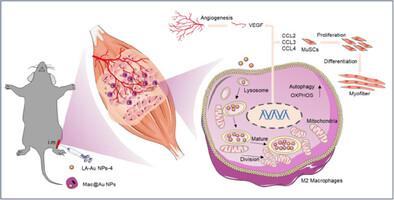
Macrophages are key innate immune cells in the muscle environment of sarcopenia patients, significantly influencing muscle stem cell (MuSC) proliferation and differentiation. However, prolonged activation of macrophages can hinder muscle recovery. In this study, it synthesizes lipoic acid-modified gold nanoparticles (LA-Au NPs) of varying sizes to evaluate their biocompatibility and immunomodulatory effects. The findings demonstrate that LA-Au NPs exhibit excellent biocompatibility with macrophages and promoted M2 polarization in a size-dependent manner. Mechanistically, LA-Au NPs facilitated metabolic reprogramming in macrophages by enhancing lysosomal autophagy and mitochondrial oxidative phosphorylation. Furthermore, macrophages are shown to chemotax toward MuSCs, regulating their proliferation via the chemokine system, inhibiting MuSC apoptosis, and enhancing differentiation under inflammatory conditions. In vivo studies have confirmed the safety and efficacy of LA-Au NPs in sarcopenia mice. To further enhance the effectiveness of LA-Au NPs, it investigates a delivery strategy that involves preconditioning macrophages with LA-Au NPs (Mac@Au NPs). Compared to the direct injection of LA-Au NPs, Mac@Au NPs demonstrate significantly greater benefits for muscle repair. This highlights the potential of macrophage therapy as a promising strategy for effective muscle regeneration and therapeutic intervention in sarcopenia.
期刊介绍:
Small serves as an exceptional platform for both experimental and theoretical studies in fundamental and applied interdisciplinary research at the nano- and microscale. The journal offers a compelling mix of peer-reviewed Research Articles, Reviews, Perspectives, and Comments.
With a remarkable 2022 Journal Impact Factor of 13.3 (Journal Citation Reports from Clarivate Analytics, 2023), Small remains among the top multidisciplinary journals, covering a wide range of topics at the interface of materials science, chemistry, physics, engineering, medicine, and biology.
Small's readership includes biochemists, biologists, biomedical scientists, chemists, engineers, information technologists, materials scientists, physicists, and theoreticians alike.




 京公网安备 11010802042870号
京ICP备2023020795号-1
京公网安备 11010802042870号
京ICP备2023020795号-1

 分享
分享
 求助内容:
求助内容: 应助结果提醒方式:
 扫码关注我们
