Yaxiao Lian, Yaxin Wang, Yucai Yuan, Zhixiang Ren, Weidong Tang, Zhe Liu, Shiyu Xing, Kangyu Ji, Bo Yuan, Yichen Yang, Yuxiang Gao, Shiang Zhang, Ke Zhou, Gan Zhang, Samuel D. Stranks, Baodan Zhao, Dawei Di
{"title":"Downscaling micro- and nano-perovskite LEDs","authors":"Yaxiao Lian, Yaxin Wang, Yucai Yuan, Zhixiang Ren, Weidong Tang, Zhe Liu, Shiyu Xing, Kangyu Ji, Bo Yuan, Yichen Yang, Yuxiang Gao, Shiang Zhang, Ke Zhou, Gan Zhang, Samuel D. Stranks, Baodan Zhao, Dawei Di","doi":"10.1038/s41586-025-08685-w","DOIUrl":null,"url":null,"abstract":"Many technological breakthroughs in electronics and photonics were made possible by downscaling—the process of making elementary devices smaller in size1–5. The downsizing of light-emitting diodes (LEDs) based on III–V semiconductors led to micro-LEDs5–12, an ‘ultimate technology’ for displays. However, micro-LEDs are costly to produce and they exhibit severe efficiency losses when the pixel sizes are reduced to about 10 μm or less, hindering their potential in commercial applications. Here we show the downscaling of an emerging class of LEDs based on perovskite semiconductors to below the conventional size limits. Micro- and nano-perovskite LEDs (micro-PeLEDs/nano-PeLEDs) with characteristic pixel lengths from hundreds of micrometres down to about 90 nm are demonstrated, through a localized contact fabrication scheme that prevents non-radiative losses at the pixel boundaries. For our near-infrared (NIR) and green micro-PeLEDs, average external quantum efficiencies (EQEs) are maintained at around 20% across a wide range of pixel lengths (650 to 3.5 μm), exhibiting minimum performance reduction on downsizing. Our nano-PeLEDs with characteristic pixel lengths down to about 90 nm represent the smallest LEDs reported, enabling a record-high pixel density of 127,000 pixels per inch (PPI) among all classes of LED arrays. Our demonstration showcases the strength of micro- and nano-PeLEDs as a next-generation light-source technology with unprecedented compactness and scalability. A process based on perovskite semiconductors is described to downscale micro-LEDs and nano-LEDs to below the conventional size limits, demonstrating average external quantum efficiencies maintained at around 20% across a wide range of pixel lengths.","PeriodicalId":18787,"journal":{"name":"Nature","volume":"640 8057","pages":"62-68"},"PeriodicalIF":48.5000,"publicationDate":"2025-03-19","publicationTypes":"Journal Article","fieldsOfStudy":null,"isOpenAccess":false,"openAccessPdf":"","citationCount":"0","resultStr":null,"platform":"Semanticscholar","paperid":null,"PeriodicalName":"Nature","FirstCategoryId":"103","ListUrlMain":"https://www.nature.com/articles/s41586-025-08685-w","RegionNum":1,"RegionCategory":"综合性期刊","ArticlePicture":[],"TitleCN":null,"AbstractTextCN":null,"PMCID":null,"EPubDate":"","PubModel":"","JCR":"Q1","JCRName":"MULTIDISCIPLINARY SCIENCES","Score":null,"Total":0}
引用次数: 0
Abstract
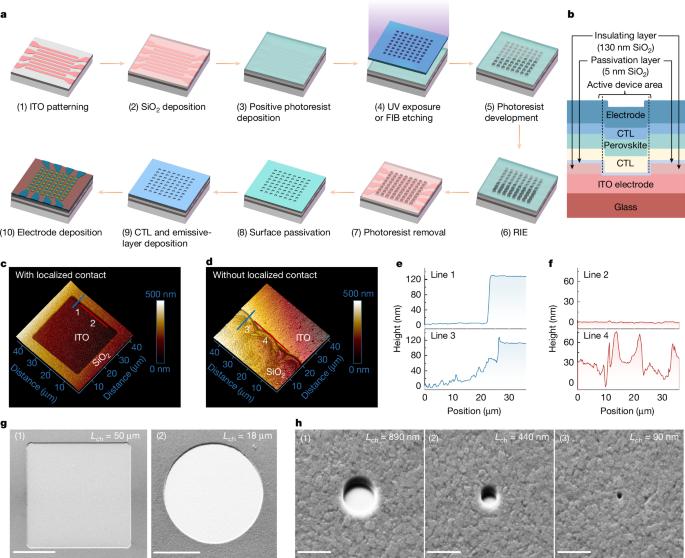
Many technological breakthroughs in electronics and photonics were made possible by downscaling—the process of making elementary devices smaller in size1–5. The downsizing of light-emitting diodes (LEDs) based on III–V semiconductors led to micro-LEDs5–12, an ‘ultimate technology’ for displays. However, micro-LEDs are costly to produce and they exhibit severe efficiency losses when the pixel sizes are reduced to about 10 μm or less, hindering their potential in commercial applications. Here we show the downscaling of an emerging class of LEDs based on perovskite semiconductors to below the conventional size limits. Micro- and nano-perovskite LEDs (micro-PeLEDs/nano-PeLEDs) with characteristic pixel lengths from hundreds of micrometres down to about 90 nm are demonstrated, through a localized contact fabrication scheme that prevents non-radiative losses at the pixel boundaries. For our near-infrared (NIR) and green micro-PeLEDs, average external quantum efficiencies (EQEs) are maintained at around 20% across a wide range of pixel lengths (650 to 3.5 μm), exhibiting minimum performance reduction on downsizing. Our nano-PeLEDs with characteristic pixel lengths down to about 90 nm represent the smallest LEDs reported, enabling a record-high pixel density of 127,000 pixels per inch (PPI) among all classes of LED arrays. Our demonstration showcases the strength of micro- and nano-PeLEDs as a next-generation light-source technology with unprecedented compactness and scalability. A process based on perovskite semiconductors is described to downscale micro-LEDs and nano-LEDs to below the conventional size limits, demonstrating average external quantum efficiencies maintained at around 20% across a wide range of pixel lengths.
期刊介绍:
Nature is a prestigious international journal that publishes peer-reviewed research in various scientific and technological fields. The selection of articles is based on criteria such as originality, importance, interdisciplinary relevance, timeliness, accessibility, elegance, and surprising conclusions. In addition to showcasing significant scientific advances, Nature delivers rapid, authoritative, insightful news, and interpretation of current and upcoming trends impacting science, scientists, and the broader public. The journal serves a dual purpose: firstly, to promptly share noteworthy scientific advances and foster discussions among scientists, and secondly, to ensure the swift dissemination of scientific results globally, emphasizing their significance for knowledge, culture, and daily life.



 京公网安备 11010802042870号
京ICP备2023020795号-1
京公网安备 11010802042870号
京ICP备2023020795号-1

 分享
分享
 求助内容:
求助内容: 应助结果提醒方式:
 扫码关注我们
