Bohan Li, Zhiquan Yuan, James Williams, Warren Jin, Adrian Beckert, Tian Xie, Joel Guo, Avi Feshali, Mario Paniccia, Andrei Faraon, John Bowers, Alireza Marandi, Kerry Vahala
{"title":"Down-converted photon pairs in a high-Q silicon nitride microresonator","authors":"Bohan Li, Zhiquan Yuan, James Williams, Warren Jin, Adrian Beckert, Tian Xie, Joel Guo, Avi Feshali, Mario Paniccia, Andrei Faraon, John Bowers, Alireza Marandi, Kerry Vahala","doi":"10.1038/s41586-025-08662-3","DOIUrl":null,"url":null,"abstract":"Entangled photon pairs from spontaneous parametric down-conversion (SPDC)1 are central to many quantum applications2–6. SPDC is typically performed in non-centrosymmetric systems7 with an inherent second-order nonlinearity (χ(2))8–10. We demonstrate strong narrowband SPDC with an on-chip rate of 0.8 million pairs per second in Si3N4. Si3N4 is the pre-eminent material for photonic integration and also exhibits the lowest waveguide loss (which is essential for integrated quantum circuits). However, being amorphous, silicon nitride lacks an intrinsic χ(2), which limits its role in photonic quantum devices. We enabled SPDC in Si3N4 by combining strong light-field enhancement inside a high optical Q-factor microcavity with an optically induced space-charge field. We present narrowband photon pairs with a high spectral brightness. The quantum nature of the down-converted photon pairs is verified through coincidence measurements. This light source, based on Si3N4 integrated photonics technology, unlocks new avenues for quantum systems on a chip. Spontaneous parametric down-conversion was used to generate narrowband photon pairs with a high spectral brightness in a high-Q silicon nitride microresonator.","PeriodicalId":18787,"journal":{"name":"Nature","volume":"639 8056","pages":"922-927"},"PeriodicalIF":48.5000,"publicationDate":"2025-03-19","publicationTypes":"Journal Article","fieldsOfStudy":null,"isOpenAccess":false,"openAccessPdf":"https://www.nature.com/articles/s41586-025-08662-3.pdf","citationCount":"0","resultStr":null,"platform":"Semanticscholar","paperid":null,"PeriodicalName":"Nature","FirstCategoryId":"103","ListUrlMain":"https://www.nature.com/articles/s41586-025-08662-3","RegionNum":1,"RegionCategory":"综合性期刊","ArticlePicture":[],"TitleCN":null,"AbstractTextCN":null,"PMCID":null,"EPubDate":"","PubModel":"","JCR":"Q1","JCRName":"MULTIDISCIPLINARY SCIENCES","Score":null,"Total":0}
引用次数: 0
Abstract
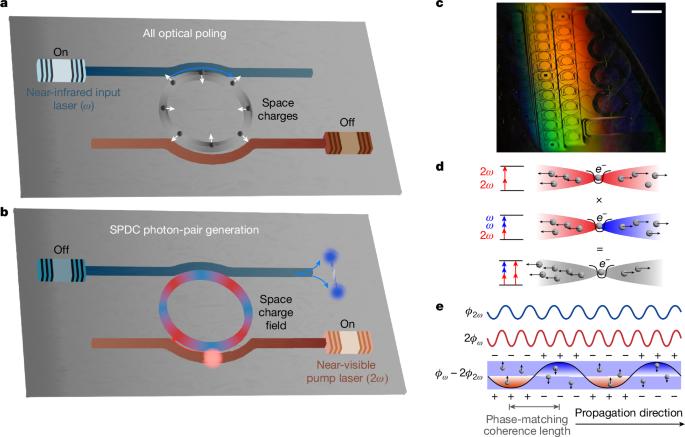
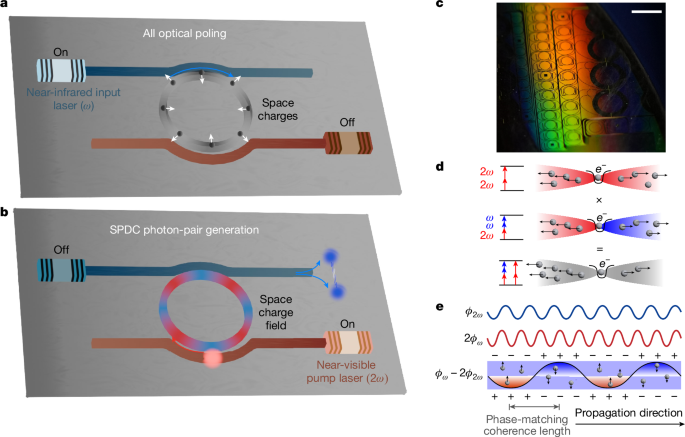
Entangled photon pairs from spontaneous parametric down-conversion (SPDC)1 are central to many quantum applications2–6. SPDC is typically performed in non-centrosymmetric systems7 with an inherent second-order nonlinearity (χ(2))8–10. We demonstrate strong narrowband SPDC with an on-chip rate of 0.8 million pairs per second in Si3N4. Si3N4 is the pre-eminent material for photonic integration and also exhibits the lowest waveguide loss (which is essential for integrated quantum circuits). However, being amorphous, silicon nitride lacks an intrinsic χ(2), which limits its role in photonic quantum devices. We enabled SPDC in Si3N4 by combining strong light-field enhancement inside a high optical Q-factor microcavity with an optically induced space-charge field. We present narrowband photon pairs with a high spectral brightness. The quantum nature of the down-converted photon pairs is verified through coincidence measurements. This light source, based on Si3N4 integrated photonics technology, unlocks new avenues for quantum systems on a chip. Spontaneous parametric down-conversion was used to generate narrowband photon pairs with a high spectral brightness in a high-Q silicon nitride microresonator.
期刊介绍:
Nature is a prestigious international journal that publishes peer-reviewed research in various scientific and technological fields. The selection of articles is based on criteria such as originality, importance, interdisciplinary relevance, timeliness, accessibility, elegance, and surprising conclusions. In addition to showcasing significant scientific advances, Nature delivers rapid, authoritative, insightful news, and interpretation of current and upcoming trends impacting science, scientists, and the broader public. The journal serves a dual purpose: firstly, to promptly share noteworthy scientific advances and foster discussions among scientists, and secondly, to ensure the swift dissemination of scientific results globally, emphasizing their significance for knowledge, culture, and daily life.



 京公网安备 11010802042870号
京ICP备2023020795号-1
京公网安备 11010802042870号
京ICP备2023020795号-1

 分享
分享
 求助内容:
求助内容: 应助结果提醒方式:
 扫码关注我们
