{"title":"Novel hydrogen-bonded organic framework (HOF) for highly efficient photocatalysis: From structural designs to multifunctional applications","authors":"Akanksha Chauhan , Rohit Kumar , Pankaj Raizada , Sourbh Thakur , Van-Huy Nguyen , Archana Singh , Quyet Van Le , Pardeep Singh , Anita Sudhaik","doi":"10.1016/j.ccr.2025.216634","DOIUrl":null,"url":null,"abstract":"<div><div>Hydrogen-bonded organic frameworks (HOFs), an emerging category of porous crystalline materials, are engineered via intermolecular H-bonding between organic monomers. Distinctive features of HOFs, including ease of solution processing, high crystallinity, and facile regeneration, have sparked significant research interest, providing innovative platforms for diverse multifunctional applications. Here, we summarize the strategies to expand the stability of HOFs, such as strengthening intermolecular interactions (via integrating multiple H-bonds and creating assisted H-bonds), introducing additional intermolecular interactions (including π–π stacking and Van der Waals (VDW) interactions), interpenetration, avoiding donor/acceptor structure formation, and cross-linking. In photocatalysis, visible light absorption is crucial, so to enhance this property of HOFs, several building blocks, including pyrene, perylene, porphyrin, heptazine units, and the addition of metal, are thoroughly discussed. Furthermore, this review explored the creation of heterojunctions, such as conventional heterojunction and Z/S-scheme, as modification strategies, along with their synergistic effects on enhancing the photocatalytic performance of HOF-based materials. With the growing immense potential applications of current HOF-related research in addressing critical environmental and energy challenges, this review emphasizes advancements in dyes and antibiotics degradation, energy conversion processes such as CO<sub>2</sub> conversion, H<sub>2</sub> and O<sub>2</sub> evolution, and reduction of toxic metal-ions, especially U(VI). Lastly, the forthcoming prospects and challenges related to HOFs are explored.</div></div>","PeriodicalId":289,"journal":{"name":"Coordination Chemistry Reviews","volume":"535 ","pages":"Article 216634"},"PeriodicalIF":23.5000,"publicationDate":"2025-03-19","publicationTypes":"Journal Article","fieldsOfStudy":null,"isOpenAccess":false,"openAccessPdf":"","citationCount":"0","resultStr":null,"platform":"Semanticscholar","paperid":null,"PeriodicalName":"Coordination Chemistry Reviews","FirstCategoryId":"92","ListUrlMain":"https://www.sciencedirect.com/science/article/pii/S0010854525002048","RegionNum":1,"RegionCategory":"化学","ArticlePicture":[],"TitleCN":null,"AbstractTextCN":null,"PMCID":null,"EPubDate":"","PubModel":"","JCR":"Q1","JCRName":"CHEMISTRY, INORGANIC & NUCLEAR","Score":null,"Total":0}
引用次数: 0
Abstract
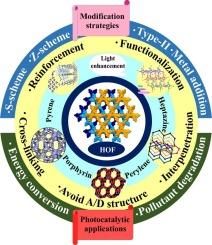
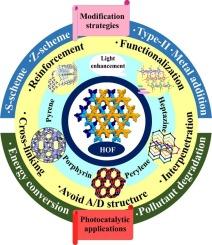
Hydrogen-bonded organic frameworks (HOFs), an emerging category of porous crystalline materials, are engineered via intermolecular H-bonding between organic monomers. Distinctive features of HOFs, including ease of solution processing, high crystallinity, and facile regeneration, have sparked significant research interest, providing innovative platforms for diverse multifunctional applications. Here, we summarize the strategies to expand the stability of HOFs, such as strengthening intermolecular interactions (via integrating multiple H-bonds and creating assisted H-bonds), introducing additional intermolecular interactions (including π–π stacking and Van der Waals (VDW) interactions), interpenetration, avoiding donor/acceptor structure formation, and cross-linking. In photocatalysis, visible light absorption is crucial, so to enhance this property of HOFs, several building blocks, including pyrene, perylene, porphyrin, heptazine units, and the addition of metal, are thoroughly discussed. Furthermore, this review explored the creation of heterojunctions, such as conventional heterojunction and Z/S-scheme, as modification strategies, along with their synergistic effects on enhancing the photocatalytic performance of HOF-based materials. With the growing immense potential applications of current HOF-related research in addressing critical environmental and energy challenges, this review emphasizes advancements in dyes and antibiotics degradation, energy conversion processes such as CO2 conversion, H2 and O2 evolution, and reduction of toxic metal-ions, especially U(VI). Lastly, the forthcoming prospects and challenges related to HOFs are explored.
期刊介绍:
Coordination Chemistry Reviews offers rapid publication of review articles on current and significant topics in coordination chemistry, encompassing organometallic, supramolecular, theoretical, and bioinorganic chemistry. It also covers catalysis, materials chemistry, and metal-organic frameworks from a coordination chemistry perspective. Reviews summarize recent developments or discuss specific techniques, welcoming contributions from both established and emerging researchers.
The journal releases special issues on timely subjects, including those featuring contributions from specific regions or conferences. Occasional full-length book articles are also featured. Additionally, special volumes cover annual reviews of main group chemistry, transition metal group chemistry, and organometallic chemistry. These comprehensive reviews are vital resources for those engaged in coordination chemistry, further establishing Coordination Chemistry Reviews as a hub for insightful surveys in inorganic and physical inorganic chemistry.



 京公网安备 11010802042870号
京ICP备2023020795号-1
京公网安备 11010802042870号
京ICP备2023020795号-1

 分享
分享
 求助内容:
求助内容: 应助结果提醒方式:
 扫码关注我们
