{"title":"Concept and Strategies: Equivalent Predictive Control and Handle Point Control for Bipedal-Vehicle Transformable Robots Under Various Disturbances","authors":"Chencheng Dong;Zhangguo Yu;Xuechao Chen;Junhang Lai;Jiayi Liu;Chao Li;Qiang Huang","doi":"10.1109/TASE.2025.3552429","DOIUrl":null,"url":null,"abstract":"Bipedal-vehicle transformable robots (BVTRs), equipped with driving wheels, combine the flexibility of bipedal locomotion with the speed of wheeled movement. However, maintaining balance across different formations under various external disturbances remains a significant challenge due to uncertain disturbance types and dynamic shifts between formations. To address these challenges, this paper introduces the concept of Equivalent Predictive Control (EPC), which models all disturbances as unified virtual wrenches and integrates them directly into the robot’s predictive control model, treated as an inertia-varying single rigid body. By anticipating the future impact of disturbances, EPC enhances stability and enables simultaneous handling of various disturbances. To address the challenge of dynamic changes, contact variations, and shifting constraints during formation transitions, we propose Handle Point Control (HPC). HPC simplifies multi-task tracking by reducing joint space control to a set of virtual target points, called ‘handle points’, such as knees, hips, and shoulders. This method facilitates real-time formation switching by tracking different handle points. Experiments on the BVTR platform BHR8-2 validate the effectiveness of the proposed control strategies. Note to Practitioners—This paper addresses two critical challenges for applying BVTRs in real-world industrial scenarios: 1) managing various external disturbances, and 2) overcoming the complexities associated with changing dynamics and contact situations during formation transitions. The proposed EPC strategy unifies all disturbance types and integrates them into the robot’s dynamic model, enhancing stability and adaptability across formations. The HPC method simplifies control by focusing on tracking key handle points, allowing smooth, real-time formation transitions without needing multiple optimization schemes. These methods can also be applied to other robotic systems that face similar control challenges.","PeriodicalId":51060,"journal":{"name":"IEEE Transactions on Automation Science and Engineering","volume":"22 ","pages":"13470-13484"},"PeriodicalIF":6.4000,"publicationDate":"2025-03-18","publicationTypes":"Journal Article","fieldsOfStudy":null,"isOpenAccess":false,"openAccessPdf":"","citationCount":"0","resultStr":null,"platform":"Semanticscholar","paperid":null,"PeriodicalName":"IEEE Transactions on Automation Science and Engineering","FirstCategoryId":"94","ListUrlMain":"https://ieeexplore.ieee.org/document/10930893/","RegionNum":2,"RegionCategory":"计算机科学","ArticlePicture":[],"TitleCN":null,"AbstractTextCN":null,"PMCID":null,"EPubDate":"","PubModel":"","JCR":"Q1","JCRName":"AUTOMATION & CONTROL SYSTEMS","Score":null,"Total":0}
引用次数: 0
Abstract
Bipedal-vehicle transformable robots (BVTRs), equipped with driving wheels, combine the flexibility of bipedal locomotion with the speed of wheeled movement. However, maintaining balance across different formations under various external disturbances remains a significant challenge due to uncertain disturbance types and dynamic shifts between formations. To address these challenges, this paper introduces the concept of Equivalent Predictive Control (EPC), which models all disturbances as unified virtual wrenches and integrates them directly into the robot’s predictive control model, treated as an inertia-varying single rigid body. By anticipating the future impact of disturbances, EPC enhances stability and enables simultaneous handling of various disturbances. To address the challenge of dynamic changes, contact variations, and shifting constraints during formation transitions, we propose Handle Point Control (HPC). HPC simplifies multi-task tracking by reducing joint space control to a set of virtual target points, called ‘handle points’, such as knees, hips, and shoulders. This method facilitates real-time formation switching by tracking different handle points. Experiments on the BVTR platform BHR8-2 validate the effectiveness of the proposed control strategies. Note to Practitioners—This paper addresses two critical challenges for applying BVTRs in real-world industrial scenarios: 1) managing various external disturbances, and 2) overcoming the complexities associated with changing dynamics and contact situations during formation transitions. The proposed EPC strategy unifies all disturbance types and integrates them into the robot’s dynamic model, enhancing stability and adaptability across formations. The HPC method simplifies control by focusing on tracking key handle points, allowing smooth, real-time formation transitions without needing multiple optimization schemes. These methods can also be applied to other robotic systems that face similar control challenges.
期刊介绍:
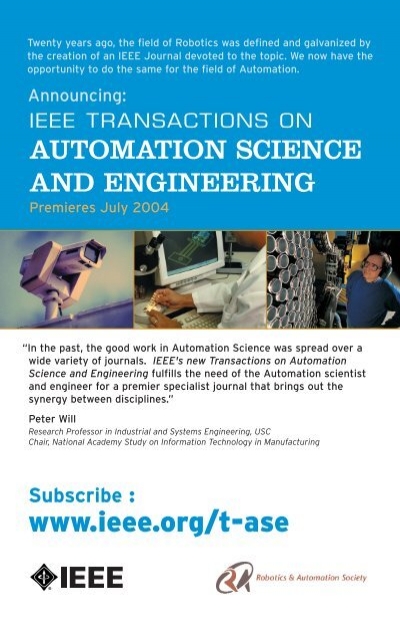
The IEEE Transactions on Automation Science and Engineering (T-ASE) publishes fundamental papers on Automation, emphasizing scientific results that advance efficiency, quality, productivity, and reliability. T-ASE encourages interdisciplinary approaches from computer science, control systems, electrical engineering, mathematics, mechanical engineering, operations research, and other fields. T-ASE welcomes results relevant to industries such as agriculture, biotechnology, healthcare, home automation, maintenance, manufacturing, pharmaceuticals, retail, security, service, supply chains, and transportation. T-ASE addresses a research community willing to integrate knowledge across disciplines and industries. For this purpose, each paper includes a Note to Practitioners that summarizes how its results can be applied or how they might be extended to apply in practice.



 京公网安备 11010802042870号
京ICP备2023020795号-1
京公网安备 11010802042870号
京ICP备2023020795号-1

 分享
分享
 求助内容:
求助内容: 应助结果提醒方式:
 扫码关注我们
