{"title":"Extraction of grape seeds by different solvents affects the activities of the resultant extract.","authors":"Kareem Tarek, Alyaa Farid, Gehan Safwat","doi":"10.1186/s13568-025-01851-3","DOIUrl":null,"url":null,"abstract":"<p><p>Phenolic compounds are concentrated in grape seeds; 60-70% of the extractable grape phenols are found in the seeds. The focus of this research was to isolate the phytochemicals from grape seed and to determine their ability to prevent haemolysis, their antioxidant and microbiological activities. By using the extraction procedure, three solvents were used (distilled water, ethanol and methanol). A high-performance liquid chromatographic (HPLC) test was performed to analyse the phenolic compounds and flavonoids content that were used to determine the efficiency of the various solvents used in the extraction process. All the variables under study, namely yield percentage, phenolic component concentration, and flavonoid content got significantly affected by the choice of the solvent used. The flavonoid content of the extracts was in the order methanolic extract > ethanolic extract > water extract. The methanolic extract of the grape seeds exhibited the most powerful antioxidant and hemolysis inhibitory effects among the three extracts, followed by the ethanolic and water extracts. The antibacterial activity of methanolic extract was found to be higher as compared to the ethanolic extract against Staphylococcus aureus. The antibacterial activity of the ethanolic and methanolic extracts against Salmonella enteritidis, Bacillus subtilis, Aspergillus niger and Escherichia coli were found to be equivalent. In conclusion, grape seeds contained several bioactive compounds that exerted an antioxidant, hemolysis inhibition and anti-microbial activities. These activities depends on the concentration of phenolic compounds and flavonoids in the grape seed extracts. Methanol was the superior solvent in the extraction process followed by ethanol.</p>","PeriodicalId":7537,"journal":{"name":"AMB Express","volume":"15 1","pages":"51"},"PeriodicalIF":3.7000,"publicationDate":"2025-03-19","publicationTypes":"Journal Article","fieldsOfStudy":null,"isOpenAccess":false,"openAccessPdf":"https://www.ncbi.nlm.nih.gov/pmc/articles/PMC11923327/pdf/","citationCount":"0","resultStr":null,"platform":"Semanticscholar","paperid":null,"PeriodicalName":"AMB Express","FirstCategoryId":"5","ListUrlMain":"https://doi.org/10.1186/s13568-025-01851-3","RegionNum":3,"RegionCategory":"生物学","ArticlePicture":[],"TitleCN":null,"AbstractTextCN":null,"PMCID":null,"EPubDate":"","PubModel":"","JCR":"Q2","JCRName":"BIOTECHNOLOGY & APPLIED MICROBIOLOGY","Score":null,"Total":0}
引用次数: 0
Abstract
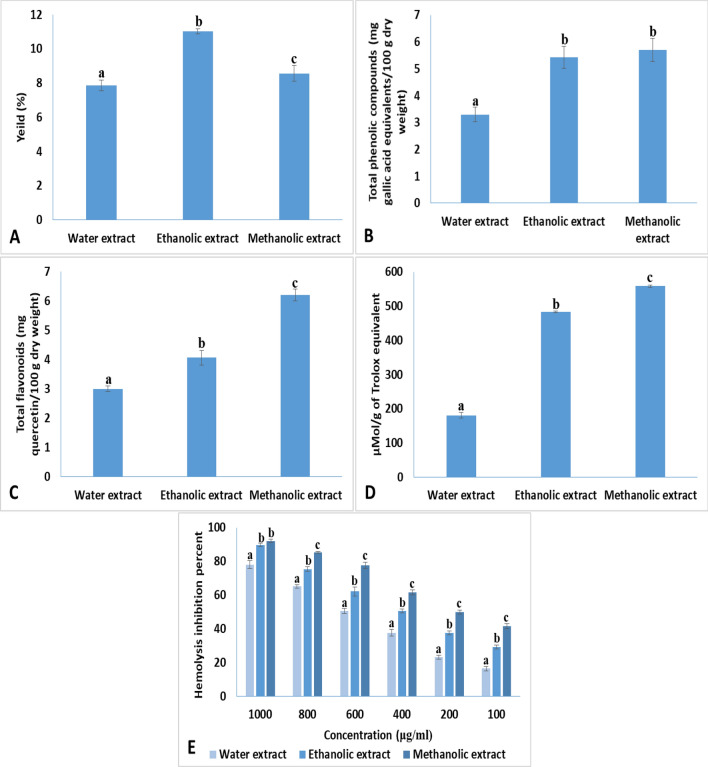
Phenolic compounds are concentrated in grape seeds; 60-70% of the extractable grape phenols are found in the seeds. The focus of this research was to isolate the phytochemicals from grape seed and to determine their ability to prevent haemolysis, their antioxidant and microbiological activities. By using the extraction procedure, three solvents were used (distilled water, ethanol and methanol). A high-performance liquid chromatographic (HPLC) test was performed to analyse the phenolic compounds and flavonoids content that were used to determine the efficiency of the various solvents used in the extraction process. All the variables under study, namely yield percentage, phenolic component concentration, and flavonoid content got significantly affected by the choice of the solvent used. The flavonoid content of the extracts was in the order methanolic extract > ethanolic extract > water extract. The methanolic extract of the grape seeds exhibited the most powerful antioxidant and hemolysis inhibitory effects among the three extracts, followed by the ethanolic and water extracts. The antibacterial activity of methanolic extract was found to be higher as compared to the ethanolic extract against Staphylococcus aureus. The antibacterial activity of the ethanolic and methanolic extracts against Salmonella enteritidis, Bacillus subtilis, Aspergillus niger and Escherichia coli were found to be equivalent. In conclusion, grape seeds contained several bioactive compounds that exerted an antioxidant, hemolysis inhibition and anti-microbial activities. These activities depends on the concentration of phenolic compounds and flavonoids in the grape seed extracts. Methanol was the superior solvent in the extraction process followed by ethanol.
期刊介绍:
AMB Express is a high quality journal that brings together research in the area of Applied and Industrial Microbiology with a particular interest in ''White Biotechnology'' and ''Red Biotechnology''. The emphasis is on processes employing microorganisms, eukaryotic cell cultures or enzymes for the biosynthesis, transformation and degradation of compounds. This includes fine and bulk chemicals, polymeric compounds and enzymes or other proteins. Downstream processes are also considered. Integrated processes combining biochemical and chemical processes are also published.




 京公网安备 11010802042870号
京ICP备2023020795号-1
京公网安备 11010802042870号
京ICP备2023020795号-1

 分享
分享
 求助内容:
求助内容: 应助结果提醒方式:
 扫码关注我们
