{"title":"HPV integration profiling using nanopore sequencing and association with cervical precancerous lesion.","authors":"Ying Hou, Shoufeng Ni, Xin Liu, Xingyu Liu, Nan Wang, Fuqiang Xu, Jianyong Gao, Yanmei Li, Yuxiang Zhou, Huadong Tang, Meina Bian, Xiulan Li, Lili Zhang, Weiwei Wang, Qing Liu","doi":"10.3389/fmicb.2025.1522550","DOIUrl":null,"url":null,"abstract":"<p><strong>Objectives: </strong>HPV infection and HPV DNA integration can lead to cervical cancer, but the relationship with lesion severity is unclear. This study aimed to investigate the correlation between HPV integration profile and cervical lesion extent.</p><p><strong>Materials and methods: </strong>Twenty patients representing cervicitis, CIN I, CIN II, and CIN III underwent nanopore sequencing for HPV genotype and integration site analysis. HPV integration profiles were correlated with lesion severity. Gene Ontology (GO) and KEGG analysis were used to identify stage-specific genes and pathways.</p><p><strong>Results: </strong>HPV integration rates were 60, 60, 100, and 100% for cervicitis, CIN I, CIN II, and CIN III, respectively, with varying numbers of integrated genes. Each group had specific stage-related genes, with 83 shared genes linked to neuron development and cell-cell processes. CIN II and CIN III displayed more cancer-related pathway enrichment than earlier stages.</p><p><strong>Conclusion: </strong>A positive correlation exists between HPV integration frequency and cervical lesion stage. Late-stage lesions showed heightened enrichment in cancer-related pathways through specific HPV-integrated genes.</p>","PeriodicalId":12466,"journal":{"name":"Frontiers in Microbiology","volume":"16 ","pages":"1522550"},"PeriodicalIF":4.0000,"publicationDate":"2025-03-05","publicationTypes":"Journal Article","fieldsOfStudy":null,"isOpenAccess":false,"openAccessPdf":"https://www.ncbi.nlm.nih.gov/pmc/articles/PMC11920162/pdf/","citationCount":"0","resultStr":null,"platform":"Semanticscholar","paperid":null,"PeriodicalName":"Frontiers in Microbiology","FirstCategoryId":"99","ListUrlMain":"https://doi.org/10.3389/fmicb.2025.1522550","RegionNum":2,"RegionCategory":"生物学","ArticlePicture":[],"TitleCN":null,"AbstractTextCN":null,"PMCID":null,"EPubDate":"2025/1/1 0:00:00","PubModel":"eCollection","JCR":"Q2","JCRName":"MICROBIOLOGY","Score":null,"Total":0}
引用次数: 0
Abstract
Objectives: HPV infection and HPV DNA integration can lead to cervical cancer, but the relationship with lesion severity is unclear. This study aimed to investigate the correlation between HPV integration profile and cervical lesion extent.
Materials and methods: Twenty patients representing cervicitis, CIN I, CIN II, and CIN III underwent nanopore sequencing for HPV genotype and integration site analysis. HPV integration profiles were correlated with lesion severity. Gene Ontology (GO) and KEGG analysis were used to identify stage-specific genes and pathways.
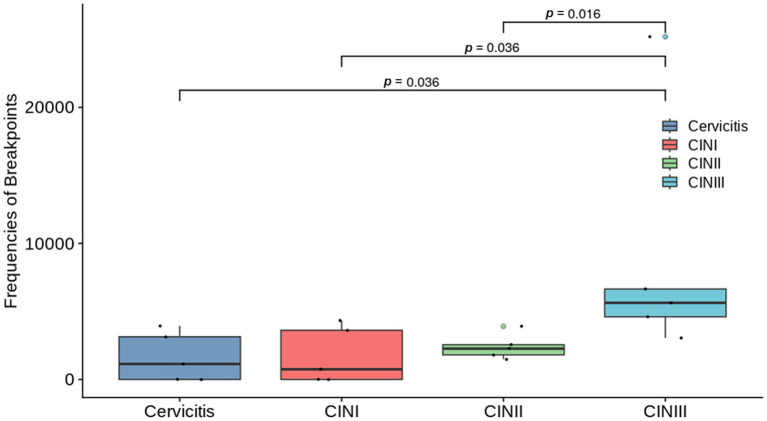
Results: HPV integration rates were 60, 60, 100, and 100% for cervicitis, CIN I, CIN II, and CIN III, respectively, with varying numbers of integrated genes. Each group had specific stage-related genes, with 83 shared genes linked to neuron development and cell-cell processes. CIN II and CIN III displayed more cancer-related pathway enrichment than earlier stages.
Conclusion: A positive correlation exists between HPV integration frequency and cervical lesion stage. Late-stage lesions showed heightened enrichment in cancer-related pathways through specific HPV-integrated genes.
期刊介绍:
Frontiers in Microbiology is a leading journal in its field, publishing rigorously peer-reviewed research across the entire spectrum of microbiology. Field Chief Editor Martin G. Klotz at Washington State University is supported by an outstanding Editorial Board of international researchers. This multidisciplinary open-access journal is at the forefront of disseminating and communicating scientific knowledge and impactful discoveries to researchers, academics, clinicians and the public worldwide.





 京公网安备 11010802042870号
京ICP备2023020795号-1
京公网安备 11010802042870号
京ICP备2023020795号-1

 分享
分享
 求助内容:
求助内容: 应助结果提醒方式:
 扫码关注我们
