{"title":"Summary of best evidence for prevention of postoperative pulmonary complications after surgery for patients undergoing gastric cancer operations.","authors":"Mengnan Li, Guang Fu, Wenjuan Mo, Yuanyuan Yan","doi":"10.3389/fonc.2025.1515502","DOIUrl":null,"url":null,"abstract":"<p><strong>Background: </strong>Postoperative pulmonary complications in gastric cancer surgery significantly impact patient recovery and prognosis. These complications, including infections, can increase hospital stays and costs, and even lead to death. Numerous risk factors are involved, such as age, smoking history, and lung function. Although preventive measures exist, a unified and effective strategy is lacking. Therefore, researching and implementing effective prevention measures is crucial for improving patients' postoperative quality of life and survival rates.</p><p><strong>Aim: </strong>To collate and summarize the best available evidence for the prevention of pulmonary complications in patients undergoing gastric cancer surgery, thereby providing a reference for the clinical development of relevant intervention strategies.</p><p><strong>Methods: </strong>A literature search was conducted in databases including BMJ Best Practice, UpToDate, JBI, Cochrane Library, PubMed, Embase, the Ontario Nurses Registration Network, the U.S. National Clinical Practice Guidelines, and MedLine, for documents related to the prevention of pulmonary complications in gastric cancer surgery patients. The search period extended from the inception of these databases to July 25, 2024. The quality of the literature was evaluated according to the standards of the Joanna Briggs Institute (JBI) Evidence-Based Health Care Center, and evidence was extracted from the included documents.</p><p><strong>Results: </strong>A total of 27 documents were ultimately included. The extracted content encompassed three areas: preoperative assessment, risk prevention and intervention measures, totaling 31 best evidences across five categories. The findings of our study underscore the significance of comprehensive preoperative assessments, such as the ARISCAT index for pulmonary risk evaluation, and stress the importance of preoperative interventions like inspiratory muscle training, smoking cessation, and oral care in mitigating postoperative pulmonary complications (PPCs) following gastric cancer surgery. We also advocate for the adoption of protective lung ventilation strategies during surgery and continuous pulse oximetry monitoring postoperatively, along with targeted treatments for specific complications.</p><p><strong>Conclusion: </strong>The best evidence extracted for the prevention of complications in gastric cancer surgery patients serves as a basis for evidence-based practice for the prevention of pulmonary complications in this patient group. Further research topics on pulmonary complications of gastric cancer, we recommend further optimization of preoperative assessment tools, investigation into the efficacy of smoking cessation programs, comparative studies on intraoperative ventilation strategies, development of postoperative rehabilitation programs, and research into culturally and resource-sensitive interventions to broaden the global applicability of these practices.</p>","PeriodicalId":12482,"journal":{"name":"Frontiers in Oncology","volume":"15 ","pages":"1515502"},"PeriodicalIF":3.5000,"publicationDate":"2025-03-05","publicationTypes":"Journal Article","fieldsOfStudy":null,"isOpenAccess":false,"openAccessPdf":"https://www.ncbi.nlm.nih.gov/pmc/articles/PMC11919682/pdf/","citationCount":"0","resultStr":null,"platform":"Semanticscholar","paperid":null,"PeriodicalName":"Frontiers in Oncology","FirstCategoryId":"3","ListUrlMain":"https://doi.org/10.3389/fonc.2025.1515502","RegionNum":3,"RegionCategory":"医学","ArticlePicture":[],"TitleCN":null,"AbstractTextCN":null,"PMCID":null,"EPubDate":"2025/1/1 0:00:00","PubModel":"eCollection","JCR":"Q2","JCRName":"ONCOLOGY","Score":null,"Total":0}
引用次数: 0
Abstract
Background: Postoperative pulmonary complications in gastric cancer surgery significantly impact patient recovery and prognosis. These complications, including infections, can increase hospital stays and costs, and even lead to death. Numerous risk factors are involved, such as age, smoking history, and lung function. Although preventive measures exist, a unified and effective strategy is lacking. Therefore, researching and implementing effective prevention measures is crucial for improving patients' postoperative quality of life and survival rates.
Aim: To collate and summarize the best available evidence for the prevention of pulmonary complications in patients undergoing gastric cancer surgery, thereby providing a reference for the clinical development of relevant intervention strategies.
Methods: A literature search was conducted in databases including BMJ Best Practice, UpToDate, JBI, Cochrane Library, PubMed, Embase, the Ontario Nurses Registration Network, the U.S. National Clinical Practice Guidelines, and MedLine, for documents related to the prevention of pulmonary complications in gastric cancer surgery patients. The search period extended from the inception of these databases to July 25, 2024. The quality of the literature was evaluated according to the standards of the Joanna Briggs Institute (JBI) Evidence-Based Health Care Center, and evidence was extracted from the included documents.
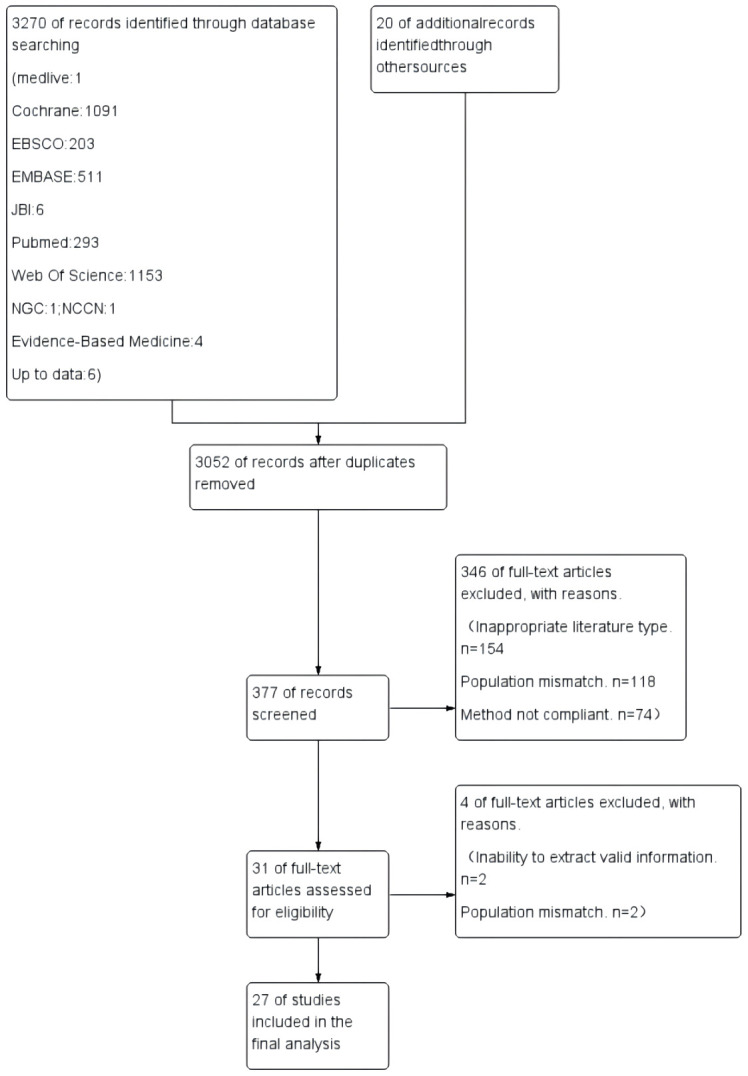
Results: A total of 27 documents were ultimately included. The extracted content encompassed three areas: preoperative assessment, risk prevention and intervention measures, totaling 31 best evidences across five categories. The findings of our study underscore the significance of comprehensive preoperative assessments, such as the ARISCAT index for pulmonary risk evaluation, and stress the importance of preoperative interventions like inspiratory muscle training, smoking cessation, and oral care in mitigating postoperative pulmonary complications (PPCs) following gastric cancer surgery. We also advocate for the adoption of protective lung ventilation strategies during surgery and continuous pulse oximetry monitoring postoperatively, along with targeted treatments for specific complications.
Conclusion: The best evidence extracted for the prevention of complications in gastric cancer surgery patients serves as a basis for evidence-based practice for the prevention of pulmonary complications in this patient group. Further research topics on pulmonary complications of gastric cancer, we recommend further optimization of preoperative assessment tools, investigation into the efficacy of smoking cessation programs, comparative studies on intraoperative ventilation strategies, development of postoperative rehabilitation programs, and research into culturally and resource-sensitive interventions to broaden the global applicability of these practices.
背景:胃癌手术后肺部并发症显著影响患者的康复和预后。包括感染在内的这些并发症会增加住院时间和费用,甚至导致死亡。有许多危险因素,如年龄、吸烟史和肺功能。虽然有预防措施,但缺乏统一和有效的战略。因此,研究并实施有效的预防措施对提高患者术后生活质量和生存率至关重要。目的:整理和总结现有预防胃癌手术患者肺部并发症的最佳证据,为相关干预策略的临床制定提供参考。方法:在BMJ Best Practice、UpToDate、JBI、Cochrane Library、PubMed、Embase、安大略省护士注册网络、美国国家临床实践指南和MedLine等数据库中检索与胃癌手术患者肺并发症预防相关的文献。搜索期从这些数据库建立之初一直延伸到2024年7月25日。根据乔安娜布里格斯研究所(JBI)循证卫生保健中心的标准评估文献的质量,并从纳入的文献中提取证据。结果:最终共纳入27篇文献。提取的内容包括术前评估、风险预防和干预措施三个方面,共5类31项最佳证据。我们的研究结果强调了全面的术前评估的重要性,如ARISCAT指数对肺部风险评估,并强调了术前干预如吸气肌训练、戒烟和口腔护理对减轻胃癌手术后肺部并发症(PPCs)的重要性。我们还提倡术中采用保护性肺通气策略,术后持续脉搏血氧监测,并针对特定并发症进行针对性治疗。结论:所提取的预防胃癌手术患者并发症的最佳证据,为预防该患者组肺部并发症的循证实践提供了依据。进一步研究胃癌的肺部并发症,我们建议进一步优化术前评估工具,调查戒烟计划的疗效,术中通气策略的比较研究,制定术后康复计划,研究文化和资源敏感的干预措施,以扩大这些做法的全球适用性。
期刊介绍:
Cancer Imaging and Diagnosis is dedicated to the publication of results from clinical and research studies applied to cancer diagnosis and treatment. The section aims to publish studies from the entire field of cancer imaging: results from routine use of clinical imaging in both radiology and nuclear medicine, results from clinical trials, experimental molecular imaging in humans and small animals, research on new contrast agents in CT, MRI, ultrasound, publication of new technical applications and processing algorithms to improve the standardization of quantitative imaging and image guided interventions for the diagnosis and treatment of cancer.



 京公网安备 11010802042870号
京ICP备2023020795号-1
京公网安备 11010802042870号
京ICP备2023020795号-1

 分享
分享
 求助内容:
求助内容: 应助结果提醒方式:
 扫码关注我们
