Comparison of safety and efficacy of different endovascular treatments for symptomatic intracranial atherosclerotic stenosis: results from a single center.
{"title":"Comparison of safety and efficacy of different endovascular treatments for symptomatic intracranial atherosclerotic stenosis: results from a single center.","authors":"Qiao Lin, Kaiyi Zhong, Xiyue Pan, Congfang Li, Xiaozhen Lu, Naidong Wang","doi":"10.3389/fneur.2025.1539127","DOIUrl":null,"url":null,"abstract":"<p><strong>Background: </strong>Symptomatic intracranial atherosclerotic stenosis (sICAS) is one of the common causes of ischemic stroke. However, the treatment of sICAS has remained a challenge in the past with unfavorable findings. This study aimed to evaluate the effectiveness and safety of different endovascular treatment methods for sICAS.</p><p><strong>Methods: </strong>The study involved 154 patients with sICAS who received endovascular treatment at Qingdao University Hospital between January 2021 and October 2023. Based on the characteristics of the lesions, three different types of treatments were performed: bare metal stent group (BMS group), drug-coated balloon group (DCB group), and drug-eluting stent group (DES group). The primary endpoints included the incidence of in-stent restenosis (ISR) in the 6-month, periprocedural complications, the rate of stroke recurrence in the area of the stented artery during the follow-up period, and modified Rankin score (mRS) at discharge, at 1-month, at 3-month, at 6-month of patients after stenting.</p><p><strong>Results: </strong>The incidence of perioperative complications did not differ significantly between groups (11.3% in the BMS group, 8.0% in the DCB group, and 6.1% in the DES group, <i>p</i> = 0.776). All patients (154/154) had successful reperfusion after endovascular treatment. The incidence of stroke during follow-up was 4.5% (7/154), with 5 (7.0%) patients in the BMS group, 1 (2.0%) patient in the DCB group, and 1 (3.0%) patient in the DES group. The restenosis rate in the BMS group [35.2% (25/71)] tended to be higher than that in the DCB group [6.0% (3/50)] and DES group [9.1% (3/33)]. In multivariate logistic regression analysis, endovascular treatment strategy and vessel distribution were significant independent risk factors for ISR within 6 months (<i>p</i> < 0.05).</p><p><strong>Conclusion: </strong>Adverse events and success rates following stent implantation are comparable across therapy groups in individuals with sICAS. When compared to BMS, DES, and DCB reduce the risk of ISR, with the advantages of the DCB appearing to be greater for some high-risk patients with ICAS.</p>","PeriodicalId":12575,"journal":{"name":"Frontiers in Neurology","volume":"16 ","pages":"1539127"},"PeriodicalIF":2.8000,"publicationDate":"2025-03-05","publicationTypes":"Journal Article","fieldsOfStudy":null,"isOpenAccess":false,"openAccessPdf":"https://www.ncbi.nlm.nih.gov/pmc/articles/PMC11919668/pdf/","citationCount":"0","resultStr":null,"platform":"Semanticscholar","paperid":null,"PeriodicalName":"Frontiers in Neurology","FirstCategoryId":"3","ListUrlMain":"https://doi.org/10.3389/fneur.2025.1539127","RegionNum":3,"RegionCategory":"医学","ArticlePicture":[],"TitleCN":null,"AbstractTextCN":null,"PMCID":null,"EPubDate":"2025/1/1 0:00:00","PubModel":"eCollection","JCR":"Q2","JCRName":"CLINICAL NEUROLOGY","Score":null,"Total":0}
引用次数: 0
Abstract
Background: Symptomatic intracranial atherosclerotic stenosis (sICAS) is one of the common causes of ischemic stroke. However, the treatment of sICAS has remained a challenge in the past with unfavorable findings. This study aimed to evaluate the effectiveness and safety of different endovascular treatment methods for sICAS.
Methods: The study involved 154 patients with sICAS who received endovascular treatment at Qingdao University Hospital between January 2021 and October 2023. Based on the characteristics of the lesions, three different types of treatments were performed: bare metal stent group (BMS group), drug-coated balloon group (DCB group), and drug-eluting stent group (DES group). The primary endpoints included the incidence of in-stent restenosis (ISR) in the 6-month, periprocedural complications, the rate of stroke recurrence in the area of the stented artery during the follow-up period, and modified Rankin score (mRS) at discharge, at 1-month, at 3-month, at 6-month of patients after stenting.
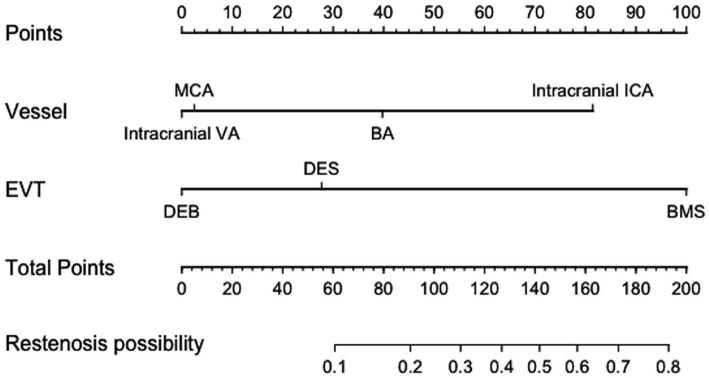
Results: The incidence of perioperative complications did not differ significantly between groups (11.3% in the BMS group, 8.0% in the DCB group, and 6.1% in the DES group, p = 0.776). All patients (154/154) had successful reperfusion after endovascular treatment. The incidence of stroke during follow-up was 4.5% (7/154), with 5 (7.0%) patients in the BMS group, 1 (2.0%) patient in the DCB group, and 1 (3.0%) patient in the DES group. The restenosis rate in the BMS group [35.2% (25/71)] tended to be higher than that in the DCB group [6.0% (3/50)] and DES group [9.1% (3/33)]. In multivariate logistic regression analysis, endovascular treatment strategy and vessel distribution were significant independent risk factors for ISR within 6 months (p < 0.05).
Conclusion: Adverse events and success rates following stent implantation are comparable across therapy groups in individuals with sICAS. When compared to BMS, DES, and DCB reduce the risk of ISR, with the advantages of the DCB appearing to be greater for some high-risk patients with ICAS.
期刊介绍:
The section Stroke aims to quickly and accurately publish important experimental, translational and clinical studies, and reviews that contribute to the knowledge of stroke, its causes, manifestations, diagnosis, and management.




 京公网安备 11010802042870号
京ICP备2023020795号-1
京公网安备 11010802042870号
京ICP备2023020795号-1

 分享
分享
 求助内容:
求助内容: 应助结果提醒方式:
 扫码关注我们
