Valeria Pingue, Irene Bossert, Daniela D'Ambrosio, Antonio Nardone, Giuseppe Trifirò, Nicola Canessa, Diego Franciotta
{"title":"Brain glucose metabolism in patients with traumatic brain injury undergoing rehabilitation: a longitudinal 18F-FDG PET study.","authors":"Valeria Pingue, Irene Bossert, Daniela D'Ambrosio, Antonio Nardone, Giuseppe Trifirò, Nicola Canessa, Diego Franciotta","doi":"10.3389/fneur.2025.1556427","DOIUrl":null,"url":null,"abstract":"<p><strong>Background: </strong>Measuring 18F-FDG PET-detected brain glucose uptake provides reliable information on metabolic tissue abnormalities, cells dysfunction, and neurovascular changes after traumatic brain injury (TBI).</p><p><strong>Objectives: </strong>We aimed to study the relationship between post-traumatic brain glucose metabolism and functional outcomes in the so far unexplored field of longitudinally 18F-FDG PET-monitored patients undergoing rehabilitation after moderate-to-severe TBI.</p><p><strong>Methods: </strong>Fourteen patients consecutively admitted to our unit in the post-acute phase after TBI underwent 18F-FDG-PET scans performed before and 6 months after inpatient rehabilitation program. The Glasgow Coma Scale (GCS) for neurological status, and the Functional Independence Measure (FIM) plus the Glasgow Outcome Scale-Extended (GOSE) scales for the rehabilitation outcome, were applied on admission and discharge. Voxel-wise analyses were performed, with the Statistical Parametric Mapping (SPM12) software, to investigate pre- vs. post-rehabilitation changes of brain metabolism, and their relationships with clinical indices.</p><p><strong>Results: </strong>In the whole sample, 18F-FDG uptake significantly increased in the following five regions that were hypometabolic before rehabilitation: inferior frontal gyrus bilaterally, alongside right precentral gyrus, inferior parietal lobule, and cerebellum. However, only for the right precentral gyrus the median voxel peak-value at baseline resulted a significant predictor of both cognitive (FIM cognitive subscale, <i>p</i> = 0.012), and functional (GOS-E, <i>p</i> = 0.02; post- vs. pre-treatment GOS-E difference, <i>p</i> = 0.009) improvements. ROC curve analysis showed that a peak voxel-value of 1.7998 was the optimal cut-off for favorable rehabilitation outcome. Unfavorable functional outcomes were predicted by increased 18F-FDG uptake in the inferior frontal gyrus (GOS-E, <i>p</i> = 0.032) and precentral gyrus (FIM cognitive subscale, <i>p</i> = 0.017; GOS-E, <i>p</i> = 0.015).</p><p><strong>Conclusion: </strong>This proof-of-principle study enlightens the metabolic changes occurring in moderate-to-severe TBI course. Notably, such changes preferentially involve definite frontal brain areas regardless of TBI localization and entity. These findings pave the way for further studies with translational purposes.</p>","PeriodicalId":12575,"journal":{"name":"Frontiers in Neurology","volume":"16 ","pages":"1556427"},"PeriodicalIF":2.8000,"publicationDate":"2025-03-06","publicationTypes":"Journal Article","fieldsOfStudy":null,"isOpenAccess":false,"openAccessPdf":"https://www.ncbi.nlm.nih.gov/pmc/articles/PMC11922693/pdf/","citationCount":"0","resultStr":null,"platform":"Semanticscholar","paperid":null,"PeriodicalName":"Frontiers in Neurology","FirstCategoryId":"3","ListUrlMain":"https://doi.org/10.3389/fneur.2025.1556427","RegionNum":3,"RegionCategory":"医学","ArticlePicture":[],"TitleCN":null,"AbstractTextCN":null,"PMCID":null,"EPubDate":"2025/1/1 0:00:00","PubModel":"eCollection","JCR":"Q2","JCRName":"CLINICAL NEUROLOGY","Score":null,"Total":0}
引用次数: 0
Abstract
Background: Measuring 18F-FDG PET-detected brain glucose uptake provides reliable information on metabolic tissue abnormalities, cells dysfunction, and neurovascular changes after traumatic brain injury (TBI).
Objectives: We aimed to study the relationship between post-traumatic brain glucose metabolism and functional outcomes in the so far unexplored field of longitudinally 18F-FDG PET-monitored patients undergoing rehabilitation after moderate-to-severe TBI.
Methods: Fourteen patients consecutively admitted to our unit in the post-acute phase after TBI underwent 18F-FDG-PET scans performed before and 6 months after inpatient rehabilitation program. The Glasgow Coma Scale (GCS) for neurological status, and the Functional Independence Measure (FIM) plus the Glasgow Outcome Scale-Extended (GOSE) scales for the rehabilitation outcome, were applied on admission and discharge. Voxel-wise analyses were performed, with the Statistical Parametric Mapping (SPM12) software, to investigate pre- vs. post-rehabilitation changes of brain metabolism, and their relationships with clinical indices.
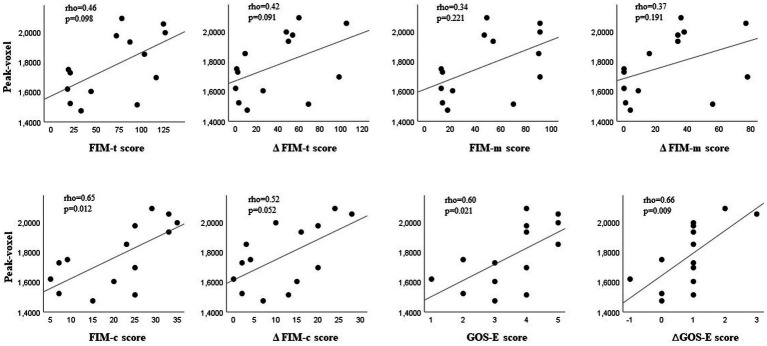
Results: In the whole sample, 18F-FDG uptake significantly increased in the following five regions that were hypometabolic before rehabilitation: inferior frontal gyrus bilaterally, alongside right precentral gyrus, inferior parietal lobule, and cerebellum. However, only for the right precentral gyrus the median voxel peak-value at baseline resulted a significant predictor of both cognitive (FIM cognitive subscale, p = 0.012), and functional (GOS-E, p = 0.02; post- vs. pre-treatment GOS-E difference, p = 0.009) improvements. ROC curve analysis showed that a peak voxel-value of 1.7998 was the optimal cut-off for favorable rehabilitation outcome. Unfavorable functional outcomes were predicted by increased 18F-FDG uptake in the inferior frontal gyrus (GOS-E, p = 0.032) and precentral gyrus (FIM cognitive subscale, p = 0.017; GOS-E, p = 0.015).
Conclusion: This proof-of-principle study enlightens the metabolic changes occurring in moderate-to-severe TBI course. Notably, such changes preferentially involve definite frontal brain areas regardless of TBI localization and entity. These findings pave the way for further studies with translational purposes.
期刊介绍:
The section Stroke aims to quickly and accurately publish important experimental, translational and clinical studies, and reviews that contribute to the knowledge of stroke, its causes, manifestations, diagnosis, and management.





 京公网安备 11010802042870号
京ICP备2023020795号-1
京公网安备 11010802042870号
京ICP备2023020795号-1

 分享
分享
 求助内容:
求助内容: 应助结果提醒方式:
 扫码关注我们
